


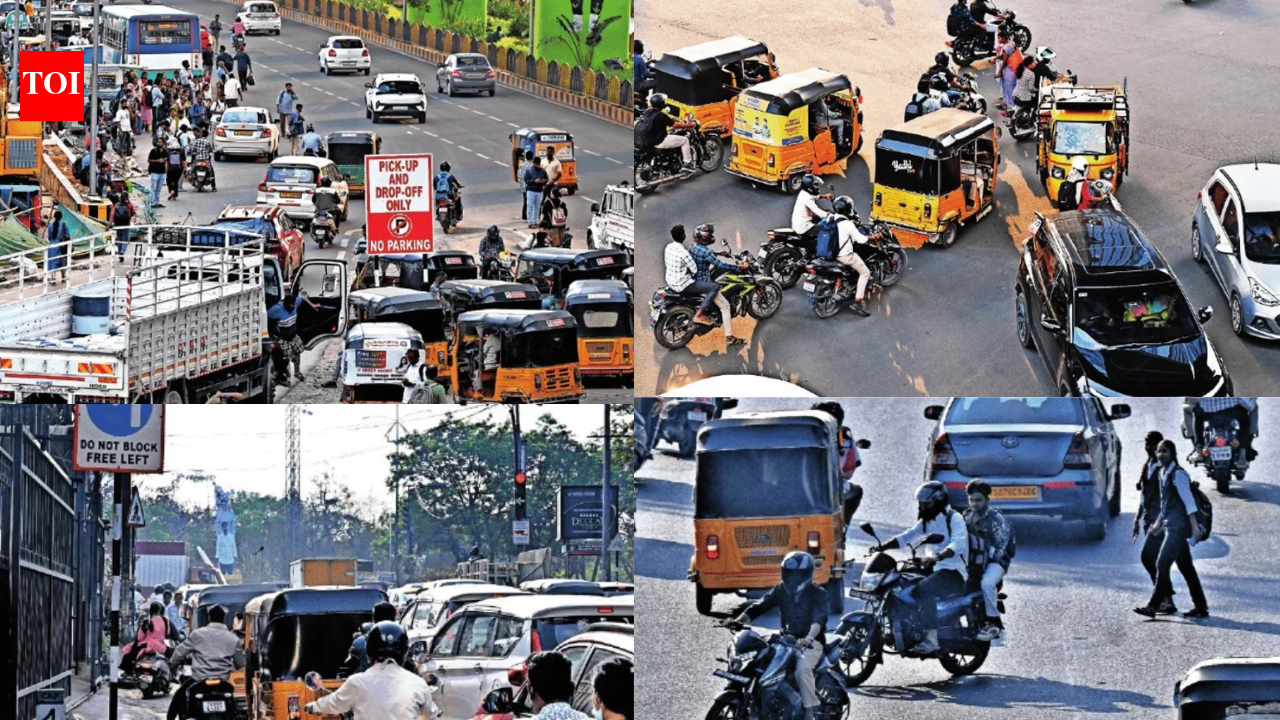
HYDERABAD: The city’s traffic mess is not just about rising vehicle numbers or limited road space. Much of it is self-inflicted. From signal jumping and wrong-side driving to blocking free left turns and reckless lane changes, everyday violations are turning key junctions into choke points.Across Hyderabad, Ranga Reddy and Medchal-Malkajgiri districts, nearly 90 lakh vehicles together racked up a staggering 1.3 crore traffic challans in 2025 alone. Despite sustained enforcement drives and awareness campaigns, indiscipline continues to fuel congestion, accidents and commuter frustration.
Signal rush, chaos followsSignal jumping remains the most persistent violation. More than three lakh motorists jumped signals this year, often blocking cross-traffic and forcing junctions into chaos that takes multiple signal cycles to clear.
Wrong-side driving
“Everyone is in a hurry, but when motorists try to outpace signals, the result is complete disorder. Triple riding is another common sight. Many don’t even wear helmets and argue despite riding rashly. The problem worsens during peak hours, especially in commercial hubs and residential pockets where narrow roads amplify the chaos,” said G Sanjay, a regular commuter at Punjagutta Circle.Traffic volunteers warn that such violations directly reduce junction efficiency. “When a driver crosses the stop line after the signal turns red, it disrupts the transition between phases. Vehicles from the other direction, which have just received green, are forced to slow down or stop. This reduces signal efficiency and prevents smooth flow,” said Lokendra Singh, a traffic volunteer.
Illegal parking
U-turns and lane driftImproper U-turns are another flashpoint. Motorists frequently attempt last-minute turns from the wrong lanes or cut across multiple lanes, disrupting traffic in both directions. Busy corridors like Jubilee Hills, SR Nagar, Miyapur and Chandanagar routinely witness such manoeuvres, leading to prolonged snarls.
Free left blocking
Lane indiscipline compounds the chaos. Vehicles switch lanes without indicators, occupy multiple lanes or squeeze into narrow gaps, triggering sudden braking and ripple slowdowns. Two-wheelers weaving unpredictably between cars make steady movement nearly impossible.The cumulative effect is visible daily: longer queues, missed signal cycles and tempers flaring at intersections. Discipline over drivesAuthorities insist enforcement alone cannot restore order.
Signal jumping
“Traffic discipline is a shared responsibility. Enforcement cannot solve the problem if motorists continue to disregard basic rules. Every time a motorist jumps a signal, drives on the wrong side or blocks a free left, it affects several commuters. Small acts of compliance can collectively improve road safety and traffic flow,” said Ranjan Rathan Kumar, DCP (traffic), Cyberabad police.Road safety experts argue that sustained change requires a mix of strict enforcement, public awareness campaigns, school-level education and technology-driven monitoring.
Junction encroachment
“As Hyderabad expands and vehicle numbers surge, restoring order will require a fundamental shift in driving behaviour. Without discipline at intersections and respect for lane rules and pedestrian crossings, even modern infrastructure will struggle to deliver relief. Until then, congestion will remain a daily ordeal,” said T Satyanarayana Reddy, a traffic planning expert.Infra gaps & glitchesMotorists, however, say infrastructure and technology gaps also add to the problem. Many argue that amber light timers need proper calibration and synchronisation to prevent confusion during signal transitions.
Using mobile while driving
“There is inadequate verification of number plates before challans are generated. They are imposed based on visible images without thorough verification. By the time the real owner realises the mistake, the challan is already issued,” said T Harsha from Team Road Squad.Civic coordination has also come under scrutiny. Motorists say the GHMC must work closely with traffic police to ensure clearly painted stop lines, visible road markings and properly installed signal poles at major junctions.For a city that is rapidly expanding, experts say the answer lies not just in flyovers and wider roads but in everyday discipline. Until motorists respect signals, lanes and basic right-of-way rules, Hyderabad’s traffic will remain less a crisis of capacity and more a crisis of conduct.Wrong-side driving remains one of the most dangerous violations on city roads. Traffic police issued over 10 lakh challans last year across three commissionerates for vehicles moving against the flow. Motorists often risk it to skip U-turns on stretches like Jubilee Hills, Hi-Tec City and Ameerpet. Officials warn that even one wrong-side vehicle can disrupt an entire lane, confuse junction movement and sharply increase head-on collision risks.Illegal roadside parking is a silent but steady contributor to congestion. Vehicles parked haphazardly along main roads shrink carriageway width, forcing abrupt merging and triggering bottlenecks near junctions. “Road widening and flyovers offer only temporary relief. Without discipline, congestion will persist. In many areas, roadside parking severely disrupts flow, especially near major intersections,” said Rahul Hegde, DCP (Traffic), Hyderabad, stressing sustained enforcement and behavioural change.Blocking free left turns defeats their very purpose. At junctions like Punjagutta, Khairatabad, Masab Tank and Miyapur X Roads, motorists routinely stop in designated free-left lanes while waiting for signals. This practice alone can raise waiting time by 20–30% during peak hours. “Free left lanes are meant to ease congestion. When vehicles queue there, it chokes continuous flow,” said a senior police officer in Cyberabad traffic wing.Traffic discipline in global citiesHelsinkiIn this Finland’s city, traffic discipline is deeply ingrained. Drivers, cyclists and pedestrians strictly follow signals. Vehicles stop instantly at red lights and yield consistently at zebra crossings. Honking is rare and used only in emergencies. Lane discipline is strong, and cars typically halt well before crossing lines.CopenhagenDenmark’s capital reflects a culture of shared road responsibility. Drivers, cyclists and pedestrians respect signals and lane boundaries. Yielding at zebra crossings is standard. The city is widely regarded as a model for seamless integration between cars, bicycles and pedestrians, supported by well-planned infrastructure and civic awareness.ZurichThis Swiss city is known for strict rule compliance and predictable driving. Motorists stop precisely at red lights and halt when pedestrians approach crosswalks. Mutual respect defines road use, with cars, cyclists and walkers coexisting smoothly. Orderly conduct and adherence to rules make traffic movement efficient and calm.AmsterdamNetherlands’ Amsterdam exemplifies disciplined coexistence on roads. Cars, cyclists, pedestrians and trams operate within defined spaces. Speed limits, typically 30–50 km/h, are widely respected. Honking and aggressive driving are uncommon, especially in narrow, traffic-calmed central streets.
