


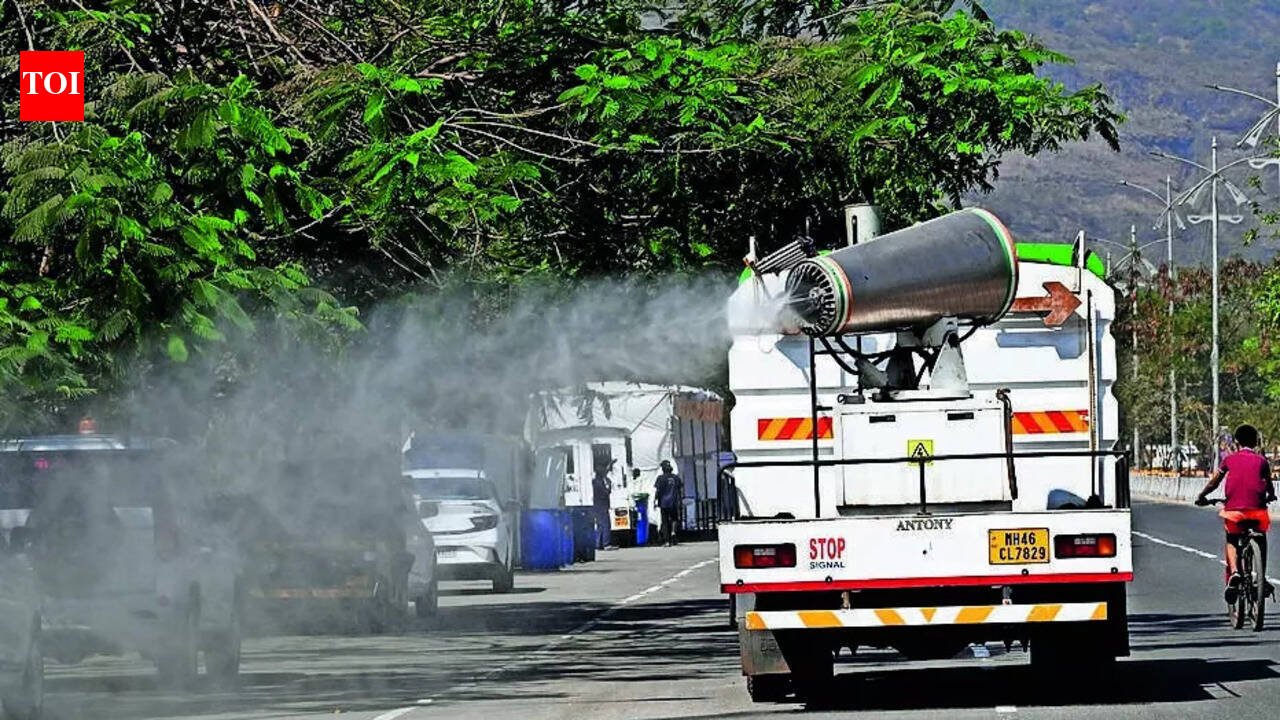
Noida: Despite studies identifying road dust as one of the biggest contributors to air pollution, Delhi and NCR administrations have made little headway in curbing it.The ‘Air Quality Monitoring Emission Inventory & Source Apportionment Studies’ for Delhi by NEERI, Nagpur, in Dec 2018 pegged road dust as making up 52.5% of PM10 emissions. Experts believe the weapons being deployed in the battle are unscientific.The peak pollution season in 2025 began with the failed experiment of rain seeding, followed by sprinkling water on roads, and anti-smog guns mounted on diesel-fuelled trucks. More than 200 anti-smog guns were operating on the streets of the capital, while another 148 were put in place in large commercial complexes, malls, hotels and office buildings (G+5 and above).Nearly a decade ago, however, in 2017, Central Pollution Control Board (CPCB) scientists flagged anti-smog guns as an ineffective combatant. Then head of CPCB’s air laboratory, Dipankar Saha, after observing trials at Anand Vihar, said, “The machine’s utility is limited to a small area as it is primarily a water scrubber suited to bring down industrial dust at construction and mining sites.” The smog gun’s working area was limited to 30-100m. With Delhi spanning 1,484 sq km, the board pointed out that the capital “would require 50,000 such installations to make a difference to the air quality”.On Dec 24 last year, Delhi CM Rekha Gupta said the idea of operating anti-smog guns over high-rise buildings was cumbersome, so they should be replaced with a mist spray system — yet another measure experts believe would have negligible effect. A statement was issued reading, “Govt is now mulling amendments to the existing rules and will soon permit the installation of mist spray systems in place of anti-smog guns.”Delhi govt’s public works department, which had been operating anti-smog guns, also decided to set up a water mist monitoring dashboard at the PWD headquarters’ control command centre.Using anti-smog guns and sprinkling water, however, were temporary measures with limited impact, said Dr Niraj Sharma, retired senior principal scientist of CSIR-CRRI (Central Road Research Institute). “Unless roads are free of potholes, shoulders are paved, and the open area is covered with plants, no measure can check resuspension of dust,” he said.Sharma highlighted that the Indian Roads Congress, the premier body of highways engineers in the country, had clear-cut guidelines on how to tackle dust pollution. It posited end-to-end road coverage to check dust generation and suitable vegetation at different levels to ensure that whatever minor quantity was produced would be absorbed by green cover. Sharma added that loose soil from road medians and unpaved sidewalks, aggravated by vehicular movement, hugely contributed to dust.CR Babu, a retired Delhi University professor known as ‘the green doctor’, also expressed disappointment at the dust control measures being adopted. He said having three distinct layers of vegetation with grass cover beneath could be the most effective solution.Babu said he had put forth the suggestion at various levels of govt. “It seems, however, that it is very difficult to change the mindset of policymakers, who are ready to spend crores on machines but not adopt time-tested measures,” he said, adding, “We cannot check road dust unless the source is tapped (tapping refers to capturing the source from where dust is produced).”In addition to efforts going towards — according to experts — ineffective courses of action, there has been poor implementation of the 2019 National Clean Air Programme. According to the Portal for Regulation of Air Pollution in Non-Attainment Cities, Delhi and Noida are at the bottom of the list in terms of utilising funds. Out of around Rs 81.4 crore available, Delhi used Rs 14.1 crore (17%) in the last six years. Of Rs 55.7 crore available to Noida, it used about Rs 9 crore (16%). The only exception in NCR is Ghaziabad, which has utilised close to 80%.On June 25 last year, before retiring, Sharma represented CSIR-CRRI at the signing of a tripartite agreement with Commission for Air Quality Management and School of Planning and Architecture, New Delhi. The collaboration aims at effective implementation of the standard framework for redevelopment of urban roads. This includes paving and greening of pathways and sidewalks to check dust pollution across Delhi-NCR.Pointing to the contents and objectives of the MoU, Sharma said domain experts would guide cross-section design for different types of roads and the width of the right of way, ensure mitigation of road dust through greening measures, and adopt new technologies in construction and maintenance.
