


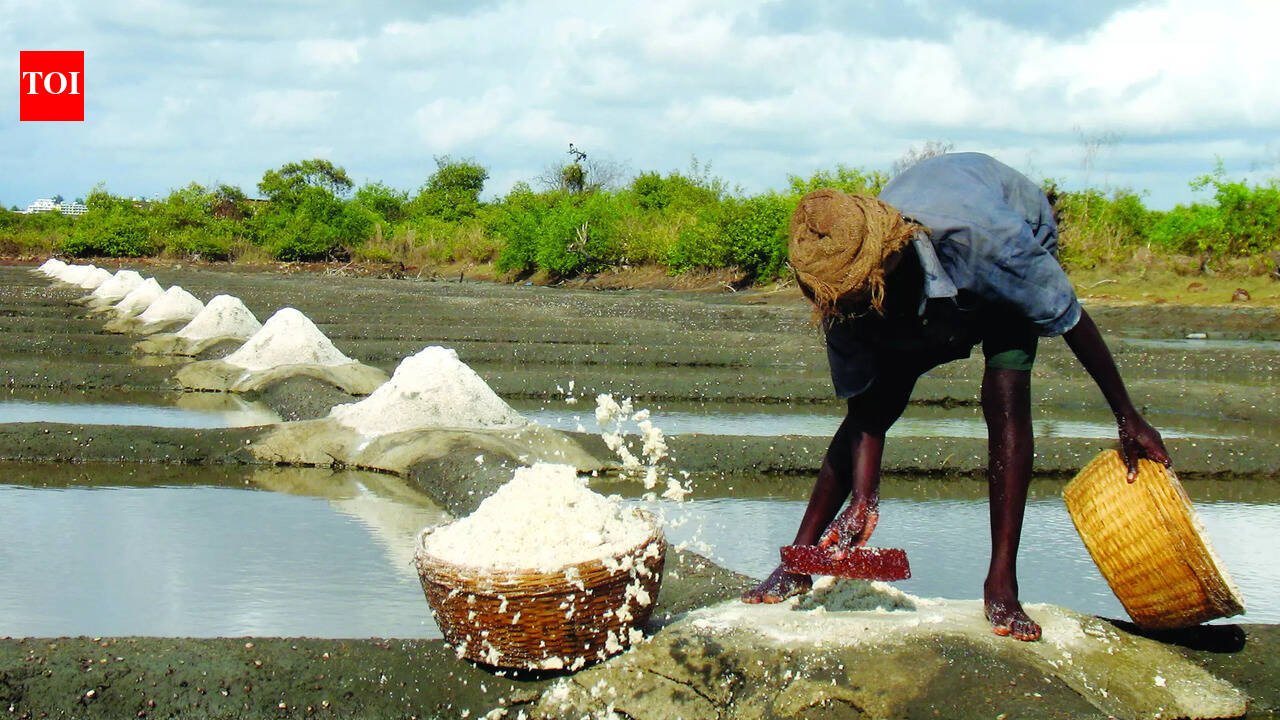
Panaji: Salt farming, which was once a thriving livelihood along Goa’s estuarine belts, witnessed a steady decline over the decades due to urbanisation, labour shortage, salinity changes, and a lack of institutional support. To revive Goa’s rapidly declining traditional salt pans and support local cultivators, state govt approved a financial assistance package totalling Rs 95 lakh under the Salt Pan Conservation, Support and Revival Scheme, effective from the 2025–26 fiscal year.In direct financial relief to traditional salt pan cultivators, a total of Rs 75 lakh was earmarked for 75 salt farmers, each eligible to receive Rs 1 lakh as financial assistance.To ensure effective implementation, govt sanctioned Rs 10 lakh towards salaries for a newly created salt pan support unit. The unit will comprise one scientific officer, two scientific assistants (for North and South Goa), one accountant, and one multi-tasking staff member. Another Rs 10 lakh was allocated for office and administrative expenses, including laptops, field logistics, monitoring, documentation, awareness material, and field visits.The scheme outlines a range of permissible activities, such as farmer hand-holding, field-level technical assistance, demonstrations, and expert advisory services; capacity-building programmes focused on traditional bund techniques, water management, and salt-based livelihoods; and exposure visits and peer-learning programmes within and outside the state.Special emphasis was placed on the restoration of degraded salt pans, including bund strengthening, canal cleaning, drainage maintenance, and water flow restoration. Govt also permitted expenditure on IT systems, GIS mapping, digital platforms, mobile applications, farmer databases, and monitoring dashboards. Activities related to research, quality assessment, certification, innovation, and climate-resilient salt farming practices are also included.Detailed project reports, baseline surveys, hydrological assessments, and feasibility studies can be undertaken to strengthen planning and the long-term sustainability of salt pan revival efforts.Govt laid down stringent financial and audit conditions. Scheme accounts must be maintained separately by the Goa State Biodiversity Board and will be audited by a govt auditor upon completion of the programme. The Comptroller and Auditor General of India may also conduct test checks at its discretion.Any misutilisation of funds, whether by implementing agencies or beneficiaries, will attract recovery of the full amount and may result in disqualification from future assistance. Unspent funds must be returned to the govt treasury by March 31, 2026.
