


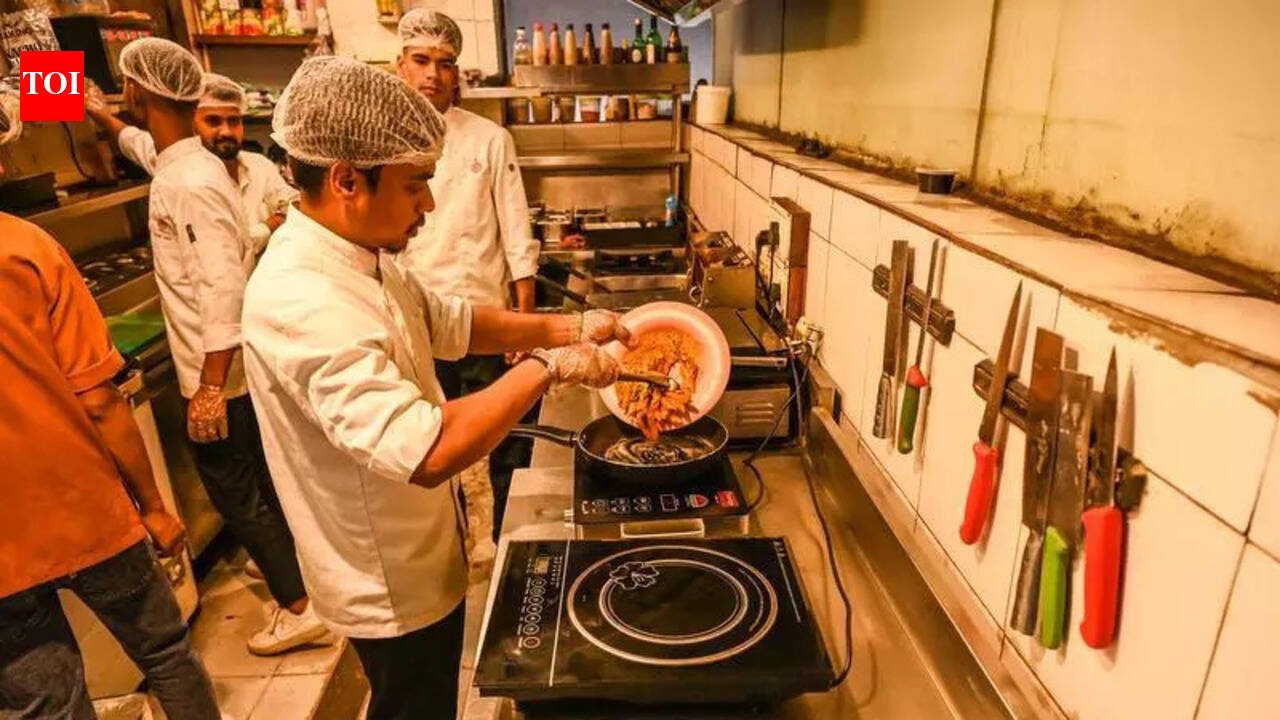
Noida: When supply of commercial LPG cylinders stopped this week,several restaurant owners in the city found themselves making quick decisions to keep their kitchens running. For some, that meant investing in a new set of electrical appliances. For others, it meant rewriting menus overnight.At Baby Dragon, a bar and restaurant in Sector 18, owner Vicky Saluja spent nearly Rs 1 lakh in two days to convert much of his kitchen from gas to electricity. Six induction cooktops, an electric deep fryer and new utensils arrived early this week after news spread that LPG supplies to restaurants had been disrupted. “We had to adapt quickly,” Saluja said. “The entire setup costs around Rs 1 lakh, but we can’t afford to shut the kitchen.“Under normal circumstances, the restaurant consumes around 60 commercial LPG cylinders of 19 kg every month. Switching to electric appliances may prove slightly more economical in the long run, Saluja said, though he prefers to return to LPG once supply stabilises.For smaller establishments, the shift has required improvisation. Sunaina, who runs Rasamama Coastal Dining in Sector 104, said her kitchen ran out of LPG two days ago. With no piped natural gas connection available, she turned to induction cooking and purchased six induction cooktops and an electric dosa plate to keep the cafe operating.“Our cylinders have run out. Thankfully, we bought the equipment quickly. Vendors are now saying prices are rising because demand has gone up,” she said. The change, however, has forced her to alter the menu. Traditional dosas require large iron griddles heated on gas flames, which the new electric plates cannot fully replicate. “So, the cafe is now serving smaller benne dosas that can be cooked on compact electric surfaces,” Sunaina said. “The regular tawa doesn’t work on the electrical plate, so we had to make the dosas smaller.”Menu changes have also become necessary at Chakra Cafe in Sector 18. Owner Heena Khera said induction cooking works better for baked dishes than for foods that require intense heat. As a result, the cafe has shifted its focus toward pizzas, pasta and other oven-based items.“Our menu is now leaning more Italian,” Khera said. “Chinese dishes need very high heat that you only get on a gas flame, so we have reduced those items.”Khera recently bought an additional induction cooktop to keep the kitchen functioning, but the transition has not been seamless.Most restaurant kitchens are designed around gas burners rather than electrical outlets. At Chakra Cafe, extension cords now run across kitchen counters to power the new appliances. “Our kitchens weren’t built for this,” she said. “We don’t have plug points where we need them, so we’re managing with extension boards. It’s not ideal, but we have to keep working.”Khera said customer footfall has also dropped slightly after news of the disruption spread. “People assume restaurants are not operating because LPG supplies are affected,” she said. “We’ve seen fewer customers since the beginning of the week.” Beyond restaurants, the disruption is rippling through the city’s vast street food economy. Roadside vendors, many of whom operate with a single gas cylinder, have had to improvise to stretch their fuel supply. In Film City, tea seller Santosh recently doubled the price of a small cup of tea from Rs 10 to Rs 20 after his commercial cylinder ran out. “I brought a cylinder from home so I can keep selling tea and samosas,” he said. “If the shortage continues, I will keep bringing the home cylinder. We cannot afford to close the stall.“Elsewhere, Some vendors are simplifying their menus to conserve fuel. In Sector 4, one street vendor who previously sold aloo and paneer parathas has switched to sandwiches instead. Parathas require more time and flame to cook, he said, while sandwiches only need to be lightly toasted.“If I use the cylinder carefully, it can last about six more days,” he said.Unlike restaurants, however, most roadside stalls cannot switch to induction cooktops. Their setups typically consist of a single stove connected to a cylinder, often without access to a reliable electricity connection. For them, adaptation means stretching every bit and hoping supplies return before the flame goes out.
