


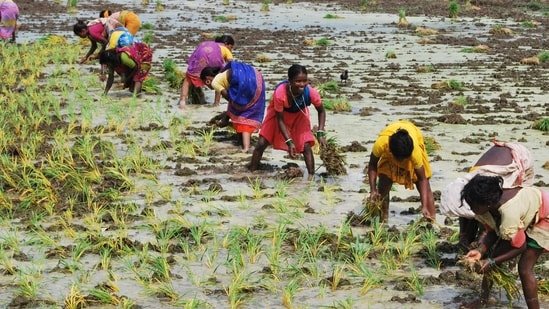
In the peri urban stretches of Visakhapatnam, as the first light falls over paddy fields and vegetable plots, it is women who are already at work. They transplant seedlings, manage livestock, negotiate with input dealers, and calculate credit in their heads. They are cultivators, risk managers, nutrition planners and increasingly technology adopters. Yet, historically and socially, they have been described as helpers.

This invisibility is not just semantic. It shapes policy access, credit flow, technology adoption and social recognition. If Indian agriculture is to become resilient, climate smart and market linked, the centrality of women farmers must move from the margins of implementation to the core of strategy.
Agriculture in India has always been a family enterprise. But land titles, extension systems and market institutions evolved around male ownership. Women’s labour was normalised. Their agency was not. Sociologically, this created a paradox. Women carried production responsibilities without proportional access to training, capital or decision-making power.
Policy has begun to correct this imbalance. The guidelines of the Department of Agriculture and Farmers Welfare explicitly mandate expenditure on women across beneficiary-oriented schemes. This shift from welfare to entitlement is significant.
Schemes such as Support to State Extension Programme for Extension Reforms ATMA, National Food Security and Nutrition Mission NFSNM, Mission for Integrated Development of Horticulture MIDH, National Mission on Edible Oils Oil Palm NMEO OP, National Mission for Edible Oils Oilseeds NMEO OS, Mission Organic Value Chain Development for North East Region MOVCDNER, Digital Agriculture, Agriculture Marketing, and National Bamboo Mission NBM include women as eligible and intended beneficiaries. The architecture exists. The question is whether we are amplifying its impact.
At the ICAR-Central Institute for Women in Agriculture in Bhubaneswar, gender in agriculture is not an afterthought. It is a research mandate. Its initiatives such as Nutri Smart Villages aligned with Poshan Abhiyan, and the Scheduled Caste Sub Plan flagship programme disseminating women friendly technologies, represent a scientific recognition of women as productivity multipliers.
Beyond research institutions, India has built a vast extension network. There are 731 Krishi Vigyan Kendras under ICAR, delivering training on modern agricultural practices to farmers, including women. The ATMA scheme operates in 740 districts across 28 states and five Union Territories, releasing grants in aid to make the latest agricultural technologies accessible.
Capacity-building programmes cover women friendly tools, drudgery reduction, income generation and nutritional security. Under the Sub Mission on Agricultural Extension, initiatives such as the Diploma in Agricultural Extension Services for Input Dealers and Skill Training of Rural Youth include women as participants. Four Farm Machinery Training and Testing Institutes at Budni, Hisar, Anantapur and Biswanath Chariali impart training in agricultural machinery management and operation of Custom Hiring Centres, opening entrepreneurial pathways.
The scaffolding of knowledge is robust. The task now is to deepen women’s leadership within it.
If one policy intervention has reshaped the sociology of rural women’s participation, it is collective institution-building.
Under the Mahila Kisan Sashaktikaran Pariyojana, a sub scheme of DAY NRLM, 4.45 crore mahila kisans have been supported through the Farm Livelihoods component, promoting agro ecological practices. A network of 3.41 lakh Community Resource Persons including Krishi Sakhi for sustainable agriculture, Pashu Sakhi for livestock management, Van Sakhi for NTFP collection and cultivation, and Matshya Sakhi for fisheries interventions now delivers field level technical support.
This is not incremental change. It is structural. When a Krishi Sakhi advises on sustainable agriculture, she is not just transferring knowledge. She is redefining authority in the village knowledge system.
Efforts to form producer groups and producer companies have improved post farm gate aggregation and market linkages. Under the Central Sector Scheme for Formation and Promotion of 10,000 Farmer Producer Organisations FPOs, every FPO board includes at least one woman member. As of November 30, 2025, 1,170 women led FPOs with 100% women shareholders and 2,272 women led FPOs with more than 50 percent women shareholders have been formed. Of 55.22 lakh total FPO shareholders, 21.45 lakh, or 39%, are women.
These numbers indicate scale. The next frontier is ensuring that women directors influence pricing strategies, credit negotiations and digital adoption decisions.
The Namo Drone Didi Scheme with an outlay of ₹1,261 crore from 2023 24 to 2025 26 aims to provide 15,000 drones to Women Self-Help Groups. By positioning women SHGs as drone service providers, the scheme links advanced technology to livelihood enhancement.
This is a profound psychological shift. For generations, rural girls have been distanced from STEM pathways. When a woman operates a drone over a field, she disrupts inherited assumptions about who can handle technology.
Under the Sub Mission on Agricultural Mechanisation, financial assistance up to 50% of drone cost capped at ₹5 lakh is provided to small and marginal, Scheduled Caste, Scheduled Tribe and North Eastern State farmers including women. Entrepreneurship through Custom Hiring Centres is similarly supported.
The Rashtriya Krishi Vikas Yojana Innovation and Agri Entrepreneurship Development programme nurtures agri startups including those led by women. Meanwhile, the Agriculture Infrastructure Fund launched in 2020 under aatmanirbhar Bharat provides medium to long term loans at up to 9% interest, with 3% interest subvention for up to seven years and credit guarantee support for loans up to ₹2 crore. As of February 28, 2025, 8,190 projects worth ₹2,377 crore have been sanctioned to women farmers.
These are not symbolic allocations. They are financial signals that women are investible economic actors.
The Pradhan Mantri Kisan Samman Nidhi provides ₹6,000 annually in three instalments directly into bank accounts of eligible landholding farmer families including women. Schemes such as Per Drop More Crop and Rainfed Area Development mandate that at least 50 percent of allocations go to small and marginal farmers, with at least 30% earmarked for women beneficiaries.
Water efficiency, integrated farming systems and climate risk mitigation are not gender-neutral concerns. Women often manage diversified cropping, livestock and household nutrition. When policy aligns water efficiency and integrated farming with women’s participation, it strengthens resilience at the household level.
Despite the breadth of schemes, three gaps remain.
First, recognition. Women must be formally acknowledged as farmers in land records and extension databases. Without identity, access remains conditional.
Second, STEM integration. Girls in rural schools must see agriculture not as distress labour but as a science driven enterprise combining drones, data, soil health analytics and market intelligence. Agriculture education and STEM exposure must converge, particularly for girls.
Third, amplification. The narrative of Indian agriculture must move beyond yield statistics to human capability. Women are not beneficiaries. They are co architects of food security.
From the fields of Vizag to national policy corridors, the transformation is visible but incomplete. We have built schemes, budgets and institutions. The next step is cultural. Recognising that when we invest in women farmers, we are not adding a gender component. We are strengthening the economic, nutritional and technological foundations of rural India.
India’s agricultural future will be written not only in laboratories or boardrooms, but in the confident steps of women who till, innovate and lead.
This article is authored by Suman S, director, Rural Livelihoods, Dr Reddy’s Foundation.
