


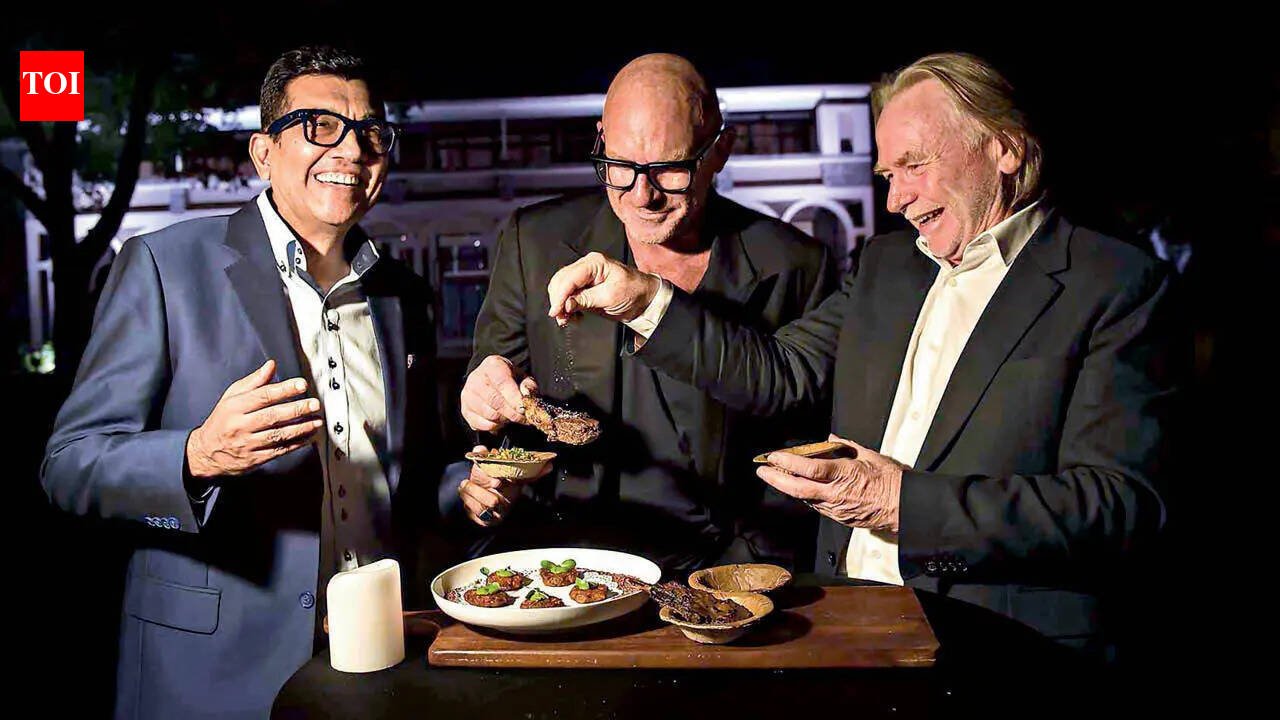
Food diplomacy took centre stage at the Australian High Commission when two celebrity chefs – Australia’s Matt Moran and India’s Sanjeev Kapoor – were in conversation with Australia’s High Commissioner Philip Green for the Plates with Purpose event. The dialogue bridged worlds, spanning food waste, the MasterChef Australia phenomenon, and one of Green’s mini discoveries – Dehraduni rice.‘WHATEVER I AM TODAY, I OWE IT TO THE FARMER: MATT MORAN’Welcoming guests, Green said, “For us, this event is a celebration of farmers who produce, the chefs who transform it, and the businesses who make it happen in hotels and restaurants and indeed bring produce to our doors… Food connects people – Indians and Australians love to eat together, and we Australians feel that food is one of the things that has brought India and Australia close,”The High Commissioner opened by asking both chefs how the land shapes their connection to food. “Coming from a farming background and being the fourth generation, I owe it to the farmer for where I am in my life. If it wasn’t for the farmer or the produce, I wouldn’t have this amazing produce to put on my plate. I could see the hardships and how hard my parents and grandparents worked, which made me realise that farming should be appreciated a lot more. That’s why I did my TV show, Paddock to Plate , because I wanted to put the farmer and the produce on a pedestal and show people how hard they work,” replied Matt, who was a Judge on MasterChef Australia (Season 3 ).
Kim McDonnell, CEO and Founder, Saveful
“My connection with food was developed quite early in life. I was taken to a big fruit and vegetable market every Sunday, which we call sabzi mandi , and I would go there with my father. That’s where I started seeing fresh vegetables coming directly from the farm, and that’s where my interaction with food started… (I noticed) that while we saw people negotiating with the vendors, my father would not. He would tell me these people put so much effort into growing this. There are many things whose prices we can bring down, but someone who grows food should get more than what they get… I never thought I’d become a chef, but that interaction stayed with me. When you become a chef, it is important to notice how someone is making you look good because all the credit is what we get, but the real credit goes to the farmer,” shared Sanjeev Kapoor.
Anant Prakash Pandey, Joint Secretary, Ministry of Tribal Affairs
‘MasterChef taught Indians how food can be romanticised’The High Commissioner noted that Australia’s primary exports to the Indian psyche are clear: first cricket, then MasterChef Australia . “Did you ever imagine that it would become an icon of the bilateral relationship?” asked Philip Green. “It really put Australia on the world map. I think it had a massive impact on people – people started cooking a lot more… People’s knowledge about food increased, it is now tenfold from my parents’ generation to my generation and then to my kids’ generation,” replied Matt. “The show was the first real conversation about food we saw. It taught viewers how food could be described. Even today, when you ask an average Indian how your meal is, they say nice and good, but MasterChef worked on the vocalisation of food. It taught them how food can be explained, how it can be romanticised – it was entertainment of a different kind. People like to see food being cooked, and the way the show is a very encouraging way to talk about food,” added Sanjeev.On sustainability in the food industryThe event also celebrated the launch of the Australian digital social-impact initiative, Saveful, in India. “Until a few years ago, sustainability was something cool to talk about. But now people are taking it seriously, and I feel the shift is happening because of the younger generation. The work is not only happening at the hotel level but also with farmers. But we still need more education and have a long way to go,” Chef Sanjeev observed.
