
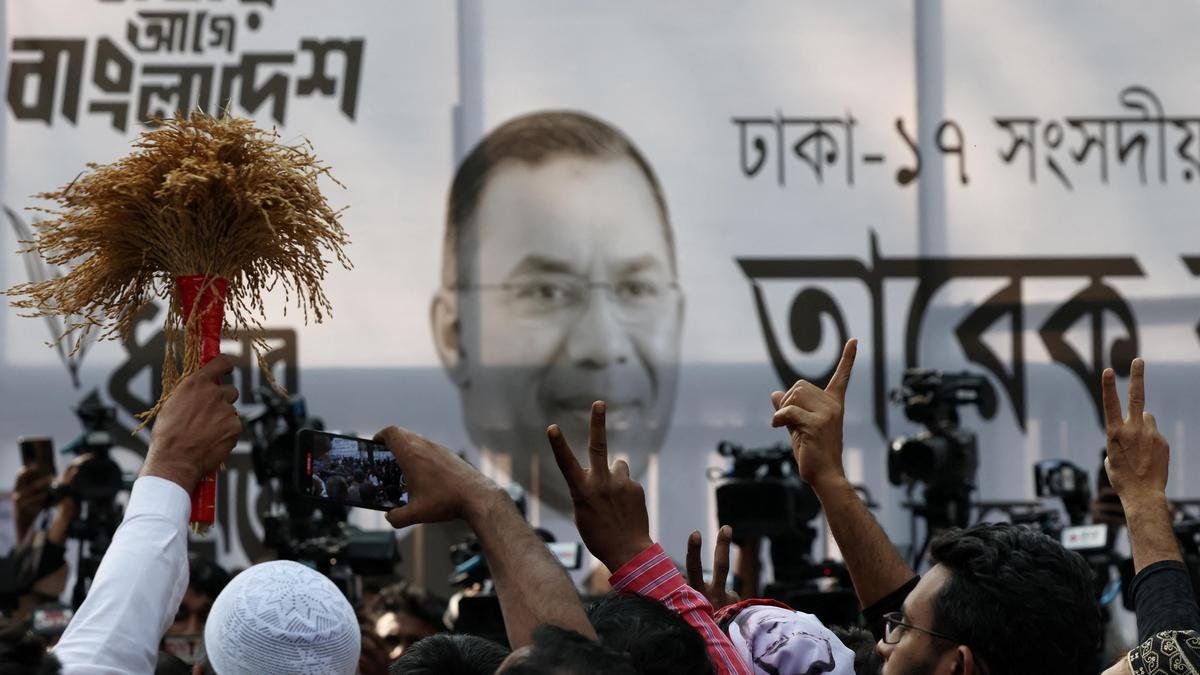
Bangladesh voters, who cast their ballots on February 12 in the first national election since the fall of Sheikh Hasina’s government in August 2024, have delivered a decisive mandate to the Bangladesh Nationalist Party (BNP) and also endorsed the July National Charter in a referendum to amend the Constitution. A BNP-led alliance has won 216 seats in the 300-member Parliament, while an 11-party coalition led by the Islamist Jamaat-e-Islami has secured 76 seats, with final results still pending. Tarique Rahman, the 60-year-old BNP chairman, is expected to become the next Prime Minister. The outcome could significantly reshape Bangladesh’s political trajectory in the years ahead. Here are five takeaways from the vote.
Bangladesh election results: Follow the updates from February 13, 2026
Change and continuity
After Ms. Hasina’s fall in August 2024, Bangladesh entered a phase of uncertainty. The Awami League, Ms. Hasina’s party, and its student wing were banned. Most of the party leaders either fled the country or went underground. There were repeated incidents of violence targeting minorities and Awami League supporters, while clashes between BNP and Jamaat supporters became increasingly frequent. The key challenge before the interim administration was to steer the country through this turbulence towards an orderly political transition.
With nearly 60% turnout in the February 12 election, the electorate has sent a clear message: it wants a stable democratic government. The strong approval of the July National Charter reflects a genuine appetite for structural reform, including judicial independence, a two-term limit for Prime Ministers, a bicameral legislature, stronger representation for women and youth. Yet, when it came to choosing who should carry out this agenda, voters turned to the BNP — an establishment party with deep roots in the old order. While Bangladeshis seek change, they prefer it to be delivered by familiar political hands, rather than old Islamist guards or untested revolutionary forces.
Also Read | Elections in Bangladesh: looking towards the future | Explained
Rise of Jamaat-e-Islami
During the 1971 Liberation movement, Bangladesh Jamaat-e-Islami viewed secular Bengali nationalism as a threat to Islamic unity and sided with the Pakistani military. The party organised three armed auxiliaries –Al-Badr, Al-Shams, and the Razakars — to support the Pakistani military’s crackdown. After independence, the party was banned in 1972, but the ban was lifted in 1976 after the assassination of Sheikh Mujibur Rahman and most of his immediate family. For years, Jamaat remained on the margins of national politics. After the 2001 election, it joined the BNP-led government, moving into the political mainstream. When Ms. Hasina returned to power in 2008, the International Crimes Tribunal tried several Jamaat leaders for complicity in the 1971 genocide, and five of them were hanged between 2013 and 2016. In 2013, the Supreme Court of Bangladesh cancelled the party’s registration.
But after Ms. Hasina’s fall, Jamaat emerged as a major force seeking to consolidate Islamist and conservative constituencies. With the Awami League barred, Jamaat became the principal electoral challenger to the BNP. The party sought to capitalise on the student-led movement by stitching together a broad coalition, including the National Citizen Party (NCP). While Jamaat did not secure a majority in the election, it emerged as the second-largest party with 62 seats, its strongest showing to date. This means that Jamaat and its ideas will continue to shape the political churn in ‘Naya Bangladesh’.
The NCP’s poor show
The National Citizen Party (NCP), founded by student leaders who spearheaded the anti-Hasina agitation in 2024, entered the election claiming the legacy of the “revolution”. Yet, voters delivered a humbling verdict. The NCP won just four of the 30 seats it contested, according to local media. While student leaders successfully channelled public anger against Ms. Hasina’s government during the protests, they failed to convince voters that they could manage a complex political transition.
The NCP appears to have recognised well before the election that it stood little chance on its own. But the partner it chose was Jamaat-e-Islami, creating internal tensions and sowing suspicion in the minds of centrist and progressive voters. Several leaders broke ranks over the alliance and quit the party. NCP convener Nahid Islam defended the tie-up saying it was driven by “brutal arithmetic”, not by ideology. But the arithmetic did not work in the NCP’s favour, as the results show. The party may still play a long game, but this election marks a humbling start.
The challenge before Rahman
The BNP returns to power with a huge electoral mandate. But its previous record in office casts a long shadow over its future administration. The BNP’s last stint in power, from 2001 to 2006, was marked by political violence, the rise of armed cadres, and the creation of the Rapid Action Battalion — a security force that later became synonymous with allegations of extrajudicial killings and disappearances.
Mr. Rahman has promised a new beginning. His ascent signals a generational shift both within the party and in Bangladesh’s politics, giving him an opportunity to pursue reform. But he faces a demanding agenda: healing the deep internal wounds after years of upheaval, managing the expectations of a restless electorate, and stabilising Bangladesh’s relationships with its neighbours. There is no Awami League to challenge his party today, but he has to deal with a resurgent Islamist opposition led by Jamaat.
India’s reset
The election offers India an opportunity to repair ties with Bangladesh, which took a hit in the post-Hasina months. The structural logic for close bilateral ties remains unchanged: geography, trade, water sharing, connectivity, and regional security all require sustained cooperation. Yet, New Delhi now faces three simultaneous headwinds.
First, domestic politics in India has increasingly turned immigration from Bangladesh into a flashpoint, generating rhetoric that has hurt public sentiment in Dhaka, regardless of who holds power there. Second, anti-India sentiment in Bangladesh has deepened since the uprising, with many viewing New Delhi as having propped up Ms. Hasina’s rule. Ms. Hasina’s continued stay in India and periodic political statements risk damaging the mood further. Third, Pakistan — historically marginalised in Dhaka’s strategic calculus — has moved quickly to rebuild and expand ties with the new Bangladesh. The return of the BNP, a familiar actor, opens a window for a reset. Prime Minister Narendra Modi was quick to congratulate Mr. Rahman and his party. The next step will be to navigate these three pressures, while building a workable partnership with the new government.
Published – February 13, 2026 05:31 pm IST
