



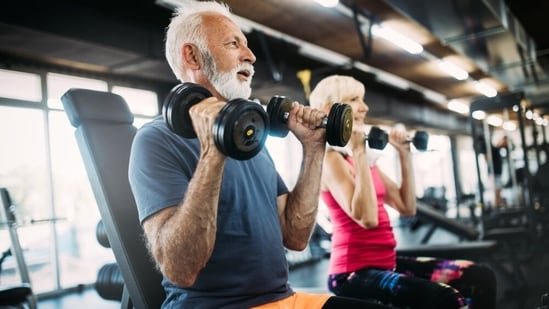
There’s no right age for strength training. Even in your 50s and 60, strength training can help older adults by building muscle, improving agility, and supporting joint health. These benefits can help them feel more independent and in control of their lives. However, it’s important to remember that older adults may need to train differently from younger people, and that is perfectly fine. As we age, our bodies change, and fitness goals should change too.
Strength training tips for seniors
Fitness coach Raj Ganpath tells Health Shots about the four simple hacks to modify strength training for older adults.
1. Keep it simple
Strength training has many intense routines, but as a senior, it is best to focus on the basics. “Stick to the basics. You don’t need to do anything extreme to get stronger. Simple movements like squats, planks, lunges, push-ups, rows, curls, and carries are enough. These exercises will help you stimulate and strengthen your muscles. Your goal is to get stronger, not to impress anyone,” added Ganpath.
2. Slow speed and low load
Strength training for seniors focuses on maintaining control and staying fit. It is not about pushing limits like younger people do. Instead, seniors should use lower, manageable weights for their workouts. “You should try to keep both of these things low. Why? When you use low to moderate weights and move at a controllable pace, you can effectively target and strengthen the right muscles without risking injury. This is very important because as you get older, injuries can be costly and burdensome,” says Ganpath.
3. Flexibility and mobility
Warming up is important before starting strength training. It prepares your muscles and gets your joints moving. This helps lower the risk of injury. “As you get older, the synovial fluid in your joints changes and decreases. This makes it harder to move and can feel unsafe. To help with this, spend 10 to 15 minutes moving your joints before you start strength training. After you finish, take another 10 to 15 minutes to stretch your muscles,” says the expert.
4. Results in everyday life
The goal of any workout is to see results. However, true progress shows in how you feel in your daily life. This can include increased energy and improved agility. The main goal is not just to get strong, but to make your life easier through good health. You can measure real progress by how you handle everyday tasks, like climbing stairs.
“Look for results in your daily life, not just at the gym. Strength training should improve your quality of life and help you feel better. Ask yourself whether you are feeling stronger. Are you feeling better and more energetic? Based on your answers, you can adjust your training. The goal is to look, feel, and function better, both in the gym and in everyday life,” elaborated Ganpath.
What are the best strength training tools for older adults?
HT Shop Now got fitness coach Raj Ganpath to curate a list of the top must-have items for your strength training ease for older adults:
1. Resistance bands
This is the safest and most joint-friendly option. The ascending resistance protects weak joints, making it ideal for sitting and for upper-body and leg exercises. Bands provide smooth, continuous resistance, which reduces the risk of joint strain or injury compared to heavy dumbbells.
How to use: You can use them to exercise major muscle groups like your arms, legs, core, and back, whether you are standing or sitting in a sturdy chair.
How to choose: As you get stronger, you can easily make the exercises harder by using a heavier band, shortening the band, or wrapping it tighter.
2. Adjustable dumbbells
To keep the muscle mass in your hands, arms, and shoulders, it’s important to choose equipment that lets you increase weights in small increments, such as 1-2 kg.
How to use: Older adults should start with light weights. Increasing weight by small amounts, like from 1 kg to 1.5 kg, helps avoid strain and allows for safe progress.
How to choose: Choose weights with dial-turning or quick-release systems that do not require you to manually unscrew collars or balance heavy plates.
3. Adjustable gym bench
Do seated presses, rows, and step-ups safely. Using a stable, flat, incline, or decline bench helps you avoid balance problems that can happen with standing or floor exercises.
How to use: Make sure there is no space between the seat and the backrest when the seat is flat. This prevents the lower back from sinking, which is important for comfort and spine alignment. A seat height of 40–45 cm (16–18 inches) makes it easier and safer to get on and off. It helps keep your feet flat on the floor during lifts, avoiding a sinking feeling.
How to choose: Choose a pad that offers a stable surface for pressing and sitting. Look for a strong alloy or steel frame with non-slip caps on the base. Stability is key to preventing the bench from wobbling when you put pressure on the edges. Clear and simple angle changes are best for safety and ease, allowing different incline positions for shoulder and chest presses.
4. Ankle and wrist weights
These weights help boost bone density in your arms and legs. You can wear them comfortably while walking or doing seated leg lifts.
How to use: Start with 0.5 kg (1 lb) to 1 kg (2.2 lbs) per limb. Using too much weight can hurt your joints, ligaments, and tendons.
How to choose: Choose adjustable sets that let you add or remove weight pouches, so you can increase the weight as you get stronger.
5. Hand grip strengtheners
Maintaining grip strength is important for safely carrying groceries, opening jars, and holding onto canes or walkers as you get older.
Why it works: You can adjust standard spring grippers to provide resistance ranging from 5 kg to 60 kg. This feature is great for progressive training. It provides resistance without the harshness of metal springs. These soft, squeeze-friendly exercisers are perfect for gentle physiotherapy and increasing blood flow.
(Disclaimer: At Hindustan Times, we help you stay up-to-date with the latest trends and products. Hindustan Times has an affiliate partnership, so we may get a part of the revenue when you make a purchase. We shall not be liable for any claim under applicable laws, including, but not limited to, the Consumer Protection Act, 2019, arising from the products. The products listed in this article are in no particular order of priority, and the brands have not been directly suggested by the expert mentioned.
This article is for informational purposes only and is not a substitute for professional medical advice. Always seek the advice of your doctor with any questions about a medical condition.)


