


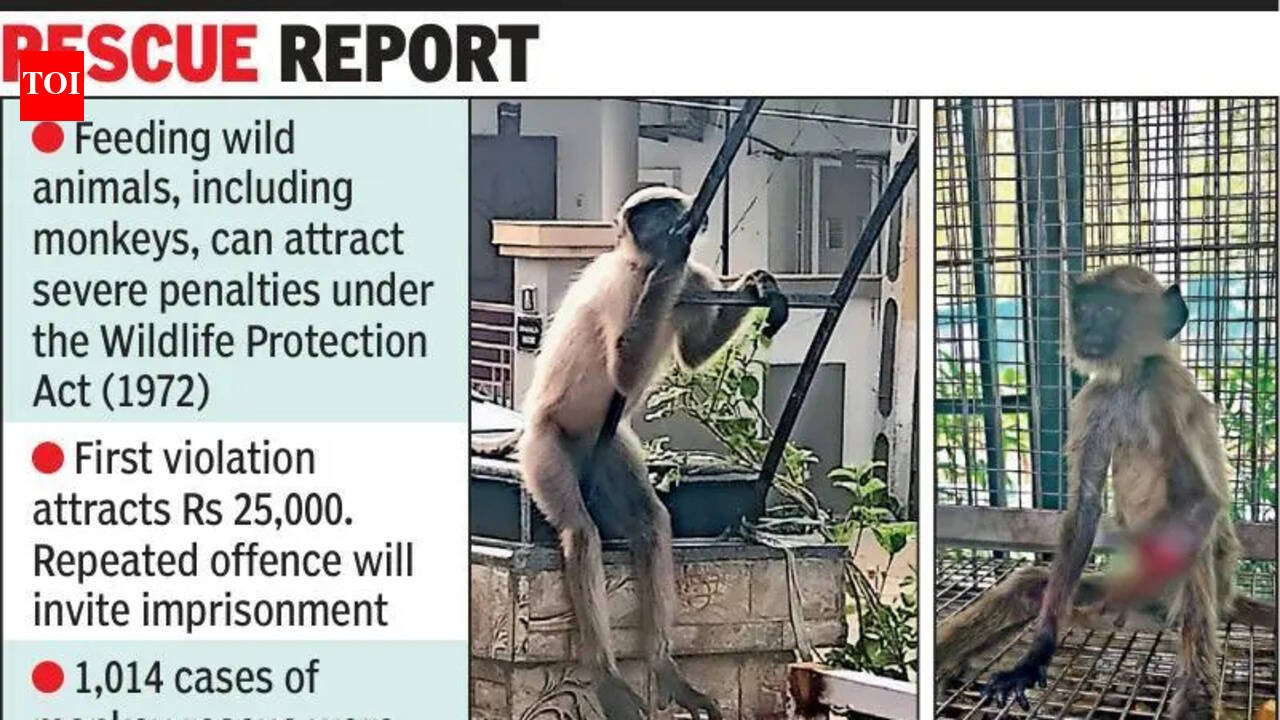
Ahmedabad: Tossing fruits, biscuits and leftovers to monkeys and langurs near temples, housing societies and open grounds was once seen as routine or even charitable. However, with rising incidents of human-animal conflict, it may no longer be seen as a harmless act. The Gujarat forest department has begun cracking down on the practice, warning that it will now be treated as a violation under the Wildlife Protection Act.The department has now stepped up awareness drives along with enforcement. A first offence of feeding monkeys or langurs can attract a fine of Rs 25,000, while repeated violations may lead to imprisonment. Rescue teams have also been asked to closely monitor behaviour in areas where aggression is increasing.Officials say the situation has moved beyond a nuisance and become a public safety concern. In Ahmedabad, many emergency calls now involve monkey bites, attacks or monkeys entering homes in search of food.Casual feeding has altered animal behaviour, leading to a growing wildlife challenge in urban spaces, say experts. Instead of passing through the city occasionally, monkeys have begun setting in empty plots, tree-lined colonies and neglected grounds, increasing daily contact with humans and raising the risk of conflict.The scale of the problem is evident in official data. During the Dec 2024 census, Ahmedabad’s monkey population was recorded at 4,602, nearly double compared to five years earlier. have gradually turned into regular habitats for primates.The forest department has identified 198 locations across the city where monkey and langur presence is a recurring issue. Areas such as Vastrapur, Navrangpura, Thaltej, Bopal, Ghuma, Ambawadi, Paldi, Shahibaug, Chandkheda, Kubernagar, Naroda, Narol, Sabarmati, Bilasiya, Maninagar, and Asarwa are among the worst-affected.In some pockets, the situation has turned alarming. Chanakyapuri alone reported 20 incidents of monkey bites. Across the city, around 40 bite cases are being reported every month. In Gomtipur, authorities recently launched an operation to capture a monkey after it bit 12 people within five days.Officials say feeding is a key trigger behind this behaviour. Under the Wildlife Protection Act, 1972, amended in 2022, monkeys and hanuman langurs are protected under Schedule II. Feeding them is legally treated as baiting, which is considered a serious offence. “Feeding encourages dependence and aggression, which leads to more conflict situations,” said Minal Jani, deputy conservator of forest, Ahmedabad.The change is also visible in rescue operations. The Human-Langur Interaction Survey revealed the scale of the challenge. Data from the Wildlife Rescue Centre in Ahmedabad shows 1,014 langur-related rescue cases between Jan 2025 and Dec 2025. In just the first two-and-a-half months of 2026, from Jan 1 to March 15, another 70 rescues were recorded from 33 locations.Residents say the impact is being felt daily. Social worker Harshad Patel from Amraiwadi said that his society alone reported more than five incidents of bites or property damage in six months.
