


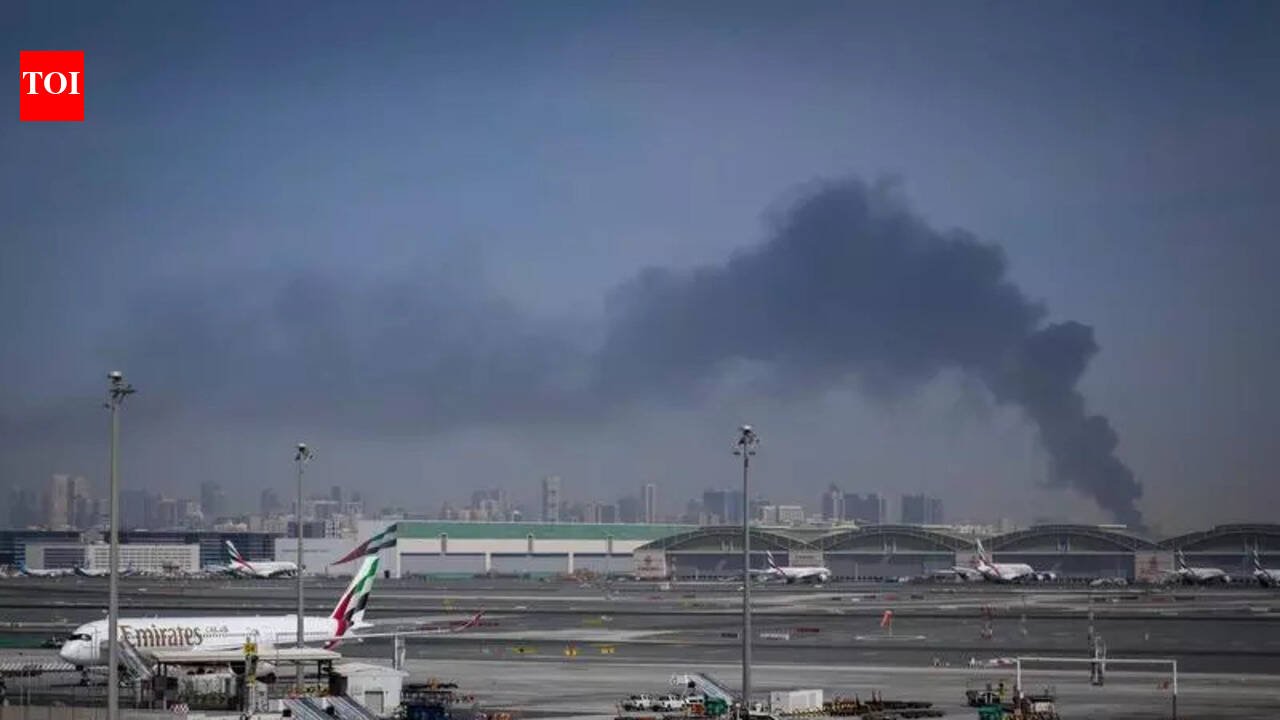
It is for the first time in the five-decade-odd history of Gulf migration from Kerala that all six GCC nations have simultaneously come under direct attack. It has triggered widespread panic and deep anxiety among the Keralite diaspora, whose livelihoods and the state’s economic security itself are closely tied to the region.War clouds have been looming on West Asia’s horizon but Keralites living in the Gulf did not anticipate any retaliatory strikes until drones started hitting various targets in the UAE, Bahrain and Qatar on Saturday.Abdul Samad, who has lived in the Gulf region for over 35 years, had always felt that the UAE gave him and his family a secure and quality life. With his native place, Thirunavaya, just a four-hour flight away — close enough to attend family functions and return to work in time — he believed he got the best of both worlds.Samad, who reached Kerala last week to attend a function, had planned to return by an IndiGo flight at 2pm on Sunday but it was cancelled following the abrupt closure of UAE airspace. With airports in the GCC countries and in India grounding hundreds of flights to the region, thousands like Samad are trying alternative routes to reunite with their families.“I’ve booked a flight to Muscat. UAE residents get an on-arrival visa in Oman. I will travel by road to Dubai,” said Samad.“The fear is real. The UAE was considered one of the safest countries in the world. So we didn’t expect this, even when such attacks happened in Qatar last year. It’s being said that Iran’s attack is concentrated on American bases, but it occurred in unexpected places on Saturday. We can’t predict where the missiles will land, so that fear is there,” he said.For the large Malayali community, this is not just a political crisis; it is a logistical and emotional worry. Keralites have migrated to 182 countries for work, but the Gulf has been their preferred destination — the UAE, Saudi Arabia and Qatar being the top three in that order –according to Pravasi ID registration details from 2018 to 2022 with Norka. He said that more than those in GCC countries, it is their relatives back home in Kerala who are more worried especially since videos -– like the smoke billowing over Palm Jumeirah in Dubai — and forwarded messages are widely shared in Kerala. “So far, the situation is not that bad,” he said.Repeated alarmsYet residents across the Gulf described scenes of panic and disruption following the continuing attacks, with loud explosions, interceptor activity and repeated sounding of alarms.Shaji Mathew, who lives in Abu Dhabi, is still in shock after receiving a missile alert message on his phone at 12.43am.“Due to the current situation and potential missile threats, seek immediate shelter in the closest secure building and stay away from windows, doors and open areas. Wait for further instructions,” read the alert from the ministry of interior.“The alert came with a loud alarm noise on the phones of my family members as well. It was scary. Soon after I heard about a strike on the airport,” said Mathew.“I watched TV in the morning to get updates. Later, a friend and I went out to check what was happening. The streets were largely empty. Abu Dhabi Mall, which usually bustles with activity, was silent. I couldn’t see any public transport either,” said Mathew. He said missiles targeted Al Dhafra Air Base, which hosts a US Air Force wing, and what he heard was that debris from intercepted missiles landed in a residential area in Mussafah Shabiya.Alerts were sent by authorities in other countries as well. Kuwait resident Naveen John confirmed that alarms were also sounded Sunday morning. “Since it is Ramzan, there are special prayers in important mosques after the evening Jumah which lasts for an hour. Such special prayers are cancelled temporarily,” he said.Biju G, of Elappully in Palakkad who is based in Dubai for 13 years and presently lives near the airport, said he heard a loud explosion from near Terminal-1 and adjacent to the airport free zone. “I think it may have been caused by falling shrapnel after an interceptor brought down an incoming projectile,” said Biju.He said that while NRKs are safe, panic spread after an alarm sounded around 12.30am on Sunday, followed by reports of incidents in areas including Jumeirah Lake Towers and Palm Jumeirah. “From my balcony, I can see aircraft lined up at the airport, all grounded. There was a rush at supermarkets on Saturday. Schools have switched to online classes,” he said.Bahrain is one of the most affected GCC countries. With expatriates comprising over 50% of its population, the country is home to a sizable Keralite community of nearly 3 lakh people. Pradeep Puravankara, who has lived in Bahrain for two decades, described the situation as unprecedented and deeply unsettling.“Nobody is stepping outdoors here; we haven’t slept for the last few days. With no flights operating, it feels like all of us are stranded here,” he said. Puravankara noted that two-three blasts were heard on Sunday morning and since the attacks were occurring in different regions, there is no clarity on which location is safe. He also said Keralites living near the naval base in Juffair were evacuated and moved to makeshift shelters. He added the Indian Embassy issued social media advisories.“We hope the situation will be under control in two-three days,” he said.Manama-based Malayali journalist Anas Yassin said explosions were heard until 3.30am on Sunday, with residents jolted awake again by loud blasts at 7am. “The attacks targeting Juffair, which hosts the US Navy’s Fifth Fleet, began around 11.30pm on Saturday. During the night, there were incidents involving civilian buildings in Hoora, Seef and Muharraq. The sky was lit up repeatedly,” he said.Yassin said people were venturing out only for emergencies and roads remained largely deserted. “There is palpable panic as the attacks are recurring. Bahrain is a small country. The area where I live is barely four kilometres from Juffair,” he said.Bahrain Keraleeya Samajam, a prominent Keralite expatriate association established in 1947, has actively coordinated relief efforts. The organization has opened its infrastructure to those requiring shelter. Samajam president P V Radhakrishnan Pillai said the situation appeared to be stabilizing, with drone and missile attacks being effectively intercepted by authorities.“I used to receive numerous calls from Keralites whenever sirens sounded and panic spread. Now, people seem to be adjusting. We’ve extended support to all Keralites and informed the same to the Loka Kerala Sabha group,” he said, adding that the association remains in close contact with the Indian Embassy in Bahrain.“The experience during Covid taught us the importance of a strong community network. It continues to help us counter misinformation,” he said.Nizar from Thalankara in Kasaragod, who is based in Sharjah, said the emirate was giving good support. “They say all should stay at home. There is no panic in Dubai, but all are on alert. The biggest problem is the stranded transit passengers in Dubai airport with several flights cancelled. The transit passengers have to be inside the airport. A passenger had to travel home because of his father’s death but is unable to go as there are no flights. We are getting requests to find solutions.”“Another problem people face here is the continuation of CBSE exams. The Dubai administration has made all their classes and exams online. We are talking to authorities to find a solution.”Paul T Joseph of All Kerala Colleges Alumni Forum said there was no panic situation in Dubai and other parts of the UAE compared to Qatar. “This is being considered as a temporary issue. There is no problem in Oman either. I live near the airport in Dubai. I can hear sounds. I can see missiles coming and getting intercepted. The airport can’t function because of fallen debris,” he said.Supplies availableR Narayanan, who lives in Academic City in UAE, said supplies were available. “We’ve stocked some essential items as there is apprehension about retaliatory strikes,” he said.The escalation has also disrupted travel plans, particularly during Ramzan. Ahmed Mohammed Iqbal, a Dubai resident currently in Ottapalam on a week-long visit, said his return flight was uncertain.Sejo Jose of IATO said: “Foreigners are stuck in Thiruvananthapuram and Kochi though the numbers are not huge. Most of the flights to Europe go via the Gulf and most foreigners had booked tickets on Emirates and Etihad airlines. There are people who wanted to come here, but cancellations have started. This will impact our economy a great deal. All non-important travel is getting cancelled.”The Kerala govt is continuously monitoring the situation. Coordination continues with the central govt, ministry of external affairs, Indian missions in respective countries, World Kerala Assembly members, and expatriate organizations.Although Israel is one of the three major countries involved in the war, nearly 10,000 Keralites working in Israel as caregivers to the elderly and sick, are not unduly worried about their safety.“We are used to the steps like going to the bunkers whenever sirens are heard,” said Powlin Mathew from Chentheri in Kannur who has been working in Israel for 10 years. “Over the years, we have developed a sort of confidence that we may not get affected by the war, probably because of the sense of security the govt here is providing. Most of the missiles fired by Iran are being intercepted mid-air and not allowed to reach the ground. Of course, we are aware that anything may happen any time,” Mathew said from Jerusalem.(With inputs from Disney Tom, Rajeev K R, Ayyappan V, Sreerag P S, Ramavarman T and M K Sunil Kumar)
