


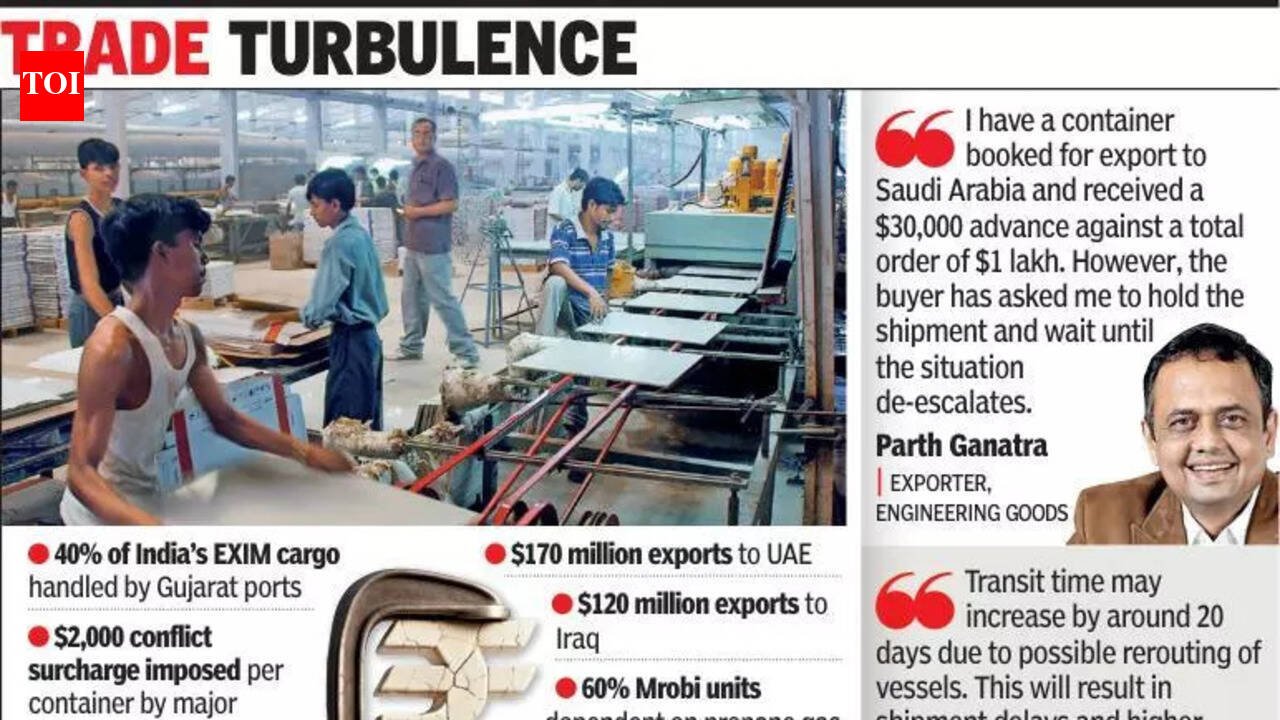
Rajkot: The escalating Middle East war has delivered a severe blow to businesses in Gujarat, India’s manufacturing hub and maritime gateway that handles nearly 40% of the country’s EXIM cargo.The emerging energy crisis, triggered by disruptions at the Strait of Hormuz — which facilitates nearly half of India’s crude oil imports — coupled with a $2,000 per container conflict surcharge imposed by major shipping lines, has significantly impacted key export sectors, especially ceramics and engineering goods.In Morbi, the ceramic hub with an annual turnover of Rs 60,000 crore, the primary concern is an uninterrupted gas supply that keeps factories operational year-round. The industry requires 55 lakh standard cubic metres (SCM) of propane gas daily and 25–30 lakh SCM of piped gas.Nilesh Jetpariya, a leading exporter, said, “There was an issue with supply from Saudi Arabia’s Aramco three days ago, which affected our propane availability. We approached Gujarat Gas for a piped gas contract, but they are not ready to add new customers.”At present, nearly 60% of Morbi units dependent on propane are receiving only about 30% of their required supply. Even if gas availability stabilises, exporters fear large-scale order cancellations amid mounting uncertainty.The ripple effects have spread to Rajkot’s engineering sector, which exports casting, forging and auto components to Gulf countries, accounting for 20% to 25% of the city’s total exports.“Dubai is the hub, and Jebel Ali port is closed,” said Paresh Patel, former president of the Rajkot Engineering Association. “Many shipments land at Jebel Ali and are then transported by road to neighbouring countries.”Port operations at Kandla and other Gulf-linked routes have also been disrupted. Vessel chartering companies report widespread disturbances across the region. Ashish Joshi, a freight forwarder in Kandla, confirmed that mainline operators have imposed a conflict surcharge of up to $2,000 per container.Insurance premiums for bulk carriers have risen following revisions by Protection and Indemnity (P&I) clubs, creating uncertainty over coverage in high-risk waters. Exporters and importers say absorbing these additional costs is becoming increasingly difficult.Ronak Shah, a customs house agent, said cargo movements have been severely impacted. Jebel Ali, one of the region’s key seaports, is facing major operational constraints.According to industry tracking data, hundreds of vessels — including those carrying Indian cargo — are stranded or delayed in and around the Gulf due to heightened security risks and navigational advisories. Vessel movement in the Upper Gulf has slowed, with some advisories asking ships to remain stationary amid radar and security concerns.“There are strong indications of freight hikes on Europe and US trade lanes,” Shah said. “With vessels rerouting via the Cape of Good Hope, transit times are increasing, bunker consumption is rising, insurance premiums are higher and vessel availability is shrinking. Shipping lines are likely to revise rates upward as capacity tightens.”Industry sources said freight rates to Europe and the US have already increased by $400–$500 per container. Ocean freight has jumped from around $1,100 to nearly $1,500 per container within just two to three days. Rates to destinations such as Egypt and Turkey — earlier around $1,100 — are also expected to climb further.Parthiv Dave, an Ahmedabad-based freight forwarder, said exporters are temporarily holding back consignments due to uncertainty over routing and pricing. If vessels avoid conflict-prone zones and reroute via the Cape of Good Hope, transit times could rise sharply, affecting delivery commitments and working capital cycles.Several major carriers have also placed booking restrictions on Middle East-bound cargo across global trade lanes until further notice, industry sources added.(With inputs from Niyati Parikh and Parag Dave in Ahmedabad)
