


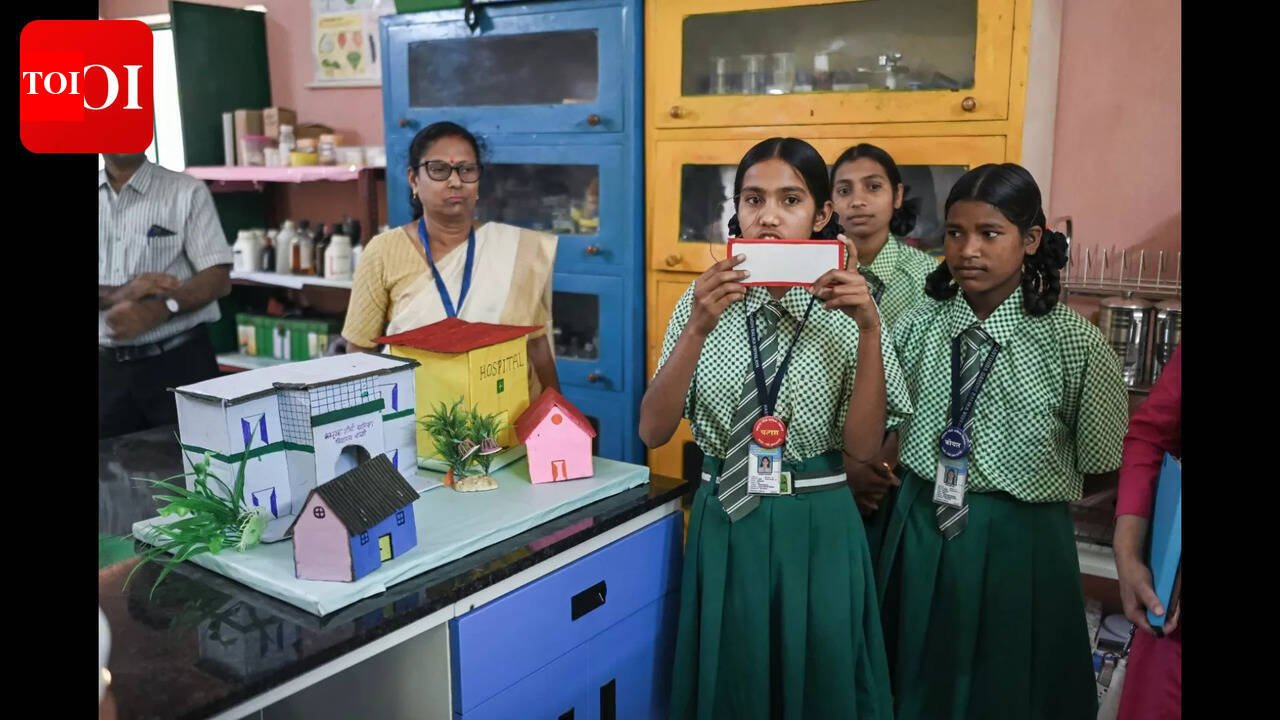
Ranchi: Khushi Kumari, a Class IX student at Kasturba Gandhi Balika Vidyalaya in Ranchi’s Chanho, recently developed a long-range audio transmitter with coverage of nearly 5 km. The device can connect hundreds of people at once to share important information, broadcast educational content for rural children, and provide other essential services.Khushi, who once struggled with science and found textbook concepts difficult to understand, developed the device after gaining experience through activity-based learning at the Science, Technology, Engineering and Mathematics (STEM) lab set up a year ago.“This device can help impart important information to a large number of audiences at one go in remote places, where communication media are very limited. I built the device at the STEM lab with the guidance of my science teacher in school,” Khushi added.Like Khushi, over 36,000 girl students belonging to the tribal and marginalised families of Jharkhand are learning science lessons with hands-on activities and finding solutions to real-life problems.The students of 82 govt-run Kasturba Gandhi Balika Vidyalayas (KGBVs) and Jharkhand Balika Awasiya Vidyalayas (JBAV) are exploring scientific concepts through practical application rather than rote memorisation, thanks to the introduction of activity-based STEM education in their schools.The labs have been set up in the schools of seven districts in Jharkhand under ‘Project Bridge’, a partnership between the education department, UNICEF India and BMW Group, to strengthen STEM education.A team from these organisations this week visited three schools in Ranchi under the project to review the progress. After the visit, UNICEF India’s chief of education, Saadhna Panday, said that while India has made progress in foundational learning, this is not translating into strong performance in secondary-level STEM subjects. “Through this partnership, we are working with state govts to improve participation and transform how these subjects are taught,” she added.Reviewing the programme on the ground, Vinod Pandey, director of govt and external affairs, CSR of BMW Group India, said that the initial results were highly encouraging with a clear demonstration of improved conceptual understanding. “We will continue to focus on enhancing content and pedagogy to drive better student outcomes in STEM subjects,” he said.Director of the Jharkhand Education Project Council (JEPC) under the state education department, Shashi Ranjan said that with the pilot project yielding outstanding results, they are planning more such labs in schools across the state. “Jharkhand has around 2,800 secondary-level schools. We are planning to set up STEM labs in all the schools in a phase-wise manner, so that more students, especially girls, can be attracted towards science in higher levels as well,” he said.
