


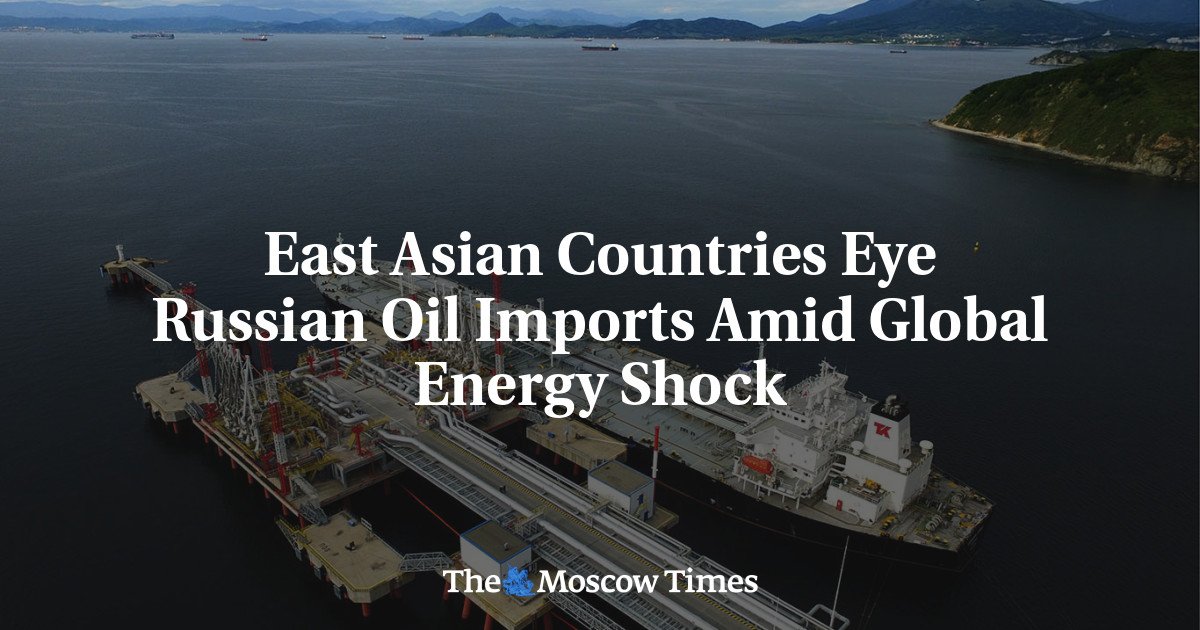
A growing number of countries in East Asia are moving or considering moves to buy Russian oil as governments scramble to boost supplies and ease soaring prices caused by the war in the Middle East.
On Thursday, the U.S. Treasury Department authorized the delivery and sale of Russian crude oil and petroleum products loaded onto ships between March 12 and April 11. Some European leaders have criticized the decision, arguing that it will help the Kremlin fund its invasion of Ukraine.
Thailand’s Deputy Prime Minister Phiphat Ratchakitprakarn said Friday that his country is preparing to open talks on purchasing Russian crude to offset shortages. Thailand, which has just over three months of crude reserves, suspended fuel exports last week to conserve domestic supplies.
Authorities in the Philippines have said they are “considering” importing Russian oil but would defer any decision to the energy department, local media reported. That comes after government workers in the Philippines shifted to a four‑day workweek in response to the recent surge in fuel costs.
Many countries in East Asia rely heavily on oil and gas supplies from the Middle East, most of which flow through the Strait of Hormuz. Shipments through the narrow waterway have come to a virtual standstill since the outbreak of hostilities, and Iran’s new supreme leader, Mojtaba Khamenei, has vowed to keep the strait closed as a “tool to pressure” the United States and Israel.
Japan, which imported 94% of its crude from the Middle East in 2025, said it would “consider” whether to buy Russian crude after the United States issued its sanctions waiver. However, unlike some Asian countries, Japan maintains large strategic reserves equivalent to 254 days of consumption.
ASEAN foreign and economic ministers on Friday called for an immediate end to the war in the Middle East, saying the effects of surging oil prices and disrupted trade are already hitting Southeast Asia’s economies.
Meanwhile, Sri Lanka’s Foreign Minister Vijitha Herath met with Russian Ambassador Levan Dzhagaryan to discuss “expediting” oil imports after the United States issued the sanctions waiver. Dzhagaryan said he would relay the request to Moscow and help facilitate the deliveries, local media reported.
Russia has earned an estimated $1.3-1.9 billion windfall from taxes on oil exports since the effective closure of the Strait of Hormuz sent global energy prices soaring, The Financial Times reported on Friday.
Asian countries were importing Russian oil even before the United States and Israel began their attacks on Iran in late February. India and China are major buyers of crude from Russia.
Last week, the U.S. Treasury Department granted Indian refiners a 30-day waiver to buy Russian oil currently stranded at sea.
A Message from The Moscow Times:
Dear readers,
We are facing unprecedented challenges. Russia’s Prosecutor General’s Office has designated The Moscow Times as an “undesirable” organization, criminalizing our work and putting our staff at risk of prosecution. This follows our earlier unjust labeling as a “foreign agent.”
These actions are direct attempts to silence independent journalism in Russia. The authorities claim our work “discredits the decisions of the Russian leadership.” We see things differently: we strive to provide accurate, unbiased reporting on Russia.
We, the journalists of The Moscow Times, refuse to be silenced. But to continue our work, we need your help.
Your support, no matter how small, makes a world of difference. If you can, please support us monthly starting from just $2. It’s quick to set up, and every contribution makes a significant impact.
By supporting The Moscow Times, you’re defending open, independent journalism in the face of repression. Thank you for standing with us.
Continue
Not ready to support today?
Remind me later.
×
Remind me next month
Thank you! Your reminder is set.
