


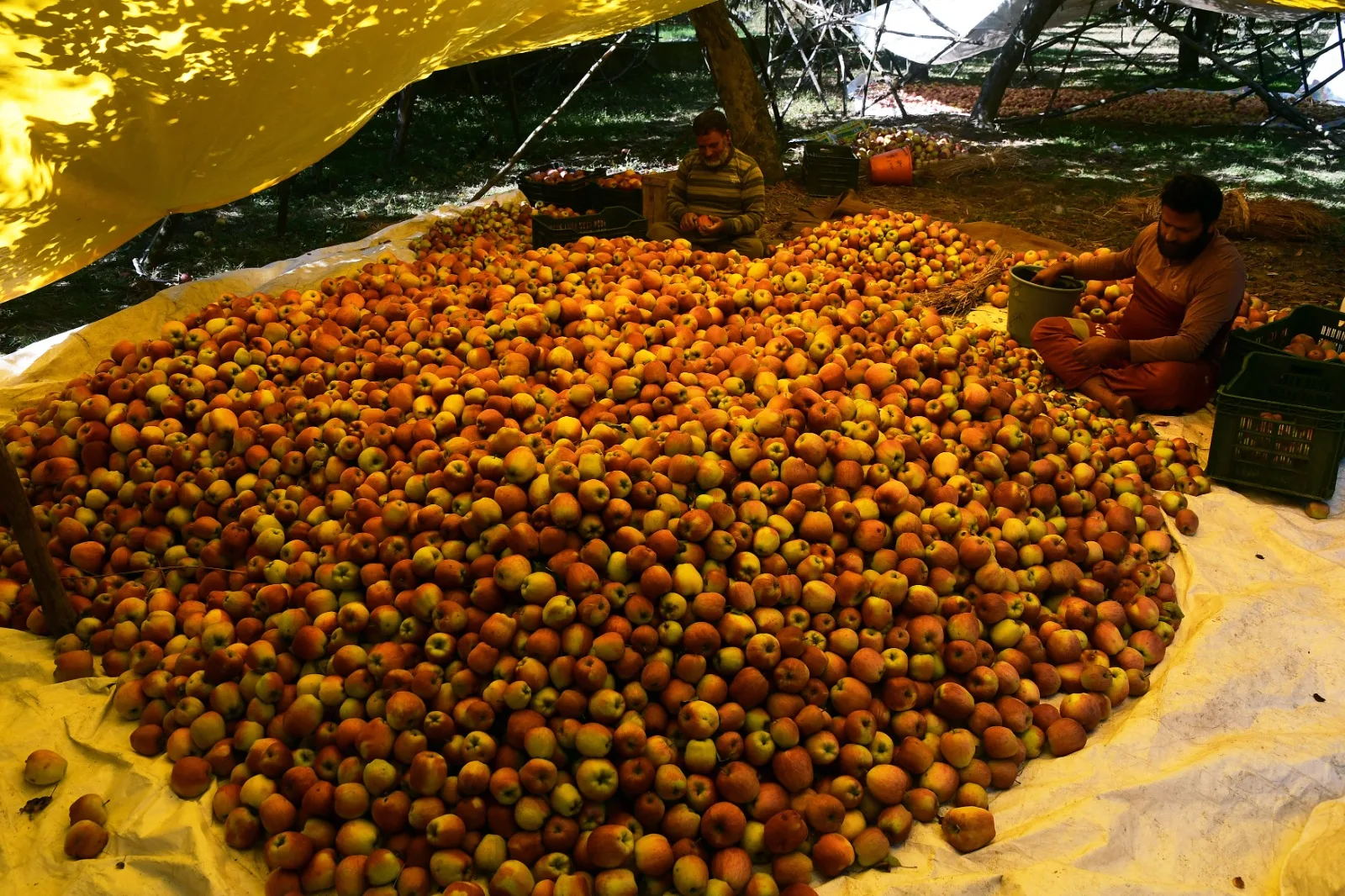
Srinagar, Mar 01: An unusually warm February has set alarm bells ringing across Kashmir’s apple belt, with farmers and experts warning that premature budding and flowering could expose the Valley’s prized crop to frost damage and yield loss.
In several parts of south and central Kashmir, growers report early swelling of buds — a sign that apple trees are responding to rising temperatures earlier than usual. While the sight of orchards stirring from winter dormancy may appear promising, experts caution that early bloom in February is a double-edged sword.
Kashmir accounts for nearly 75 per cent of India’s apple production, producing around 20–22 lakh metric tonnes annually in good years. The sector contributes an estimated Rs 8,000 to Rs 10,000 crore to the region’s economy and supports over 3.5 million people directly and indirectly — from growers and labourers to transporters and traders.
A disruption in flowering or fruit setting could therefore have far-reaching economic consequences. “Apples require a certain number of chilling hours during winter to ensure proper flowering and fruit development,” said an official from the Horticulture Department. “If February temperatures rise too quickly, dormancy breaks early. If a cold wave or Western Disturbance follows, blossoms become highly vulnerable.” Farmers in districts such as Shopian, Pulwama and Baramulla say they are already concerned.
“We are seeing buds swelling earlier than expected,” said Bashir Ahmad, an orchardist from Shopian. “If there is frost in March or April after flowering, the flowers can burn, and we lose fruit before it even forms.”
Another grower from Sopore, Abdul Majeed, echoed the anxiety. “Last year, we also saw temperature fluctuations. Apple farming is already expensive. If the bloom gets damaged, we cannot recover our costs.”
Agriculture Minister Javaid Ahmad Dar acknowledged the concern, saying the government is closely monitoring weather patterns and orchard conditions. “Apple is the backbone of Kashmir’s rural economy. We are in constant touch with horticulture experts and field officers,” Dar said. “Advisories are being issued to farmers, and necessary support will be extended if weather fluctuations impact the crop.”
He added that climate variability is emerging as a serious challenge. “Unseasonal warmth followed by sudden cold spells can affect flowering and fruit setting. We are encouraging adoption of improved orchard management practices and modern technologies to mitigate risks.”
Scientific studies show that apples need between 1,000 and 1,600 chilling hours (temperatures between 0°C and 7°C) during winter for uniform flowering. Warmer winters reduce these chilling hours, potentially leading to uneven bloom, poor pollination and reduced fruit quality.
In recent years, Kashmir has witnessed erratic weather patterns — including deficient snowfall in some winters and sudden spring frosts in others. Such fluctuations have increased uncertainty for growers who depend heavily on stable seasonal cycles.
Beyond production, apples form the economic lifeline of the Valley. The sector contributes significantly to Jammu and Kashmir’s Gross State Domestic Product (GSDP), and nearly every rural household in south and north Kashmir is linked to horticulture in some way.
For now, farmers are watching the skies with cautious hope. A stable transition into spring, without frost or hailstorms, could still safeguard the crop. But if warmth is followed by a sharp cold spell, the early bloom could turn from promise into peril. As orchards awaken ahead of schedule, Kashmir’s apple economy stands delicately balanced — its future hinging not just on blossoms, but on the unpredictable moods of the weather.
