


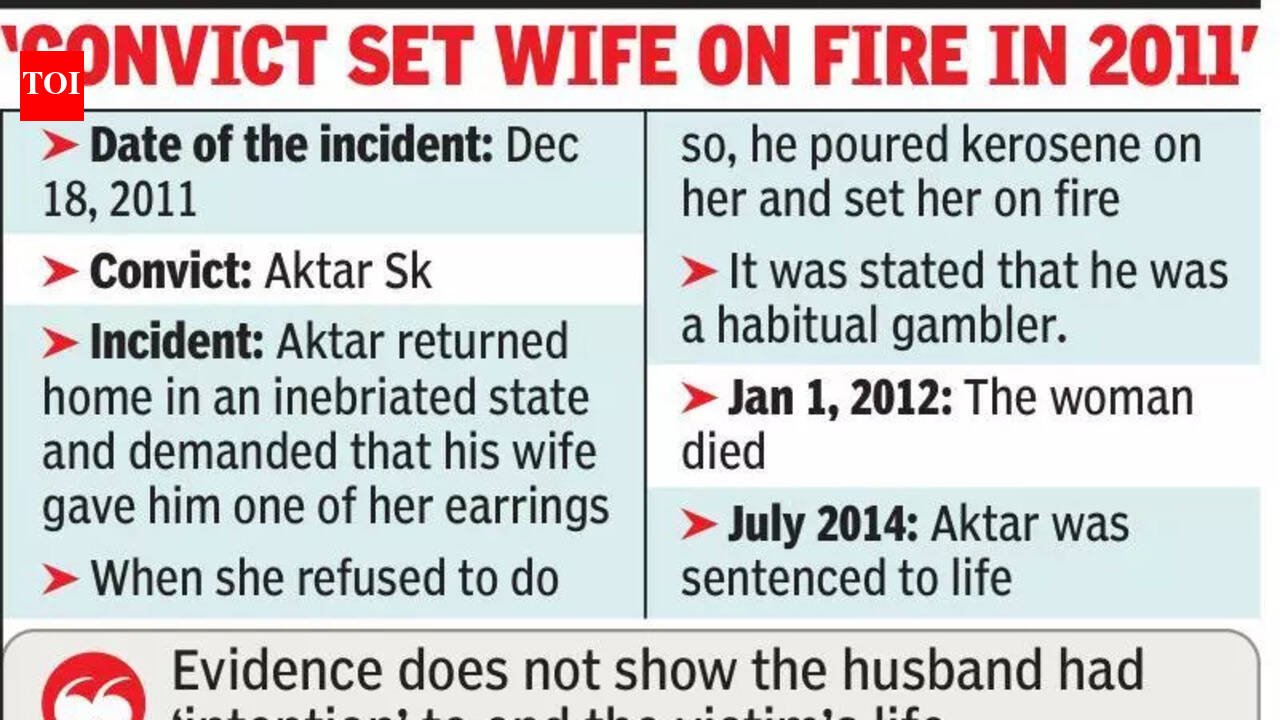
Kolkata: “Had he not been drunk, he may not have committed the murder,” the Calcutta High Court observed, reducing a murder charge to culpable homicide not amounting to murder against a man, who he set his wife on fire for refusing to give him her earring for gambling. The man has spent 13 years in jail, serving a life sentence for the murder. The maximum sentence for culpable homicide not amounting to murder is 10 years.The division bench of Justice Rajasekhar Mantha and Justice Md Shabbar Rashidi said the couple was married for 17 years. They observed that if the husband had an intention to kill his wife, he would not have called a “quack” to treat her or hired a taxi to take her to her paternal home for admission to Anupnagar BPHC Hospital. The case dates back to Dec 18, 2011, when Aktar Sk returned home drunk, asked his wife for an earring, and, on refusal, set her on fire. It was stated that he was a habitual gambler. There was no witness as two turned hostile, while others stated on a hearsay basis. The only proof that could ascertain the man’s culpability was the bed-head ticket at the two hospitals—Anupnagar and Jangipur SD Hospital—where the wife was treated for her burns. She, before dying, told the doctors that the husband returned home drunk, asked for her earring for gambling, she refused, and he set her on fire.While this proved Aktar did commit the offence, it could not prove he had the intention to kill her. The division bench stated, “Evidence does not show the husband had ‘intention’ to end the victim’s life… . There is no evidence on record of any torture by the husband on the victim. No previous complaint was lodged by the victim and her family. On the contrary, the failure on the part of the complainant (victim’s brother) to notify police of the incident from Dec 19, 2011 to Jan 1, 2012 would support the case of the defence that there is little or no evidence of offence under Sec 302, much less any offence under Sec 498A of the IPC.“
