


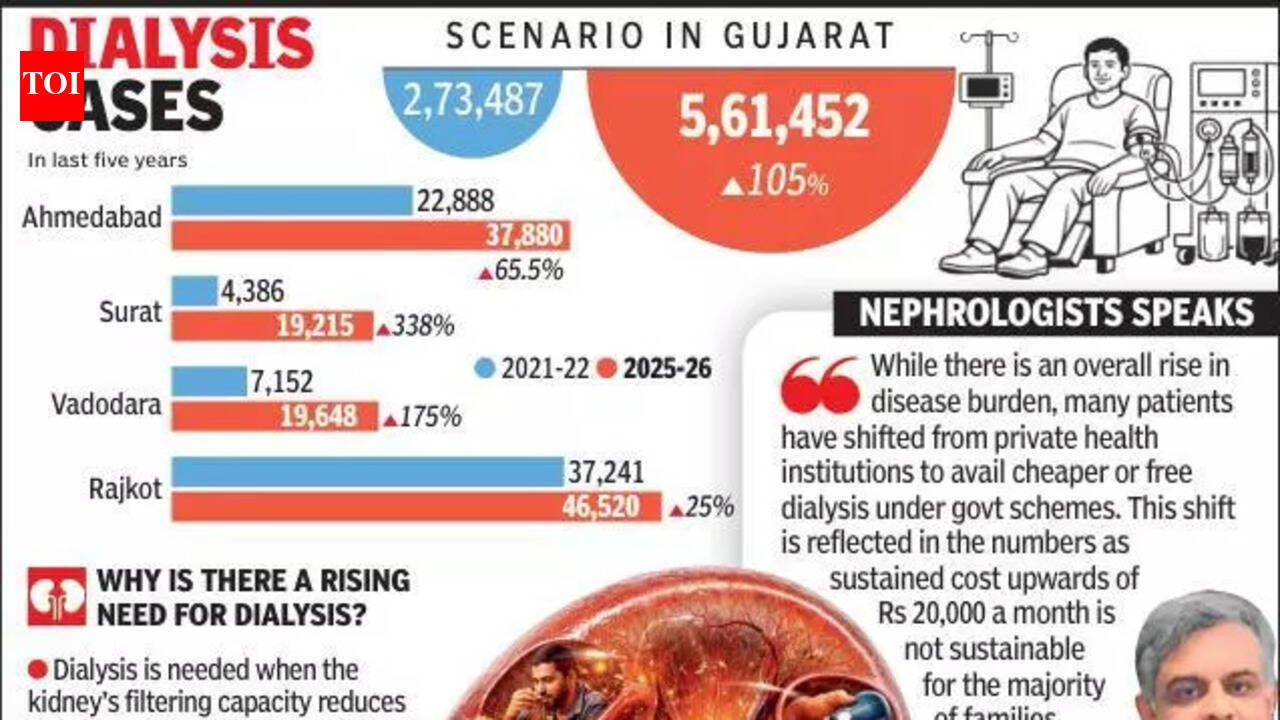
Ahmedabad: In 2021-22, Gujarat was still under the shadow of the pandemic, but those who had chronic kidney disease (CKD) or renal failure and needed to undergo dialysis to stay alive had to visit centres under the state govt-run dialysis network. During this period, the Institute of Kidney Diseases and Research Centre (IKDRC), the nodal agency for govt-run centres, recorded 2.73 lakh dialysis procedures at the rate of about 750 a day.This financial year — even when procedures from March are yet to be counted — the number has already touched 5.61 lakh, about 1,680 procedures a day, showing that numbers have more than doubled in just five years. The statistics is troubling because the only way patients can be off the dialysis, a procedure often required twice or thrice a week, is kidney transplant either from cadaver or living donors.IKDRC director Dr Pranjal Modi said that Gujarat currently has network of 280 dialysis centres that provide treatment under govt schemes. Over the years, the network has expanded to the taluka level so that patients don’t have to travel long distances, he added.Nephrologists at IKDRC said that the current financial year has seen 64,109 patients availing dialysis services so far. “Apart from the rise in absolute number of patients due to factors such as rise in non-communicable diseases (NCDs) like diabetes and hypertension, the rise can also be seen in the light of the fact that it is an expensive procedure, and over the years the families switch to the public hospital services from private hospitals,” said Dr Himanshu Patel, senior nephrologist at IKDRC.Trend of the four major districts – Ahmedabad, Surat, Vadodara, and Rajkot – and the rest of the state indicated that compared to 72% rise in the four, the rise in dialysis procedures is sharper in rest of the state at 117%. Several smaller centres have more than 1,000 patients availing services. Experts believe that the overall number of procedures and patients would be higher if services availed at private facilities are factored in.Dr Mayank Shah, a nephrologist with Shalby Hospitals, said that about one in every 10 kidney patients they see have CKD that needs long-term intervention. “We tell the patients — and physicians — that majority of the patients we see directly come in the advanced Stages 4 or 5. Thus, if a patient shows long-term illness in terms of diabetes and hypertension, they should also be checked for renal health,” he said.
