


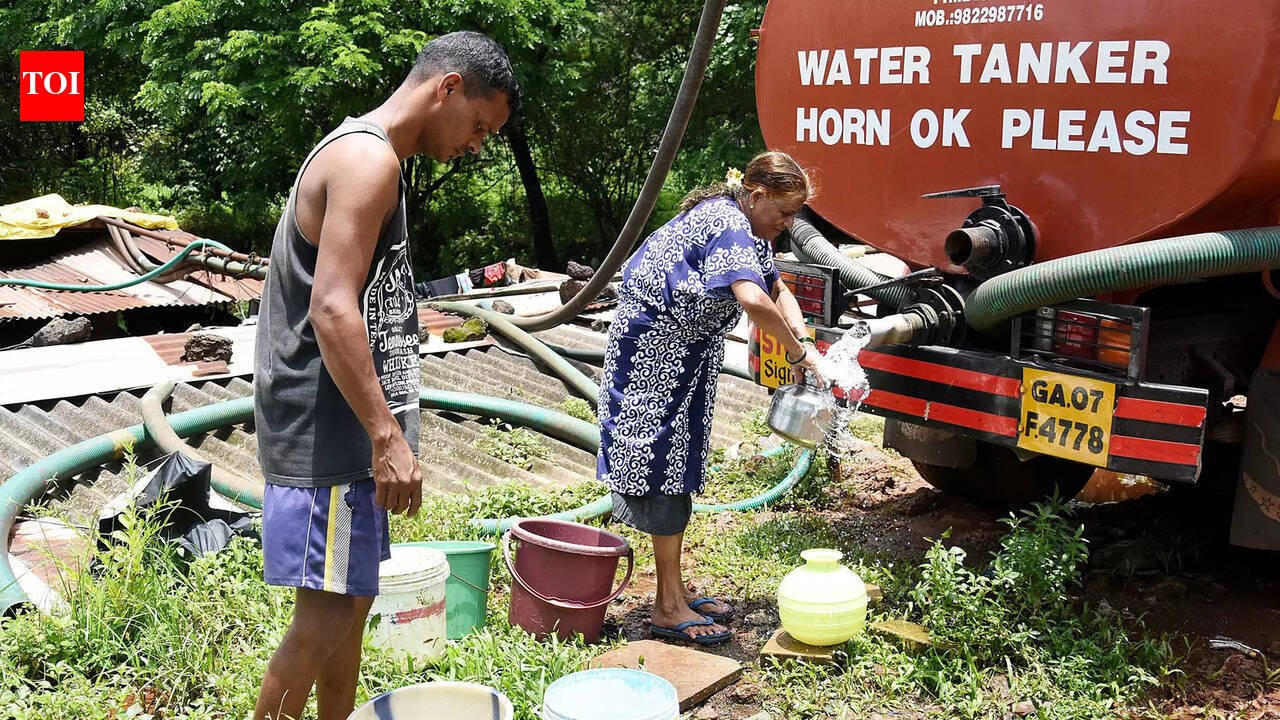
Panaji: During the current state govt’s tenure, ministers have promised 24×7 water supply, and later assured citizens of at least eight hours of piped water a day. However, even as govt’s tenure is nearing its end, data tabled in the assembly shows that a majority — 53.5% of water connections in Goa — receive water supply for between one and eight hours a day, in some cases less than two hours.Of these, 9.4% of consumers receive water for less than four hours a day. The assembly complex and the areas around it receive water supply for two hours a day only, data shows. Bardez taluka is the worst affected, with major parts being supplied water only on alternate days. Verem, Reis Magos, and Sangolda residents are among those being supplied water on alternate days, that too for two hours only, the assembly reply shows.It is no wonder, then, that from 2022 to date, 996 complaints have been received from Bardez taluka about not having received water supply. Most of Tiswadi, Sattari, and Pernem talukas also received treated water supply for not more than three hours a day.Only around 26% of water connections in Goa receive supply 24 hours a day. Canacona and Sanguem municipal areas, Cavelossim and Velsao in Mormugao, some villages of Quepem, some villages of Salcete like Raia, Rachol, Curtorim, Nuvem, Nagao are among the most fortunate ones to receive round-the-clock water supply, as per the reply tabled in the recently-concluded assembly session by minister for drinking water, Subhash Phal Dessai.However, the supply may not be as smooth as the records indicate, as the highest number of complaints — 2,682 — were received from Salcete taluka since 2022.Phal Dessai’s reply states that the complaints were due to localised issues and not due to water shortage.“The complaints being received in parts of the state are of localised nature on account of power failure, leakages, breakdowns, clogging of lines and planned shutdowns, and not primarily due to shortage of water,” said Phal Dessai.This is even though another document tabled in the House stated that Goa’s installed water production capacity is 675 MLD, short of 20MLD from the demand of 695MLD. “The production capacity will be further enhanced by another 325 MLD after completion of ongoing water treatment projects,” the minister said.Phal Dessai said in his reply that a major issue is that Goa’s non-revenue water was high at 40%. This includes loss of water due to leakages, theft, non-functional and insensitive meters, unauthorised consumption, unbilled connections, and water used to flush lines.He said the work of installing flow meters is presently on, and that these will allow areas to be divided into zones and help pinpoint the exact area of water loss.He admitted that some of the pipelines are “decades old”. But the issue does not seem likely to be fixed soon, as the minister said it will take up to seven years to replace these age-old pipelines.“The replacement of old and aged water pipeline is a continuous process and is being taken in a phase-wise manner. Replacement of 217km pipeline is ongoing and the remaining portion of old pipelines is targeted to be replaced in next three to seven years,” the reply states.
