


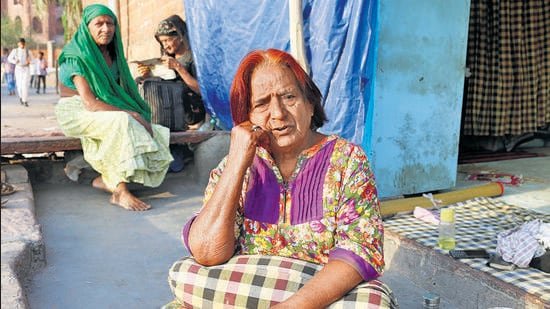
The lane is full of absences. Even its name is absent—it has none. It begins with the shrine of a Sufi mystic who lost his life to an emperor’s wrath. The small shrine of Hazrat Sarmad Shahid in Old Delhi is painted red, the traditional color of his martyrdom. Sarmad lived unconventionally, known as the naked fakir. His life, or perhaps his defiance, lingers on in the street.

A few steps away stood the makeshift home of an elderly transgender person who identified herself as a “kinnar.” Her name was Munna. She lived with a group of younger transgender people who called her their guru. One of her “chela”was the friendly Shigori, older than most of the others.
The shed where they lived had no walls, no doors. Yet within it existed a densely self-contained world. There was a stately wooden takhat, a wooden cupboard, a row of potted plants. Every morning, the residents read newspapers over glasses of very, very sugary chai, brought from a stall in Meena Bazaar. They would discuss dresses, conflicts in West Asia, the going rates of goats, and whether the best biryani in the Walled City came from Chitli Qabar or Turkman Gate.
Sometimes Munna would lie on the takhat while Shigori oiled her hair. At other times, they hosted friends and acquaintances, most of them from the transgender community. Munna sometimes wore green-rimmed glasses. Her hair was always dyed with henna. At home, she mostly preferred plain Pathan suits.
One morning, some years ago, this reporter snapped a photo of Munna, dressed in bright colors, sitting on her bed. This afternoon, when shown the photo, rickshaw puller Imran, who lives along the same lane, describes the day when Munna, sitting just like that, suddenly turned and fell. This happened a few days ago. “Woh palat gayi,” he says. She was gone.
An ambulance came and took her away, Imran recalls.“We all respected her,” he says. Shamshuddin, an attendant in the aforementioned Sufi shrine, says that “out of respect, I would call her Munna Bhai.”
Not long after Munna’s passing, those who had lived with her left the place. And Munna, who had lived here for decades, became an absence.
But in a city like Delhi, absences do not endure for long. They are quietly filled by other presences. A new group of transgender people has since moved into the space. They have made it more private. It is no longer a shed, but a room with a metal door that remains closed. Outside, though, a birdcage stands on a small table, with parrots inside.
