


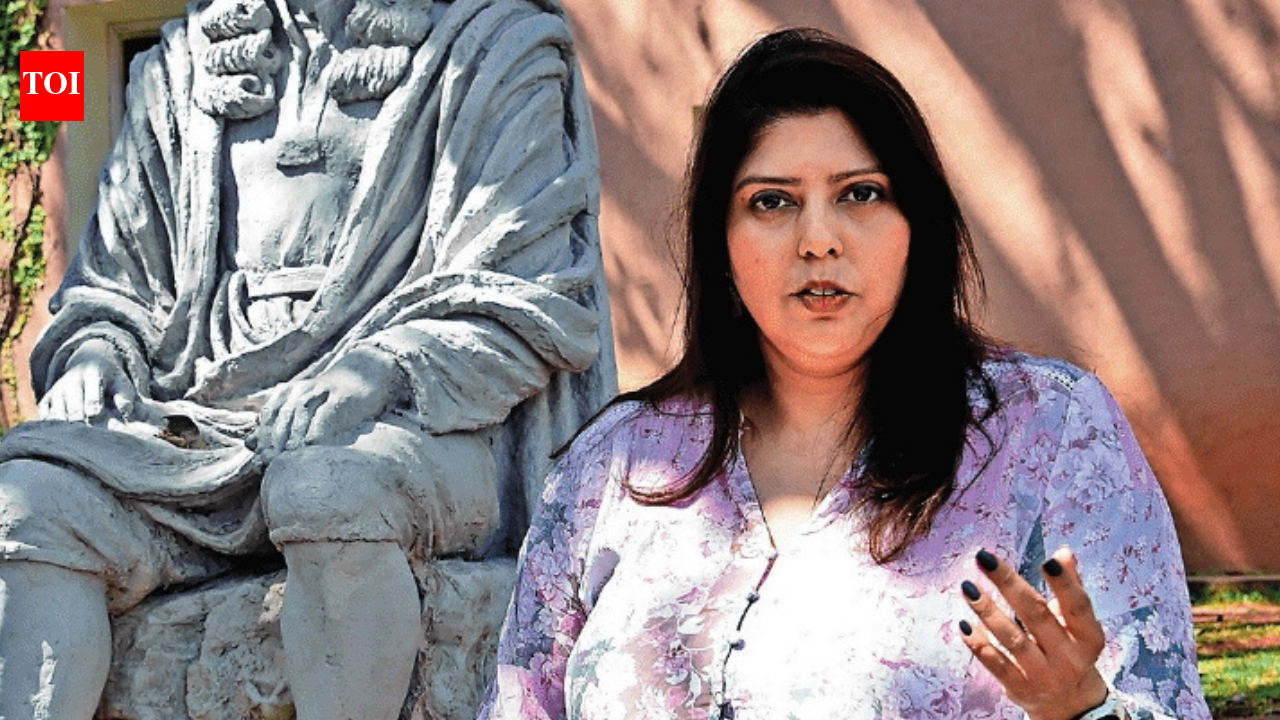
Theoretical physicist takes on the cosmos’s hardest questions and brings gravitational-wave science from the laboratories to the peopleTheoretical physicist Debarati Chatterjee focuses on neutron stars, col‑ colliding black holes and ripples that travel across the cosmos. But just as central to her work is a very earthly mission to make science visible, accessible, and possible for the next generation of women.Chatterjee, an associate professor at Inter‑University Centre for Astronomy and Astrophysics (IUCAA) in Pune and the outreach lead for LIGO India, sits at the intersection of pioneering astrophysics and pub‑ lic science communication.She gets bored easily if a problem does not challenge her intellectually. “It is one of the reasons I chose to work on compact stars and gravitational waves. Neutron stars are among the densest objects in the universe. The matter inside exists under conditions so extreme that we cannot reproduce them in laboratories on Earth. In a sense, they become natural laboratories for testing fundamental physics,” she said.Understanding these stars spans several branches of science. Nuclear physics describes the behaviour of matter at enormous densities. Particle physics helps explain what kinds of particles can exist under such conditions. Hydrodynamics and computational simulations are needed to model how these objects evolve and collide.Chatterjee’s path began decades ago in Kolkata where curiosity about science was encouraged from childhood. “I grew up as an only child in a household where science and technology were part of everyday conversations. My father was an engineer, and mother, a homemaker, had a strong scientific background. I was always encouraged to ask questions, explore how things worked and be curious about the world,” she said.Her early years were shaped by frequent relocations, which meant adapting to new environments and people. Instead of being disruptive, she says, the experience broadened her outlook. “I was constantly encountering new cultures and new people, and grew curious about the world,” she said.At school, she participated in debates, extempore speaking, theater, dance and trekking. “At the time, it simply felt like fun, but those experiences shaped my confidence. They trained me in public speaking, to communicate clearly, and those skills later became crucial when I began science outreach.” She graduated in physics from St Xavier’s College and then pursued a master’s degree at University of Calcutta.During her student years, she worked on many small research projects that gave her a taste of scientific life. The intellectual freedom appealed to her. “Research gives you the ability to pursue questions deeply, to travel, to collaborate with people across the world. That sense of exploration was extremely attractive,” she said.After doctorate, her career took her across Europe, including research stints in Germany and France, but the international mobility that often defines academic ca‑ reers also brought challenges. “Research careers can involve much instability, especially in the early and mid stages. Most positions are fixed-term and once a project ends, you have to move. That mobility is exciting, but it makes a stable personal life difficult to stick to. For women scientists, it can be particu‑ larly complicated because they are often expected them to compromise their careers for family in ways that men are rarely asked to,” Chatterjee said.In 2019, personal circumstances brought her back to India. “I started applying for positions as I wanted to be closer to my family. The first offer was from Pune’s IUCAA. Though I barely knew the city, it felt like the right opportunity. I also became a member of the LIGO scientific col‑ laboration and around 2020-end, I was asked to serve as the outreach chair for the LIGO India project. That role felt natural because during my Europe stint I had received pro‑ fessional training in science communication. In France, I worked as a science ambassador travelling to schools and public forums to explain complex research to broader audiences. I was able to quickly adapt those experiences and develop new outreach initiatives for gravitation‑ al wave science in India,” she said.Endlessly fascinatingChatterjee believes we are living in a remarkable moment for astron‑ omy. “Just a decade ago, we celebrat‑ ed the first detection of gravitation‑ al waves. Today, we have observed hundreds of such events. In fact, we are now detecting signals from black hole mergers almost routinely. Each fresh detection gives us clues about how black holes form, how they grow and what the interior of neutron stars might be like. Many of our earlier theoretical ideas are being tested against real observational data for the first time,” she said.Chatterjee believes that science should not remain confined to labo‑ ratories and academic journals. “If public money supports research, people deserve to understand what we are doing and why it matters,” she said.During the pandemic, she launched online initiatives, includ‑ ing blogs, podcasts and interviews with researchers, to explain gravita‑ tional waves. It later expanded to festivals, public talks and rural en‑ gagement programmes near the Hingoli site where the LIGO India detector will be built.School visit leaves a mark“We walked into a tiny mud structure with children sitting on the floor. It was a holiday but they wanted to meet someone from LIGO India. We had planned slide shows and videos, but we took a different approach. We used storytelling and a pop-up book to explain gravita‑ tional waves,” Chatterjee said.At the end of the session, many girls wanted to read physics. “ Devel‑ oping a scientific temper is deeply empowering. When you learn to think analytically and approach problems logically, you realise that challenges can be solved through knowledge and reasoning. If more women gain access to that kind of education, it strengthens not only individual careers but entire communities,” Chatterjee added.She believes that science benefits enormously from diversity. “When people from different backgrounds and perspectives work together, they tend to ask different questions and challenge existing assumptions. That leads to better science,” Chatterjee added.
