
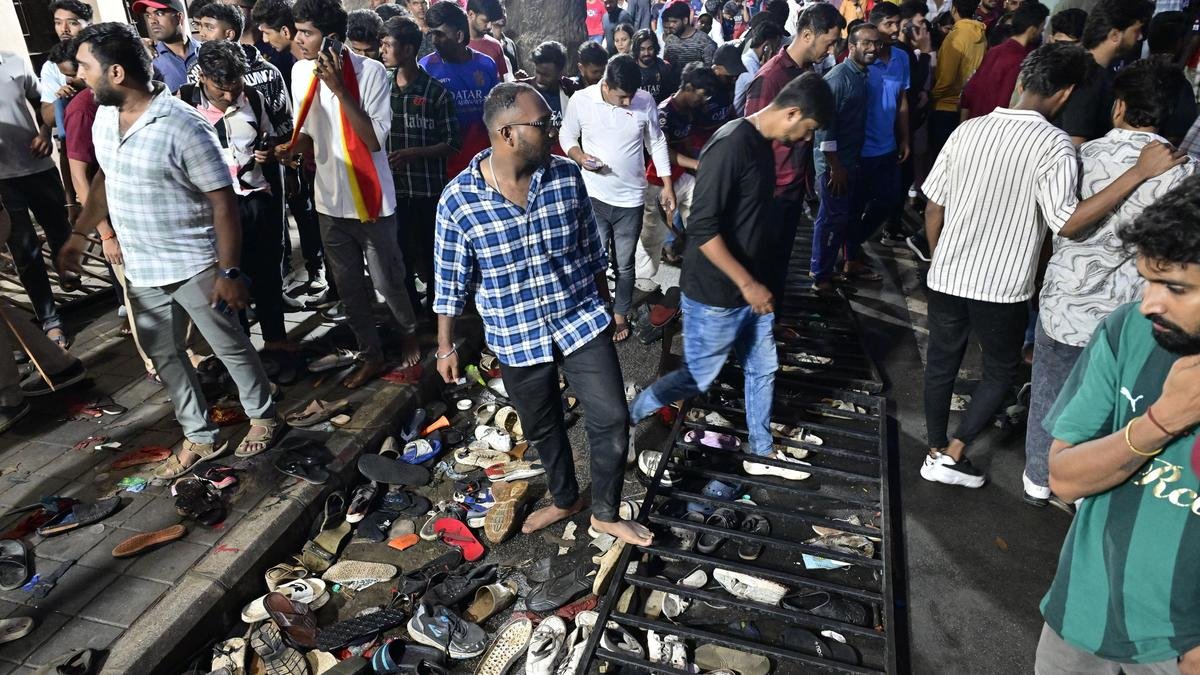
Scene at one of the gates of the M. Chinnaswamy Stadium after RCB fans tried to gain forcible entry during the IPL victory celebration in Bengaluru on June 4, 2025.
| Photo Credit: Murali Kumar K
After much deliberation, the Karnataka Cabinet recently cleared a proposal to allow big-ticket cricket matches, particularly those of the Indian Premier League (IPL), at the M. Chinnaswamy Stadium. It was in front of this venue in the heart of Bengaluru that 11 Royal Challengers Bengaluru (RCB) fans died in a stampede in June 2025. The team’s trophy victory after a 17-year wait had led to a fan frenzy, leading to the tragedy.
Following the incident, the State government, which faced criticism for its alleged failure at crowd control, imposed a blanket ban on all matches at the stadium. It did not even allow the Vijay Hazare trophy without spectators. An expert committee, led by Greater Bengaluru Authority chief M. Maheshwar Rao, had found that the Karnataka State Cricket Association (KSCA), which runs the stadium, had not implemented the safety measures recommended by the John Michael Cunha Commission after the stampede.
Also Read | Amicus curiae expresses concern over holding IPL matches at Chinnaswamy stadium without enforcing SOP
But with former Indian pacer Venkatesh Prasad taking over as chairperson of the KSCA recently, the focus shifted to reviving cricket at the stadium. The State government has now given conditional approval to hold IPL matches this season, after the KSCA promised that all safety precautions would be implemented in a phased manner. As RCB is the defending champion, the opening match of this season is expected to be held here.
The stampede also prompted a debate on relocating the stadium out of the Central Business District area. There are four major sporting venues in the Central Business District — M. Chinnaswamy Stadium, Bangalore Golf Club, Bangalore Turf Club, and Kanteerava Indoor Stadium — all within a 2-kilometre radius of the State legislature. Last week, the Cabinet also cleared a proposal to shift racing activity out of the Bangalore Turf Club to Kunigal on the city’s outskirts.
Also Read | Bengaluru stampede: How what was to be a victory celebration ended in a tragedy
The discussions have centred around the judicious use of public land and congestion caused by these venues. Over the last eight months, there have been three proposals by the Bangalore Development Authority, the Karnataka Housing Board, and the Greater Bengaluru Development Authority to build cricket stadiums on the city’s outskirts, though none of these locations are well served by public transport. By contrast, as many have pointed out, Wankhede Stadium (Mumbai), Eden Gardens (Kolkata), M.A. Chidambaram Stadium (Chennai) are all located in the centre of these cities. Even M. Chinnaswamy Stadium is set to remain within the city, according to the recent Cabinet decision.
The Cunha Commission recommended not holding “any large crowd events” at the stadium, though it did not clarify whether this includes cricket matches. The stadium, built in 1969, has a seating capacity of 33,000 and did not experience a stampede before the tragedy of June 4, 2025. That episode was caused by an unprecedented situation in which a crowd of over 2.5 lakh gathered around the stadium to join the unticketed RCB victory celebrations. An open-air felicitation of the team on the steps of the Vidhana Soudha by the Chief Minister and an announcement of a victory parade of the team that eventually did not take place contributed to the chaos.
Also Read | Karnataka govt. gives conditional clearance to IPL matches at M. Chinnaswamy Stadium
Using the tragedy as a benchmark to ban matches was seen as a knee-jerk reaction aimed at covering up the government’s own culpability. The terms of reference of the Cunha Commission were also set in such a way that the Commission only examined what happened at the stadium and did not take a holistic view of the incident. Though the Bengaluru City Police were blamed and the City Commissioner was suspended in an unprecedented manner, the Chief Minister’s sacking of his political secretary for his alleged role in the day’s preparations was an indirect admission of culpability. But now, as public anger over the mismanagement that led to the stampede has cooled off, the government has allowed KSCA to also resume cricket matches at the stadium.
The RCB, the event managers who were part of the victory celebrations, and the KSCA were all booked in the stampede case. Hearing petitions filed by them challenging the FIR, the High Court of Karnataka restrained the State police from filing a chargesheet in the case without their prior permission. No chargesheet has been filed yet. The five police officers suspended over the stampede have all been reinstated. As life moves on, cricket resumes with another IPL season. The families of the 11 who died in the stampede, however, still await justice.
Published – February 23, 2026 12:32 am IST
