


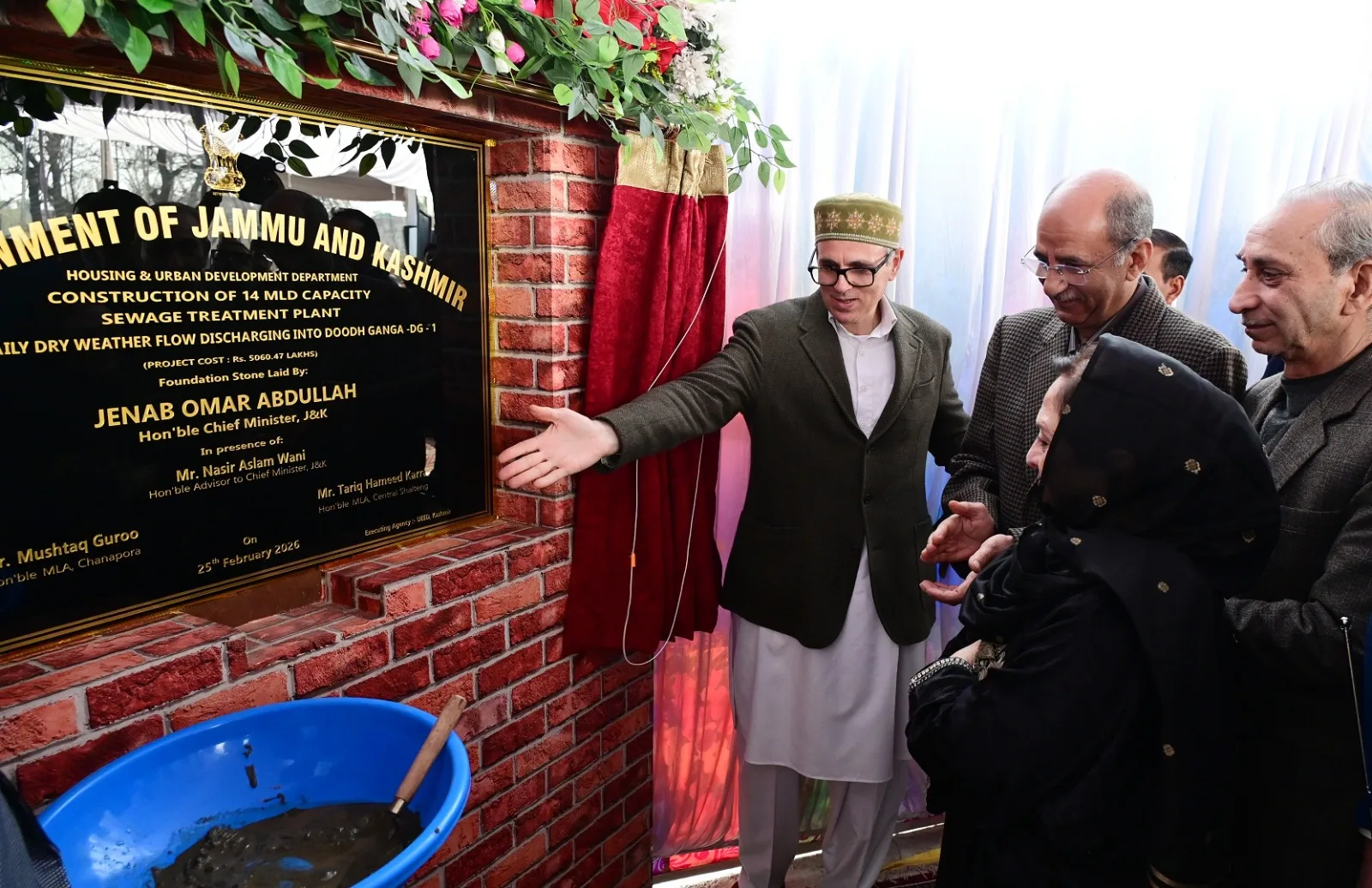
Chief Minister Omar Abdullah on Wednesday laid the foundation for infrastructure and river conservation projects worth over ₹190 crore across Srinagar and Budgam districts, marking a significant push towards urban transformation and environmental sustainability.
Spanning five constituencies, the projects focus on urban beautification, pollution abatement of the Jhelum River, and advanced sewerage treatment infrastructure for Doodh Ganga, reflecting the Government’s commitment to improving civic amenities, enhancing climate resilience, and restoring water bodies.
At Rainawari, the Chief Minister laid the foundation stone for the construction of BAB-UL-SULTAN-UL-ARIFEEN, a landmark city gateway featuring artistic calligraphy at Rainawari Chowk. Executed by PW (R&B) at a cost of ₹130 lakh, the project aims to enhance the aesthetic and cultural identity of the historic locality.
He said the gateway would not only beautify the area but also highlight its spiritual and cultural significance.
The Chief Minister also laid the foundation of a major environmental initiative at Brari-Nambal Munawarabad for Pollution Abatement and Conservation of River Jhelum at Chuntikul and Gowkadal. The project, under the Housing & Urban Development Department,, will be executed by UEED at a cost of ₹7090.68 lakh. It includes the establishment of an 8 MLD Sewage Treatment Plant (STP) to significantly reduce untreated discharge into the river.
At the same venue, the Chief Minister laid the foundation for two major sewage treatment projects under H&UDD (UEED) to curb pollution in Doodh Ganga — a 14 MLD STP at Aloochi-Bagh, Srinagar (₹5060.47 lakh), and a 6 MLD STP at Mochua, Budgam (₹6772.32 lakh) to treat dry weather flow from Chadoora to Baghi-i-Mehtab — significantly strengthening wastewater management and environmental protection in the area.
Addressing the gathering, the Chief Minister said that although projects worth nearly ₹200 crore across five constituencies would ordinarily warrant a large public function, the programme was deliberately kept modest in view of the holy month of Ramzan.
“If we had organised this programme some other time, it would have been garnered huge public participation. But keeping Ramzan in mind, we did not want to cause inconvenience to people, nor delay projects for which the public has been waiting impatiently,” he said.
Highlighting the pressure on the Housing & Urban Development Department and the Srinagar Municipal Corporation, he said drainage, sewerage, roads, parks and development of new colonies fall under their mandate.
“Our two capital cities, Srinagar and Jammu, create the first impression of Jammu and Kashmir. Tourists arrive here first. Millions of residents live here. It is our responsibility to ensure the infrastructure in cities reflects the development of this region.”
The Chief Minister stressed that inadequate drainage and sewerage systems often result in waterlogging after even brief rainfall.
“It rains for one hour and the whole city is under water. This must change. whether through Central schemes, UT Capex, District Capex or new funding schemes like SASCI, our effort is to upgrade Srinagar’s infrastructure comprehensively.”
Referring to changing climate patterns, he said rainfall distribution has become increasingly erratic.
“We may not see rain for months, and then receive six months’ rain in three days. Instead of water percolating into the ground, it flows away, leading to both flooding and water scarcity. We must prepare infrastructure that can withstand changing weather patterns.”
Emphasizing water conservation and reuse, he said treated sewage must improve, not degrade, river water quality.
“We must ensure that if treated water enters the river, it improves its quality instead of harming it. Our lakes and canals must regain their former glory.”
Recalling Srinagar’s historical identity as the “Venice of the East,” he added:
“Once, people travelled through our canals by boat. I want to see our water bodies restored to that standard. Water quality must improve, scarcity must reduce.”
The Chief Minister also stressed the need to decongest the city through planned housing colonies in peripheral areas.
“There is immense pressure on the inner city because we have not developed sufficient planned colonies. This year, we intend to take up at least one or two major housing projects with proper roads, drainage, water and electricity infrastructure, so that people willingly move towards the outskirts.”
Assuring speedy implementation, he said several projects are ready for inauguration or foundation laying.
“In the next three to three-and-a-half years, when we go back to the people, we want to present a transformed Srinagar — a city with modern infrastructure and renewed character. That is our commitment.”
Advisor to the Chief Minister Nasir Aslam Wani, MLAs Ali Mohammad Dar, Tanvir Sadiq, Sheikh Ahsan Ahmed and Shamima Firdous, Commissioner Secretary Mandeep Kaur, Commissioner Srinagar Municipal Corporation Fazlul Haseeb, and other senior officers were present on the occasion.
