


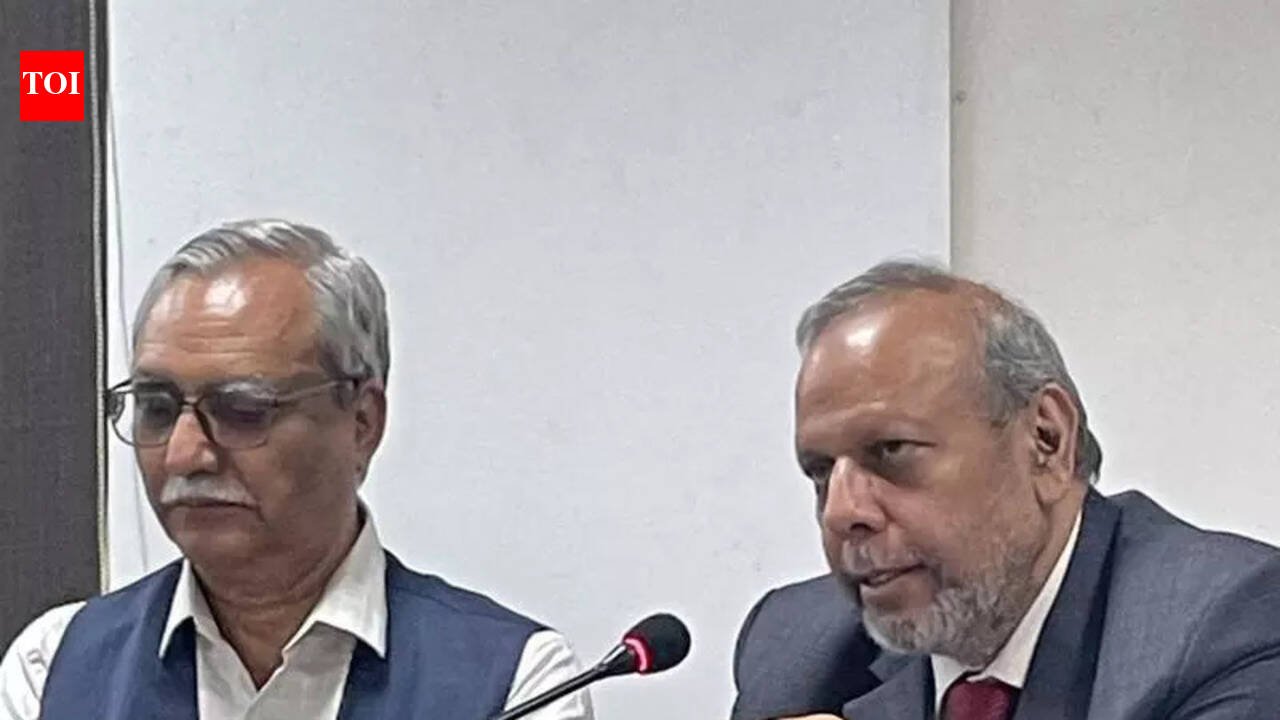
Surat: Chairman of the Economic Advisory Council to the Prime Minister of India, Prof S Mahendra Dev, highlighted various factors affecting India’s growth, challenges and development on Thursday, during his visit to the city. He spoke on, “Future of India: Challenges and Policies for Growth, Inclusive and Sustainable Development”, at the 31st I P Desai Memorial Lecture at the Centre for Social Studies.Sharing data on India’s share of global GDP in the past, Dev said, “If you see the past, India’s share of world GDP, for example in 1700, was 24%, and China’s 22%, and Japan, Germany, of course the US, were very low at that time. Our share declined drastically, partly because of the Industrial Revolution, British rule and then other factors.”On growth post-Independence, Dev said, “For three decades, 1950 to 1970, the growth rate was 3.5%. By the end of the 70s, many countries in East and Southeast Asia introduced economic reforms. But India introduced reforms only in 1991. So, in the last three decades post-reform, India’s average growth rate is 6% to 6.5% per annum. In 2013, India was in the fragile five countries — Brazil, India, Indonesia, South Africa and Turkey.”The lecture was chaired by Prof Kiran Pandya, provost of Sarvajanik University. At the lecture, Prof Dolly Sunny, director, CSS, shared details about I P Desai’s contribution to research and academics. The Centre for Social Studies (CSS) is a multidisciplinary social science research institute founded by the late Professor I P Desai in 1969.Describing growth potential and factors that affect growth, he added, “India is resilient and the fastest-growing economy in the world. India missed two chances since independence. First, in the three decades, there was no focus on labour-intensive manufacturing and human resources. Second, we were late by 15 years in liberalizing the economy compared to other countries.”Sharing concerns about global challenges, Dev said, “People now talk about Viksit Bharat 2047 goals. But what are the global challenges next? The latest is the twin shocks: geopolitical and tariff shocks. Now we also have the US-Israel versus Iran war, and it has an impact on our oil supply and other things.”“What are the drivers of growth?” asked Dev. “One is the investment rate, the second is exports. So, the investment rate, according to the new series of GDP, is presently 34%. But you need to increase the investment rate further, maybe to 36%, to get 7% to 8% growth. The govt is investing, but private sector investment is crucial.” He added, “I ask them why you are not investing. They say uncertainty. But I tell them you have been saying the same thing for the last decade, and you will say the same thing in the future. I think this is the right time to invest now.”According to Dev, exports make up around 20% of GDP, while 80% of the Indian economy is domestic demand. It is primarily driven by domestic consumption.“There is a middle-income trap. Suppose India becomes a middle-income country. Many of the World Development Reports said that of 101 middle-income economies in 1960, only 23 attained high-income status. So India has to be careful about this middle-income trap, because sometimes, once you go to middle income, the growth rate becomes lower,” Dev highlighted.
