



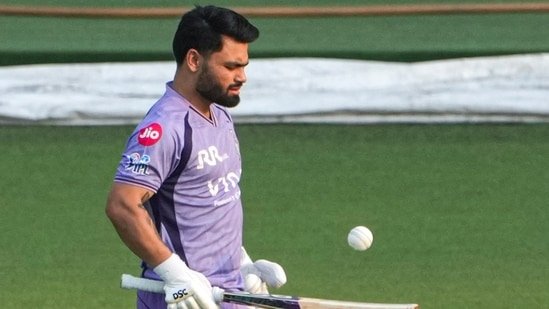
The announcement barely made headlines. Buried beneath the noise of Vaibhav Sooryavanshi’s much-anticipated selection, Shreyas Iyer‘s elevation to the captaincy and Suryakumar Yadav‘s omission was another, quieter development — Rinku Singh, part of India’s T20 World Cup-winning squad just months ago, had been left out of the next cycle of T20I assignments.
Rinku wasn’t rested. He wasn’t dropped because of poor form either. His omission appeared to be a consequence of circumstance — squeezed out by a batting order that simply no longer had room for him.
The Sooryavanshi effect
An extraordinary IPL 2026 season left the selection committee with little choice as questions of whether it was too early for Sooryavanshi took a backseat. Chief selector Ajit Agarkar used a telling word while explaining the teenager’s inclusion: “forced.”
A 776-run campaign, five individual awards and a chorus of former players and experts pushing for his selection, including Sachin Tendulkar, meant the call-up always felt inevitable.
But every addition requires a subtraction, and the ripple effects of that one decision reshaped India’s batting blueprint.
India carried three openers, Abhishek Sharma, Sanju Samson and Ishan Kishan, in their T20 World Cup squad earlier this year. Midway through the tournament, however, they tweaked their approach. Samson partnered Abhishek at the top, while Ishan moved to No. 3, a role in which he had also excelled during the lead-up to the ICC event. The reshuffle pushed Tilak Varma lower down the order, where his ability against pace made him a valuable finishing option.
The selectors have largely retained that template for the upcoming assignments against Ireland, England and at the Asian Games. With another opening option required, Sooryavanshi slotted naturally into the squad. Ishan, who also batted at No. 3 for Sunrisers Hyderabad during IPL 2026, is expected to continue in that role for India.
New captain Iyer is likely to occupy the No. 4 position, followed by Shivam Dube and Tilak. With Hardik Pandya unavailable, Nitish Kumar Reddy could also find a place in the XI, followed by the all-rounders and specialist bowlers.
By the time the selectors had assembled that structure, Rinku’s place had simply disappeared.
The brutal mathematics of a specialist batter
Rinku is a specialist batter operating in a team environment where head coach Gautam Gambhir’s preference for multi-dimensional cricketers and all-rounders is well established.
On paper, Tilak faces a similar challenge. But the selectors’ decision to hand him the vice-captaincy makes it abundantly clear which direction they see the future heading.
Unlike Tilak, who remains capable of moving through multiple batting positions despite being used as a finisher, Rinku increasingly found himself boxed into a single role. Since September last year, he batted predominantly at No. 7 or No. 8 for India and faced only 88 deliveries across nine innings.
Yet he still produced valuable contributions, including a match-winning 44 not out against New Zealand earlier this year and the memorable boundary off his very first ball to seal the Asia Cup final against Pakistan.
What ultimately did not work in his favour was IPL 2026.
Entrusted with the vice-captaincy at Kolkata Knight Riders and viewed as a potential future leader, Rinku scored 295 runs at a strike rate of 150, registering two half-centuries and an unbeaten 49. Those numbers were respectable without being extraordinary.
In most selection cycles, that might have been enough.
But in a year when a 15-year-old was smashing 776 runs and rewriting record books, respectable was no longer sufficient.
End of the road for Rinku?
Not quite. Rinku is only 28 and firmly in his prime. If injuries strike, if form dips elsewhere, or if the finisher’s role opens up again, he remains exactly the kind of proven, temperamentally strong match-winner India have historically struggled to produce.
The door is not closed. For now, it has simply swung shut.


