


India’s men have contested the final of an ICC tournament four times in the last two and a quarter years. Their record stands at an even 2-2, defeats in the title rounds of the World Test Championship in June 2023 and the 50-over World Cup final that same November, both to Australia, somewhat assuaged by victories against South Africa in the T20 World Cup decider in Bridgetown in June 2024 and against New Zealand in the Champions Trophy title tile in Dubai last March.
A little under 12 months after that stirring triumph in the desert, India are on the cusp of becoming the first three-time champions of the T20 World Cup. Standing between them and history are the perennial nice boys of world cricket, the eminently likeable bunch from New Zealand that has always punched above its weight in global competitions but never won a World Cup per se.
New Zealand have two major trophies in their cabinet – the ICC KnockOut Trophy (the original avatar of the Champions Trophy) in 2000 and the inaugural World Test Championship in 2021. In both those finals, they breezed past India. Mitchell Santher’s men, who have played wonderful cricket throughout the last four weeks, will believe they have the personnel to clinch their maiden World Cup, but they know that the magnitude of the task that confronts them is as massive as it can get.
India don’t have the fondest memories of the Narendra Modi Stadium, where more than a billion hearts shattered into a zillion pieces on a forgettable November night in 2023. India’s charge to the final of the 50-over World Cup had been exhilaratingly dominant as they crushed all before them, but the black-soil surface at the world’s largest cricket ground was the stage for their blackest night after Pat Cummins’ Australia ensured that Rohit Sharma and his team would endure the most painful of heartbreaks.
Among those who experienced that miserable night is Suryakumar Yadav, who didn’t have a tournament to remember even otherwise. Brought in because of Hardik Pandya’s injury that necessitated India to replace him with two players – Mohammed Shami took over the pace component and Suryakumar the batting responsibilities – the Mumbaikar mustered just 106 runs in seven innings. It’s no surprise that he hasn’t played an ODI since that fateful night when he was dismissed for 18.
While his 50-over career has run into an unyielding brick wall, Suryakumar’s journey has embarked on a remarkably upward graph in the last two and a half years. Within seven months of the World Cup heartbreak, Suryakumar wore a World Cup winner’s medal around his neck, in Bridgetown. His efforts with the bat were crucial but his greatest contribution was the extraordinary running catch in the final to evict David Miller in the last over with the trophy on the line. South Africa needed 16 when Pandya began the final over with Miller on strike; Suryakumar’s catch for the ages, under pressure, was the stuff of dreams.
Caught Suryakumar bowled Pandya would repeat itself once more that June afternoon with Kagiso Rabada caught on the boundary, just before India’s seven-run heist was formalised. No one knew at the time – not Suryakumar or Pandya, not even chairman of selectors Ajit Agarkar, one suspects – that these two men would hog the headlines for different reasons, a month on from that magical moment in the charming island of Barbados.
Pandya was Rohit’s deputy at the World Cup, and a vital presence because of his wonderful all-round skills, his sheer presence and his leadership abilities. When Rohit pulled the plug on his T20I career hours after holding the trophy aloft, Pandya was widely tipped to take over the captaincy until the key decision-making authorities conferred that honour on Suryakumar, ostensibly to ensure a leadership constancy that Pandya’s protesting body precluded but allegedly because the new head coach had his say. And way.
Suryakumar’s first stint as Mumbai captain had ended swiftly and dramatically. In 2014, he led his state to the 50-over Vijay Hazare Trophy but quit six games into the Ranji Trophy season, officially because of a poor run by his state, which languished in sixth place in its nine-team league even though the captain amassed 485 runs at 53.88. He was reprimanded by the Mumbai Cricket Association for using abusive language in the dressing room and on the field and had a public showdown with Shardul Thakur during the game against Madhya Pradesh. It wasn’t until 2022 that he was entrusted with the Mumbai leadership again on a permanent basis.
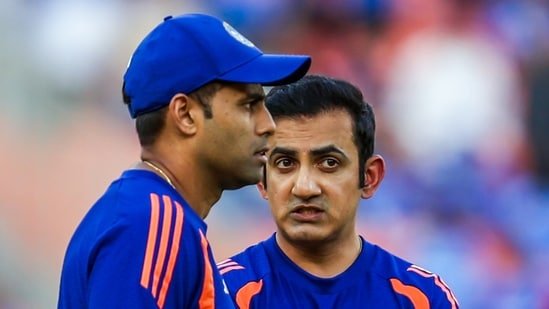
To say that he was a left-field choice to marshall the country’s fortunes will be a vast understatement but clearly, Gambhir and Agarkar, perhaps in that order, knew what they were doing. Suryakumar, now vastly more mature and bearing no resemblance to the stormy petrel of the past, has shown himself to be a master tactician and a grand man-manager, prerequisites to becoming and staying a successful captain and a respected leader. He has put into practice the lessons he has imbibed by watching Rohit from close quarters and added his own layers to the role. It has helped that for the most part, he has led from the front too – 2025 was a horrible exception but he had earned himself the long rope which he used adroitly to work his way back among the runs just before the start of the World Cup – and that India have climbed to and remained the No. 1 T20I side in the world for the longest of times.
Now, Suryakumar faces the most arduous test of his cricketing life, the most significant match of his career. Should he succeed in emulating Rohit, he will oversee the perfect trifecta – it will be India’s third T20 World Cup crown (unprecedented in the competition’s history), it will make them the first outfit to win the trophy on home soil and it will make them the first nation to successfully defend their crown. That might not completely eradicate the disaster of November 2023, but it sure will help, of that there is no doubt.
As much as for Suryakumar, the final will be great import to Gambhir too. Named Rahul Dravid’s successor in June 2024, the pugnacious former left-hander opener had massive shoes to fill. Dravid was smooth as silk, Gambhir is abrasive and aggressive, almost always angry even, and takes great offence to digs, mainly perceived than real. His coaching stint, now more than a year and a half old, has had several numbing lows offset by the Champions Trophy title and victory at the T20 Asia Cup last September. For him, a World Cup medal as a coach – he has two as a player, making the highest Indian score in victories in the 2007 T20 World Cup and the 50-over extravaganza in 2011 – will be sweet vindication of his methodologies that have attracted great scrutiny, if not sustained outright sanction. Insiders assert that there is no threat to his position and he doesn’t need the trophy to buy himself breathing room, but knowing Gambhir, he won’t even be thinking along these lines because even if his decision-making is addled, his heart has always been in the right place.
This is Jasprit Bumrah’s last chance to win a World Cup on his home patch. For Varun Chakravarthy, it’s his last chance ever to win a World Cup, one suspects. Suryakumar and Bumrah apart, there are many others who have worn the World Cup winner’s medal previously – Sanju Samson, Axar Patel, Mohammed Siraj, Ishan Kishan, Pandya, Arshdeep Singh, Kuldeep Yadav, Shivam Dube – but neither this lot nor first-time World Cuppers Abhishek Sharma, Varun Chakravarthy, Tilak Varma, Washington Sundar and Rinku Singh has experienced the high of winning at home, which Gambhir alone in this bunch has the privilege of.
New Zealand would love to make their fourth appearance in a World Cup final their first victorious one – “I wouldn’t mind breaking a few hearts to lift the trophy, for once,” Santner said, his smile taking the edge away – but even that desperation won’t match that of the Indians, players and fans alike, who are fearful of an Australian encore but optimistic of history being written. Super Sunday on the agenda, then.
