



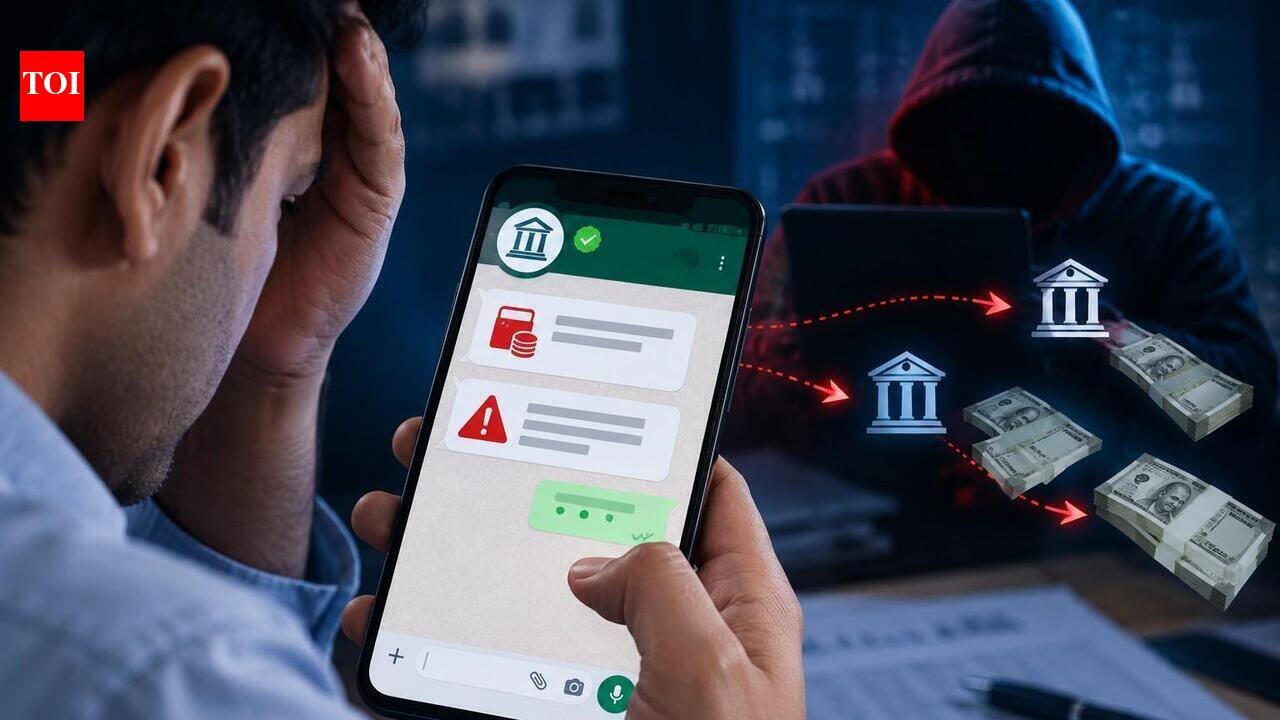
Lucknow: A chartered accountant allegedly lost ₹1.70 lakh from his ICICI Bank and IndusInd Bank accounts after responding to a WhatsApp message that falsely claimed ₹90,000 had been debited from his account, raising concerns over a suspected new social-engineering scam targeting bank customers.According to police, the victim received a WhatsApp message informing him that ₹90,000 had been withdrawn from his bank account. The message was followed by another instruction asking him to reply “No” if he had not authorised the transaction.Believing it to be a genuine security alert, the victim responded to the message. Soon afterwards, unauthorised transactions were allegedly carried out from his ICICI Bank and IndusInd Bank accounts, resulting in a combined loss of ₹1.70 lakh.Additional DCP (Crime) Kiran Yadav said the case has been reported and is being examined to determine how the fraud was executed. Investigators are looking into the sequence of events and the nature of the WhatsApp communication received by the victim.The incident is unusual because the victim reportedly did not click on any suspicious link, share a one time password (OTP), disclose banking credentials or install any remote-access application before the money was siphoned off. These actions are typically associated with online banking frauds and phishing scams.The case has sparked concerns about what could be a new form of WhatsApp-based social engineering. Fraudsters allegedly used a fake banking alert to create panic and then prompted the victim to interact with the message by sending a simple reply.According to information being examined by investigators, the fraudulent message may have contained a hidden malicious component designed to activate when the recipient interacted with it. The reported modus operandi suggests that replying “No” could have triggered the malicious payload, potentially helping fraudsters gain access to the device or facilitate unauthorised transactions.However, cybersecurity experts have cautioned against drawing conclusions before a detailed forensic investigation is completed. Experts point out that replying to a WhatsApp message alone does not ordinarily provide an external sender with complete control over a smartphone. They say the exact technical mechanism behind the incident can only be established after analysing the victim’s device, WhatsApp account activity and banking transaction records.Authorities have urged citizens not to respond to unsolicited messages claiming money has been debited from their accounts. Police advised victims of cyber fraud to immediately inform their bank and report the matter through the national cybercrime helpline, 1930, to improve the chances of recovering stolen funds.
