


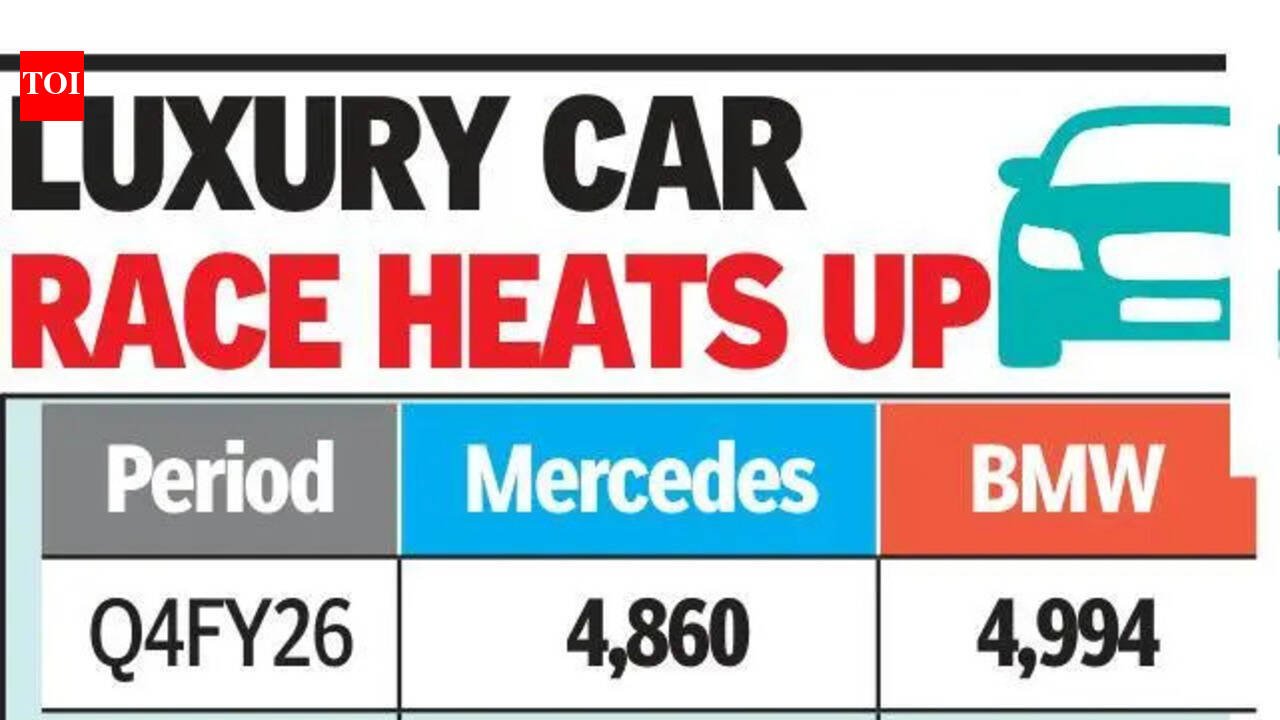
Chennai: After nearly 13 years, BMW has edged past fellow German rival Mercedes-Benz to top India’s luxury car market in the March quarter of FY26. However, for the full fiscal FY26, Mercedes-Benz retained its No. 1 position.BMW Group sold 4,944 luxury vehicles (including cars and SUVs) during Q4 FY26, while Mercedes-Benz sold about 4,860 units during the same period, according to data from the Vahan dashboard.The lead may be slender, but it marks the culmination of a steady climb by BMW, which has been narrowing the gap in recent years. BMW has more than doubled its annual volumes in about four years, helping it close in on Mercedes-Benz, while also witnessing strong traction in its premium electric cars, which accounted for a little over a fifth (21%) of its sales in Q4 FY26.More than a decade ago, BMW led the Indian luxury car market amid stiff competition from German rivals Mercedes-Benz and Audi. The last time BMW held the top position was in 2012, with sales of around 9,375 cars, followed by Audi in second place and Mercedes-Benz in third.Mercedes-Benz, however, embarked on an aggressive product expansion strategy starting in 2013—arguably its first major “product offensive” year—with a sharpened focus on new models, dealer network expansion, brand experience, and cost of ownership.While Audi snatched the No. 1 position from BMW in 2013, Mercedes-Benz moved up to second place, supported by its aggressive expansion. After narrowing the gap with Audi the following year, the three-pointed star surged to become India’s top luxury carmaker in 2015.Since then, Mercedes-Benz has remained largely unchallenged by its German rivals and other luxury car brands, retaining the No. 1 position over the past decade through a steady stream of product launches, network expansion, and customer-focused initiatives.Even as it has continued its product offensive strategy in India, Mercedes-Benz has increasingly focused on the high-end vehicle segment, driven by rising demand and a growing affluent customer base. For instance, its top-end vehicles now account for about a quarter of total volumes, with growth in the low double digits.It remains to be seen whether BMW can widen the gap and sustain its lead over Mercedes-Benz in the coming quarters.
