


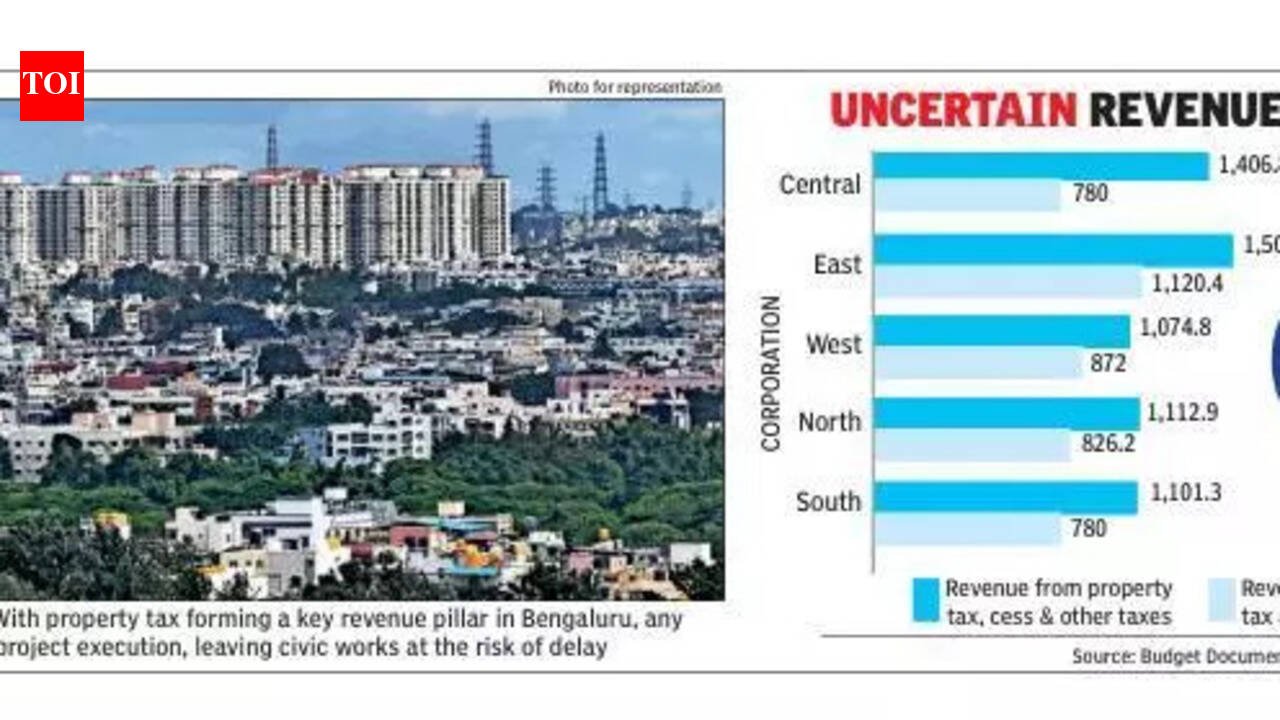
Bengaluru: The five civic corporations have proposed a combined budget outlay of Rs 20,216.5 crore for 2026-27, banking on Rs 4,378.6 crore from property tax collections. However, past trends show consistent shortfalls in meeting these targets, raising questions over how much of the planned spending will actually materialise.With property tax forming a key revenue pillar, any gap could directly affect project execution, leaving several civic works at risk of delay. Historically, the erstwhile BBMP struggled to meet its targets, often falling well short of projections. It was only in 2024-25 that collections crossed 90% of the target, offering a brief improvement. But the shortfall for the current fiscal is as high as 40% as of March 20.Data from the 2026-27 budgets shows varying degrees of reliance. In Bengaluru Central, property tax, cess and related receipts account for 41% of the total income, with Rs 780 crore expected purely from them. Bengaluru East has pegged this share at 39%, with the highest standalone property tax target of Rs 1,120.4 crore. Bengaluru West, while relatively less dependent at 23%, still expects Rs 872 crore from the collections.In Bengaluru North and South, the dependence is moderate but still significant. North estimates Rs 826.3 crore in property tax collections, with tax-related receipts forming 25.6% of its income, while South projects Rs 780 crore with a 28.8% share. Recovery measuresRecognising the risks, corporations are attempting to widen their revenue base. One of the key measures is the conversion of B-khata properties to A-khata, which is expected to bring more properties into the formal tax net. At the same time, there is a push to use technology for better assessment and enforcement.Bengaluru East is aiming to mobilise an additional Rs 150 crore through reforms such as a GIS-based property tax system integrated with utility agencies. Another Rs 100 crore is expected through identification of defaulters using AI-driven data systems. In Bengaluru Central, authorities are focusing on improving accessibility, with plans to introduce kiosk service centres for self-payment and to train staff in advanced survey techniques such as GPS and total station methods.In Bengaluru West, officials plan stricter recovery measures, including auctioning properties of defaulters and strengthening tracking systems. Commissioner KV Rajendra said the focus would be on improving the capacity of the revenue department to ensure timely assessment and collection. In Bengaluru South, officials remain cautious about recovery prospects, particularly with arrears. “Spending will be aligned with our revenue collection pattern. We are looking at all possible ways to increase our revenue,” said KN Ramesh, commissioner of Bengaluru South City Corporation. The corporation expects only about 50% recovery of arrears due to legal hurdles and is instead focusing on expanding the tax base through reassessment, apartment registrations, and B to A-khata conversions. “There is a scope to increase property tax collection by up to 40%,” Ramesh added.Bengaluru North is also relying on a mix of revenue sources, including Rs 97.1 crore from public sector undertakings and development charges, along with Rs 30.9 crore from tax revisions. Commissioner Pommala Sunil Kumar pointed out that non-tax revenues, particularly from town planning, have helped sustain finances. However, he cautioned that any delay in property tax collection would directly impact project execution and long-term planning.Despite these efforts, the underlying concern remains unchanged. Property tax continues to anchor civic finances, and any shortfall could have immediate consequences for infrastructure rollout. The pattern is clear: while budgets project steady growth and ambitious works, their delivery hinges on improving tax realisation.
