


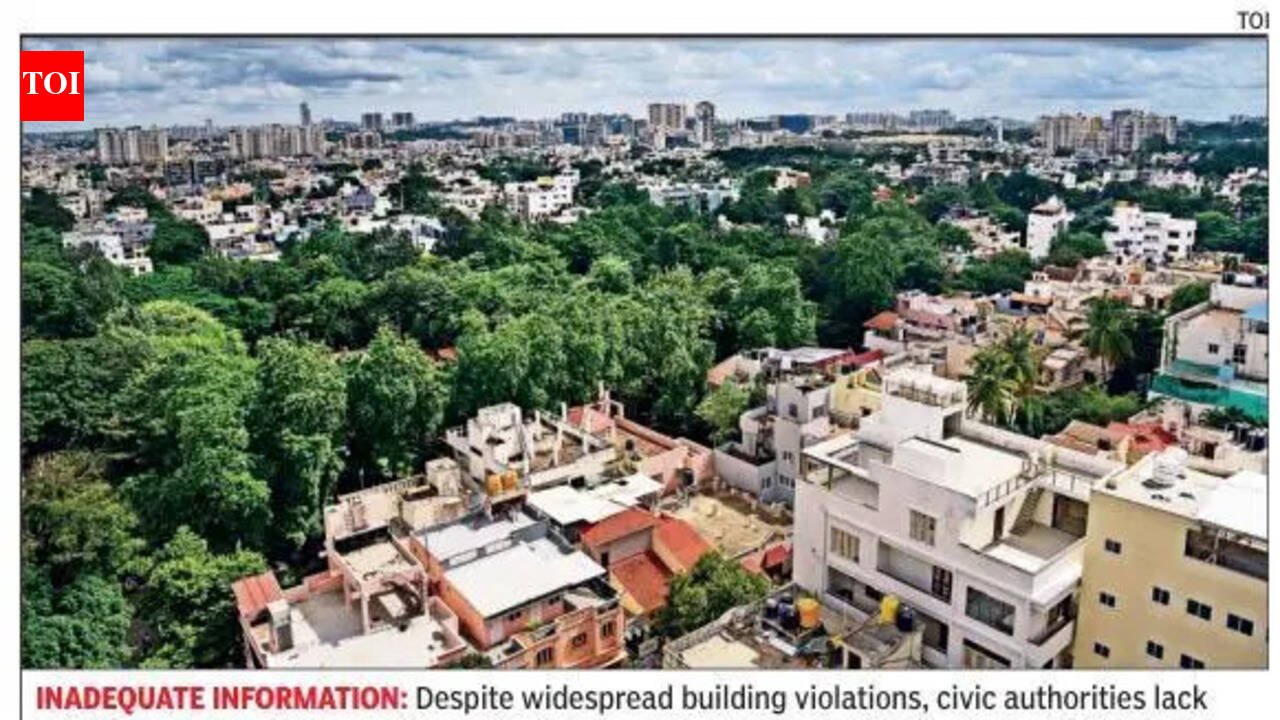
Bengaluru: The proposed draft amendment to the city’s building bylaws has triggered concerns that it could effectively legalise widespread construction violations. While Greater Bengaluru Authority (GBA) maintains that the move is not intended to mop up revenue, urban activists say the city’s civic corporations will see increased collections through revised compounding fees. The amendment to the 2003 bylaws proposes raising the permissible deviation limit from 5% to 15% across key parameters, including setbacks, floor area ratio (FAR), plot coverage, and building height. It also introduces a structured compounding fee system, allowing property owners to regularise such deviations by paying penalties and secure occupancy certificates (OCs) that were previously denied.Despite widespread violations on the ground, civic authorities lack reliable data on the scale of the problem. Neither the erstwhile Bruhat Bengaluru Mahanagara Palike (BBMP) nor GBA has conducted a comprehensive survey to identify buildings with violations. An official from the town planning department told TOI: “There are plans to digitise the issuance of notices to bring uniformity and maintain proper records, as the current manual system is inconsistent.“Planners flag problemsUrban planners have strongly opposed the proposal, warning that it may legitimise non-compliance instead of strengthening enforcement. One planner flagged legal concerns, cautioning that allowing up to 15% deviation could violate Supreme Court directives and revive elements of the controversial ‘Akrama Sakrama’ scheme. Critics argue that the draft undermines adherence to approved plans and bypasses the Metropolitan Planning Committee mandated under Article 243-ZE. R Rajagopalan, convener of the citizens’ collective Bengaluru Coalition, said, “Institutionalising a 15% deviation window without scientific study amounts to covering up repeated failures in enforcement and monitoring of unauthorised constructions, in violation of multiple Supreme Court directives mandating OCs for essential services.”Pravalika Sarvadevabhatla, of Jana Urban Space, said, “Raising the deviation limit to 15% redraws the line of illegality instead of fixing enforcement. With only about 4% of buildings receiving OCs, the real issue is compliance. Setbacks and FAR are essential for safety, as seen in the Carlton Towers fire. Relaxing them increases risk. “Focus on pending OCsOfficials, however, defended the move as a practical solution to a long-standing issue. One of the five city corporation commissioners said the amendment aims to clear the large backlog of OCs while offering relief for minor violations.“Most buildings in Bengaluru have some form of deviation. We cannot demolish all of them, nor do we have the capacity to do so. Allowing regularisation up to an additional 10% will benefit both property owners and the corporations,” he said, while adding that the move could also serve as a mechanism to mobilise funds. “On average, the corporation could earn up to Rs 3 lakh from each building that is yet to obtain OC.”Maheshwar Rao, chief commissioner, GBA, said: “There may be some increase in revenue through fees, but that is not the primary objective of this move. Given the standard plot sizes in Bengaluru, such as 30×40 or 40×60, a certain degree of deviation is inevitable. By allowing deviations of up to 15%, more property owners are likely to come forward and bring their buildings within the legal framework. However, in many cases, the deviations exceed 15%, so it remains to be seen how much practical benefit this provision will offer.“
