


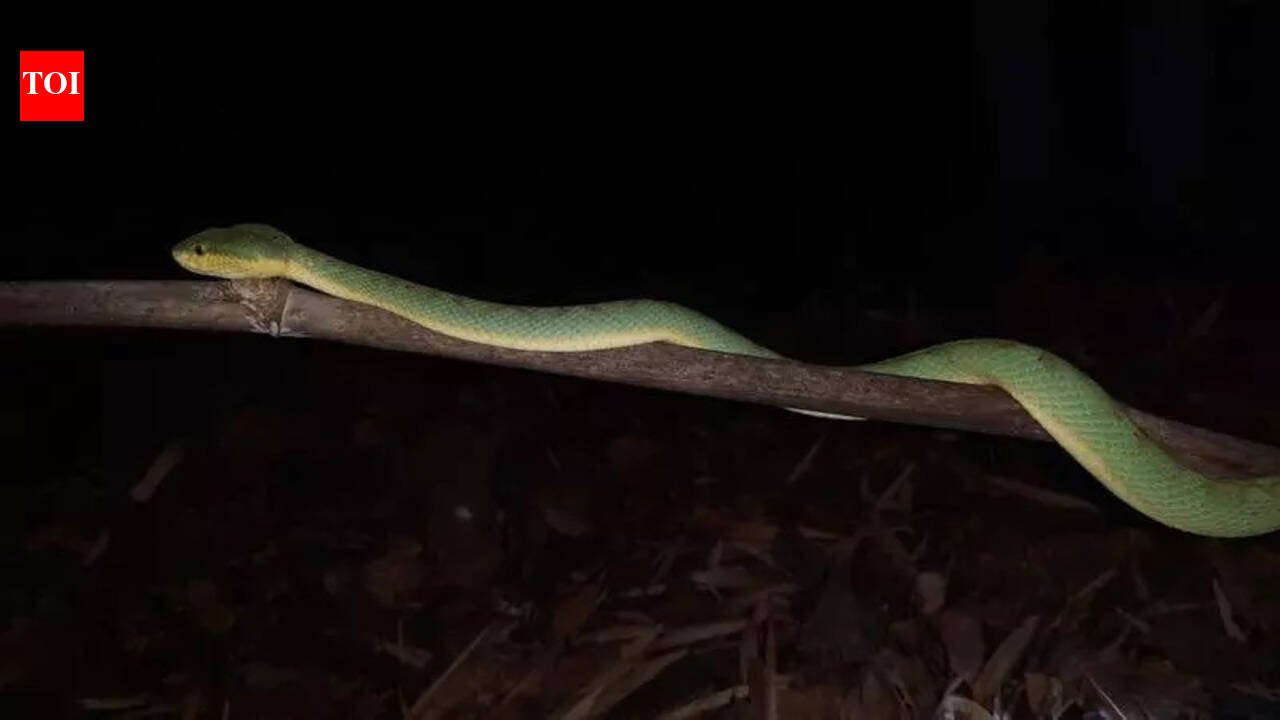
Surat: An study by a researcher from the city and a scholar from Germany has found that bamboo pit vipers (Trimeresurus gramineus) in Dang show strong fidelity to specific perches and rely on particular trees and shrubs for survival, pointing to a close ecological link between the species and its vegetation habitat. The study found that individual pit vipers return to the same perch even after being experimentally displaced, confirming site fidelity.The study, by Dikansh Parmar from Surat and Dr Hinrich Kaiser of the herpetology department at Leibniz Institute for the Analysis of Biodiversity Change (LIB) at Museum Koenig in Bonn, documents site fidelity in pit vipers. It was published in Discover Ecology. The study was carried out between Jan 2022 and May 2025. The researchers recorded 44 individual pit vipers during night surveys along forest roads. Most snakes were found 3-7 meters above the ground, perched on roots, shrubs or bamboo growing from cliff-like slopes.Parmar said, “The bamboo pit viper is the only pit viper species recorded in Gujarat, which represent the northernmost edge of its range. Despite its IUCN status as ‘of least concern’, the species faces growing threats, including habitat disturbance from road construction, erosion, vegetation clearing and illegal wildlife trade.”The researchers confirmed that these snakes reliably remained on their respective perches for a one-month period. Then they collected them, examined their scalation, sexed them, measured their length and photographed them before keeping them in captivity for 48 hours. Later, the snakes were released a few meters away from their previous location. The study found that all translocated snakes returned to the exact perches from which they were removed.“They kept going back,” Parmar said. “Even when we moved some snakes away during our observations, they returned to the exact same perch in 72 hours. This clearly shows that these snakes are tightly linked to specific microhabitats. During our previous studies on snakes, we have not noticed this behaviour.”The researchers explain that because the species is slow-moving, it prefers to use locations that offer effective camouflage, and it returns to the same spots because they provide a comparative survival advantage. In their natural habitat, these snakes are camouflaged among foliage and blend into bamboo thickets and vegetation.The snakes were not found during the daytime, as they emerged from subterranean shelters just after dusk, while the encounter frequency was markedly reduced during monsoons.Dr Kaiser said, “This study reveals how closely certain species are tied to very specific microhabitats. Protecting these roots, shrubs and bamboo is essential not just for the pit vipers, but for the broader ecological balance of these forests. Even small roadside vegetation can be critical for survival.”“These snakes return to the same perches night after night, showing incredible loyalty to their home trees and shrubs,” Parmar added. “It’s a vivid reminder that protecting wildlife sometimes begins with protecting a single root or tree.”The study, titled “Hanging in the Balance: An Ecological and Conservation Assessment Reveals Growing Threats to the Bamboo Pit Viper in the Dangs Forest of Gujarat, India,” offers a detailed account of site fidelity in pit vipers and highlights the vital interdependence between the snakes and the vegetation they rely upon.
