


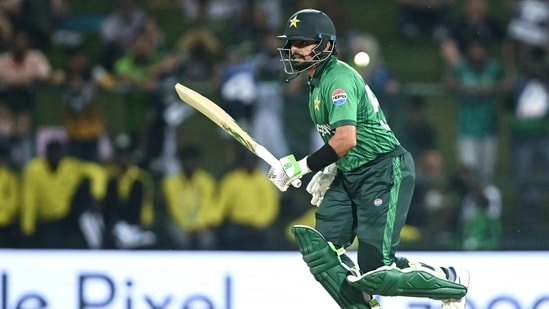
Throughout the T20 World Cup 2026 campaign, in which Pakistan eventually crashed out in the Super 8s stage, one consistent storyline unfolded. Several former Pakistan players, such as Shahid Afridi, Mohammad Yousuf, Ahmed Shehzad, Mohammad Hafeez and Umar Gul, vouched for having more youngsters in the team and looking past players who have been part of the setup for 4-5 years, regularly failing to land trophies. The thought process was that the results would change overnight and Pakistan cricket would reclaim its long-lost glory.
However, this rhetoric was given a hard reality check on Sunday when Pakistan lost the ODI series to Bangladesh. Babar Azam, Fakhar Zaman, and Salman Mirza were all ignored. No one really knows whether Babar was dropped, rested, or injured. Head coach Mike Hesson and captain Shaheen Afridi said Babar was given a break; chief selector Aaqib Javed revealed that Babar and Fakhar sustained injuries during the World Cup, and an inquiry has been ordered into their suspicious fitness concerns.
Pakistan’s lack of depth is evident in its squad for the Bangladesh series, which includes six uncapped players: Abdul Samad, Maaz Sadaqat, Muhammad Ghazi Ghori, Saad Masood, Sahibzada Farhan, and Shamyl Hussain. The opportunity was ripe for these young stars to prove their mettle on the big stage and put Babar and Rizwan under pressure. But with the series now done and dusted, it’s fair to say that the problem within Pakistan cricket is not Babar, Shaheen or Mohammad Rizwan. Rather, it’s the death of promising talent.
Unlike India, Pakistan are not spoilt for choices, and hence there is a constant need to make everyone an all-format player. This is exactly why Babar continues to remain in the T20 scheme of things despite his lacklustre strike rate of 128.02 across 145 matches for Pakistan.
Fair enough, the youngsters were just handed three matches, and it’s too small a sample size to pass a sweeping judgment. However, compared to guys like Vaibhav Sooryavanshi, Cooper Connolly, and Finn Allen, Pakistan’s players flatter to deceive.
The Pakistan cricket team, in its current structure, tends to make players feel insecure, a claim backed by several former cricketers. There is constant scrutiny, and even a single rash shot or a bad ball can turn a hero into a zero. As a result, players often feel compelled to play for their places, prioritising their own runs or wickets over the team’s larger cause.
How did the young boys perform against Bangladesh?
In the first ODI, Pakistan were bowled out for 114, with Bangladesh chasing it down with more than 34 overs to spare. Sadaqat Ali, Shamyl Hussain, Hussain Talat and Abdul Samad together contributed just 26 runs to Pakistan’s total. Over the course of the series, none of the youngsters managed to make a significant impact. Only Sadaqat showed some promise, producing a complete all-round performance in the second ODI by scoring 75 and taking three wickets.
In the decider, Pakistan failed to chase 291. Salman Ali Agha’s century brought them close; otherwise, Pakistan might have suffered a far more comprehensive defeat.
Out of the six uncapped players, Abdul Samad, Maaz Sadaqat, Saad Masood and Shamyl Hussain had recently represented the Shaheens against the England Lions in Abu Dhabi. While these youngsters have featured for the development side, they still lack experience and have not gone through a significant grind in domestic cricket.
For instance, Sadaqat, 20, had played just 31 List-A matches and 25 first-class games before making his Pakistan ODI debut. Saad Masood, meanwhile, entered the national squad by virtue of playing only four List-A matches. Can you imagine a player breaking into the Indian team after playing only four List-A games? It would be impossible given the system in place.
Lack of domestic structure
Pakistan cricket has been reduced to a game of musical chairs. Coaches keep changing, and the captaincy has moved from one player to another. Babar to Shaheen, back to Babar, and then to Mohammad Rizwan – that is how the ODI captaincy has swung between these three ever since the 2023 World Cup.
In India, the structure of domestic cricket is almost cast in stone. Changes are rare. Tweaks have been made to the Duleep Trophy format, but most competitions have been conducted in a similar fashion for decades. In contrast, almost every time a new chief takes over at the Pakistan Cricket Board, a fresh domestic format is introduced, often undoing the work done previously.
The less said about planning, the better. Ahead of a T20 World Cup, players end up playing ODIs; before an ODI World Cup, they play T20Is. One could go on and on about the problems, with solutions nowhere in sight.
To add to the concerns, Pakistan seems increasingly obsessed with India, often trying to upstage them in the race for administrative control of the sport. Yet Pakistan cricket’s future would be better served by focusing on its own issues – and there are plenty – rather than worrying about India. Having control of a trophy in a boardroom locker means little when you have already lost it in front of the world.
