


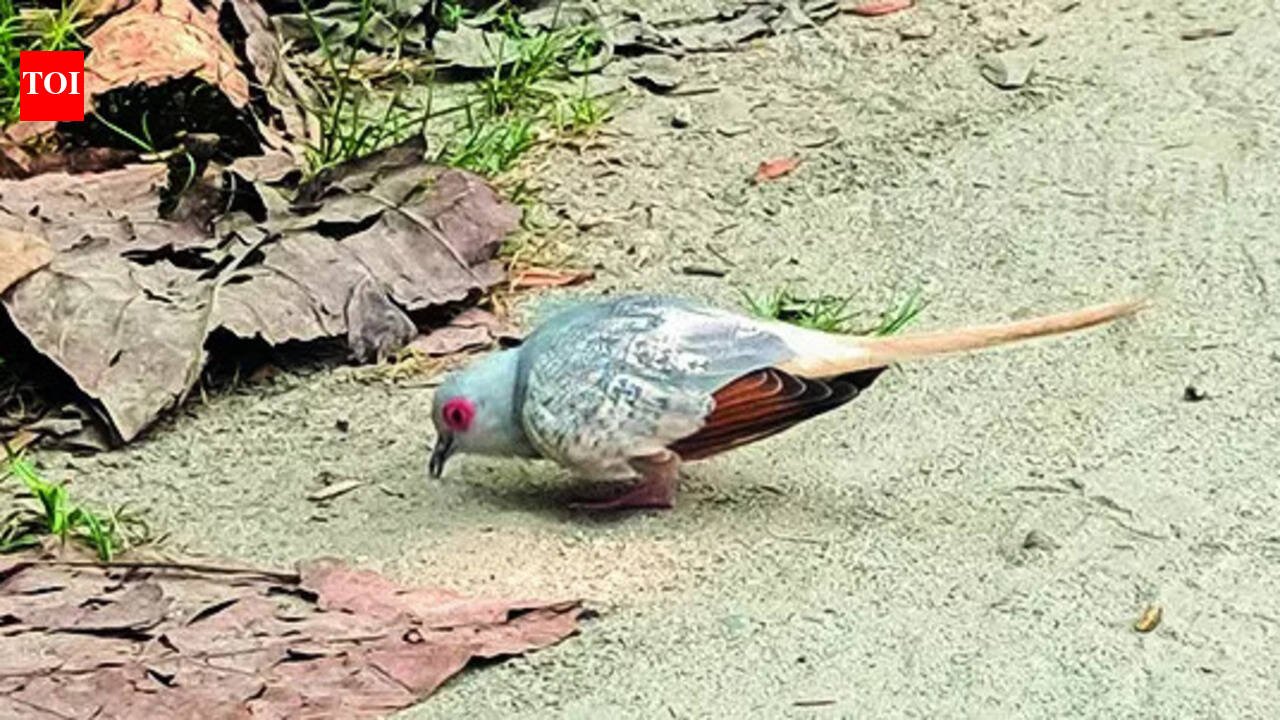
Guwahati: Researchers have documented the first-ever record of the Australian endemic diamond dove in Assam, after spotting the species inside Sikhna Jwhwlao National Park in Kokrajhar district.“This delicate dove is characterized by a long, pointed tail and sexually dimorphic plumage. Males are pale blue-grey with spotted scapulars, a chestnut wing panel, white underparts, black-and-white tail, scarlet iris, and pink legs, while females are browner with a duller orbital ring, and juveniles are overall duller with fine barring, fewer spots, a lighter bill, and paler eyes and legs,” the journal states.The finding was published in the latest issue of the ‘Journal of Threatened Texa’. The study was conducted by Bibhash Sarkar, Bijay Basfore, Anjana Singha Naorem, and Leons Mathew Abraham.“The two birds were observed in the month of April of 2025, in the Runikhata range of the national park. The birds were seen foraging on the ground approximately 200 metres from a dried up stream,” said Bijay Basfore, one of the study’s authors.Basfore said the diamond dove, listed as ‘least concern’ by the International Union for Conservation of Nature (IUCN), is a resident species in Australia and does not naturally occur in southern Asia.“The birds presence in the state is best explained as a human-mediated introduction. The species is extensively bred and traded in the global cagebird industry due to its small size, ease of maintenance, and ornamental plumage. Thus, the most plausible explanation for our record is that these individuals were escapees or intentional releases from captivity,” he also added.He warned that repeated introductions of exotic birds can pose ecological risks even if many escapees fail to establish breeding populations, including competition with native species, ecosystem disruption, disease introduction, and the potential to become invasive under favourable conditions.The authors called for closer monitoring and systematic reporting of exotic bird sightings in India, and urged stricter regulation and licensing of the exotic bird trade to prevent accidental or deliberate releases into the wild.
