
Present deployment of the Assam Rifles has proven to be a force multiplier in enhancing the security grid across Jammu and Kashmir. With battle-hardened troops trained extensively in guerrilla warfare and counter-insurgency tactics, Sentinels of the Northeast has proved their mettle through successful valley operations, producing tangible results and significantly weakening militant networks across the region. Popularly known as the “Friends of the Hill People”, the Assam Rifles is India’s oldest and most decorated paramilitary force.
Established in 1835 by the Britishers as the Cachar Levy, Assam Rifles was raised to safeguard tea plantations, uphold law and order, and curb tribal raids in North-East India. Having participated in both World Wars and with vast experience in combating insurgency in India’s North East since Independence, Assam Rifles has returned to Jammu and Kashmir for renewed counter-terrorism duties.
For over three decades now, Pakistan is providing tacit support to terrorism in Jammu & Kashmir and has consistently tried to keep the Kashmir cauldron boiling on international platforms through misleading narratives of genocide and human rights violations in Kashmir by security agencies. The truth, however, is polar opposite. Pakistan’s intelligence wing, Inter Services Intelligence (ISI), has employed asymmetric warfare strategy of “Bleed India with a thousand cuts” to destabilize the region.
The insurgency in Kashmir is widely traced back to the 1980s, particularly to Pakistan’s ISI-led Operation Tupac and the rigged state assembly elections of 1987, which are seen as essential origins of the terrorism in Kashmir. To counter, Indian Army launched Operation Rakshak in 1990 and raised the Rashtriya Rifles in October 1990 as a specialized counter-terrorism force.
While the Rashtriya Rifles was diligently executing counter-terrorism operations in keeping with its motto of ‘Dridhta & Veerta’, the Kargil conflict erupted, exposing serious gaps in India’s intelligence and border defence, leading to the Kargil Review Committee’s call for major security reforms and a “thorough review of the national security system in its entirety”. One of the key reforms, “One Border, One Force” was aimed at assigning a dedicated force to each border for better accountability and efficiency.
In line with this policy, the Assam Rifles was entrusted with the responsibility of guarding the Indo ‑ Myanmar border. Since its deployment, Assam Rifles has ensured stability in the region by containing insurgency, border management and local engagement, and civic initiatives fostering peace and development in northeast region.
The Assam Rifles is no stranger to Jammu & Kashmir, having first operated here in 90s when both the Rashtriya Rifles and terrorism in Kashmir were still in their infancy. A total of 08 battalions of Assam Rifles were deployed from April 1990 to January 1998 to assist the security apparatus. Among the notable successful operations was an operation carried out by the 26 Assam Rifles in September 1990, during which one terrorist was killed, 90 were apprehended and 142 sophisticated weapons were recovered.
Another most successful counter-insurgency operation ever conducted by any security force was Operation Dudhi, executed by 7 Assam Rifles on 3rd May 1991, in which 72 militants were killed and 13 captured. The history of Assam Rifles during its previous stint in Jammu & Kashmir is replete with such examples. During those eight years, Assam Rifles units conducted extensive arms and ammunition recoveries, neutralized hundreds of terrorists, and provided crucial support to local communities.
After twenty years, the force has been once again operationally inducted to purge terrorism & plug gaps in the region’s overall security matrix. Assam Rifles is assigned for all tasks from counter terrorism operations to civic action programmes, fostering trust and cooperation among local populations.
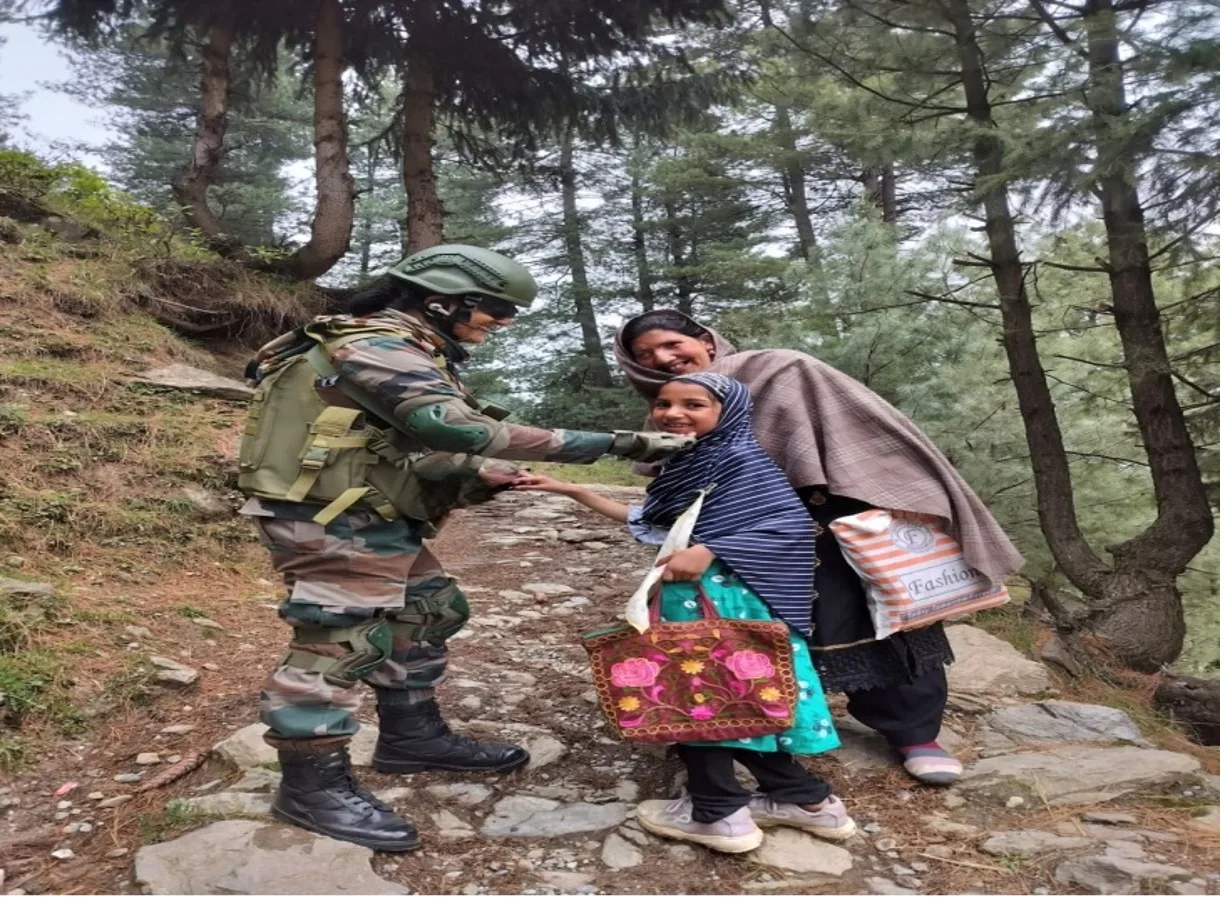
Additionally, with uniformed women serving alongside their male counterparts, the riflewomen of the Assam Rifles are strengthening the force while inspiring confidence among Kashmiri women. By breaking traditional barriers and acting as role models, they have encouraged local women to step forward & enter fields once considered inaccessible.
Moreover through my daily interactions with local residents, I have observed a growing trust in the security forces, with people increasingly willing to engage, communicate, and cooperate. Counter-terrorism operations will persist until the final terrorist is eliminated, paving the way for Kashmir to once again become a true “Paradise on earth.”
Achieving this vision requires every Kashmiri to unite, work collectively, and contribute to rebuilding the region. And as the famous Kashmiri poet Nadim has wrote “Me Chhum Aash Paghich, pagah shole duniya” (I am hopeful for tomorrow, tomorrow the world will shine).Like many others, I too long to see a progressive, peaceful, and developed Kashmir where everyone live in harmony.
(As serving defence personnel, the author brings a unique perspective to his writing, drawing from his experiences and insights gained through service. His articles often reflect his dedication to motherland and passion for inspiring others. Readers can reach the writer at: [email protected])
