


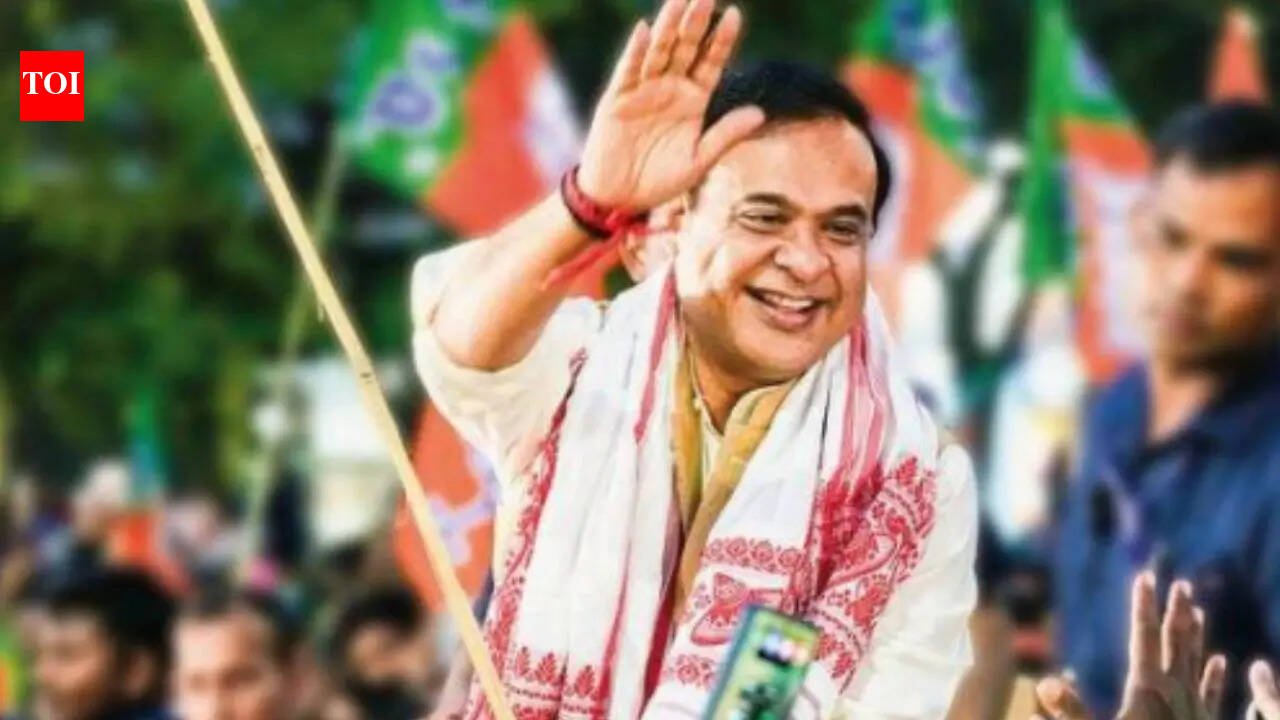
GUWAHATI: This Feb, Assam BJP uploaded a video that drew immediate protest from opposition parties, triggered outrage in sections of civil society, and led to petitions being filed in Supreme Court and Gauhati high court.The video – an edit that combined a photo of CM Himanta Biswa Sarma taking aim with an air pistol at a sports complex with a bullet moving in the direction of a man wearing a skull cap – was later taken down.There would, however, be no clarification or climbdown from a CM who has built his political fortunes around removing undocumented Bangladeshi immigrants – who are referred to locally as “miyas” – from Assam. In Jan, he told the media he and BJP are “openly against miyas” and that his job is “to make miyas suffer” so they eventually leave.Last week, replying to questions on whether he would move to national politics, Sarma said it would not be before “I break the backbones of those I’ve taught a lesson to”, again referring to Bangladesh-origin migrants.As he seeks a second term as CM, the anti-miya tirade, the no-holds-barred approach, the strong welfare pitch, and the jati, mati, bheti (identity, land, homeland) pitch have all become building blocks for ‘brand Himanta’.There aren’t many BJP CMs whose personal brand transcends the party’s. Yogi Adityanath can claim to be an exception. Sarma is out to prove he is, too. As a veteran northeast strategist, Sarma has helped shape many a poll victory for Congress, his earlier party, and BJP. But this is the first election where ‘brand Himanta’ is front and centre, the CM casting himself as master of welfare politics and champion of Assamese identity. Unlike earlier elections where BJP leaned heavily on PM Narendra Modi, it’s Sarma who is leading the charge for all NDA parties like AGP, BPF and UPPL and has taken up the responsibility of ensuring the coalition’s reach extends deep into tribal and indigenous constituencies.That’s because for Sarma, this isn’t just an election to return to office but to win bigger than ever. He has promised to take BJP, which won 60 seats in the last two polls, past the majority mark of 64 by itself. Of Assam’s 126 assembly seats, he has publicly predicted, 103 will be won by indigenous candidates.The identity pitchSince he took office, his govt’s eviction drives, targeting encroachers on forest and state-owned lands, have largely affected Muslims of Bangladeshi origin. Simultaneously, land pattas were distributed to indigenous landless families and descendants of tea garden workers. At the same time, Sarma has lost no opportunity to point out that there are 50 lakh bighas of encroached land holdings in Assam, of which only 1.5 lakh bighas have been cleared.Sarma has also sharpened his attack on Congress, ridiculing its principal election slogan of building a ‘Notun Bor Axom (New Greater Assam)’ and accusing APCC chief Gaurav Gogoi of attempting to redefine the state’s cultural identity by suggesting indigenous Assamese people should live alongside Bangladeshi-origin people. Central to Sarma’s campaign narrative is his prediction that Assam’s Muslim population will rise to 40%, up from 34% in the 2011 Census, by 2027.Author and social commentator Mayur Bora says, “Sarma’s brand of politics has two sides. One is his immense ability to work hard. We have seen infrastructure development on a scale not witnessed in decades, and that deserves appreciation. The other side is his attempt to become Hindutva’s poster boy, bringing a divisive streak unprecedented in Assam, the land of Sankaradeva and Ajan Fakir. That is deeply sad and unfortunate. This has polluted the political environment. The mentality it fosters may outlive the individual, leaving behind sharper divides between Hindus and Muslims.”The welfare pitchSarma’s welfare plan has been carefully laid out. Financial aid for women, youth empowerment programmes, scholarships for students, support for entrepreneurs, one-time assistance for tea garden workers and funds for namghars (prayer houses) – it touches every segment of society. The line Sarma has taken is that these schemes are rooted in compassion, not politics. “These are not freebies,” he has said.The optics of Sarma’s campaign, too, are well planned. In Lakhimpur, a woman kissing him on the cheek during a rally set the tone for visuals of the CM being hugged and showered with affection by women supporters. Women, who form nearly 50% of the state’s electorate, have emerged as Sarma’s most loyal constituency, thanks to cash transfers, scholarships, empowerment schemes, and recruitment drives that opened do-ors for women from poor families.To express his gratitude to them, Sarma says, “From mothers to children and elders, everyone sh-owers me with love and affection… it is only through years of penance that one receives such love.”On social media, Sarma is the most followed CM in India, and the “mama” (uncle) tag has become part of his political branding. It serves another purpose – a nickname that softens his strongman image.Seeking to retain the Jalukbari seat for the sixth time in a row, Sarma says this time 85-90% of the electorate will vote for him. Pre-delimitation, Jalukbari was a mixed urban rural constituency where Sarma’s dominance was already unchallenged, culminating in a 2021 landslide win with 77% vote share. After delimitation, Jalukbari has added 40,000 more voters and is now more urban-suburban in profile with central Guwahati wards shifted out and new peri-urban areas added. It’s a change that is seen to favour Sarma. And across Assam, a change that Sarma sees as favouring BJP.
