
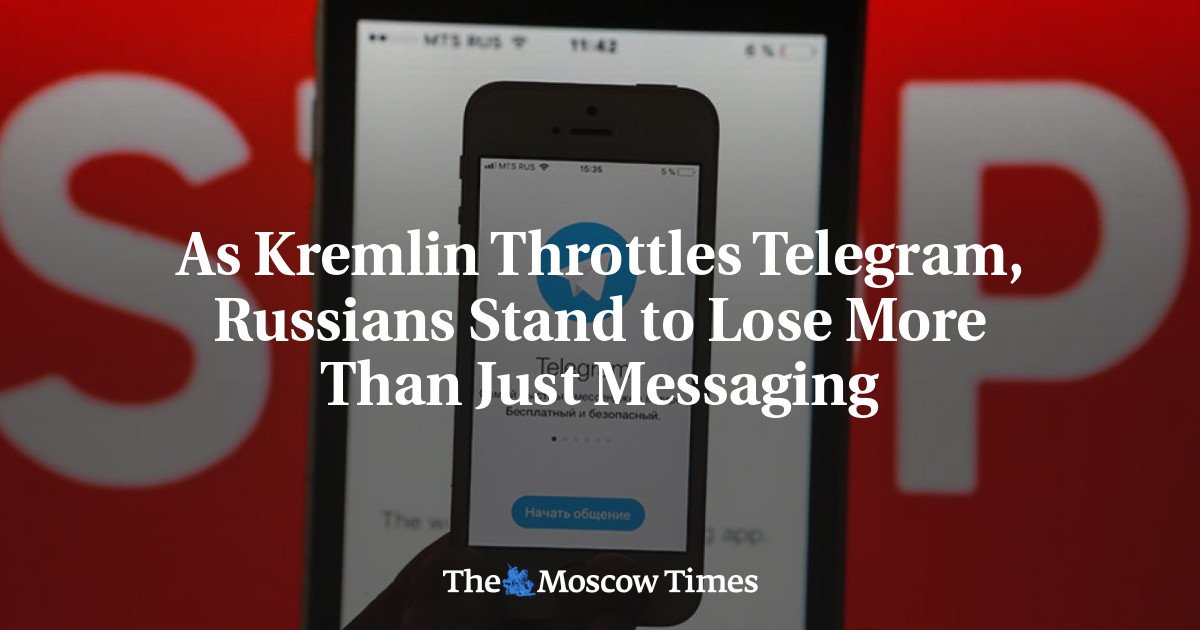
Russian state media regulator Roskomnadzor has tightened its restrictions on popular messaging app Telegram for allegedly failing to combat fraud and protect user data.
For its 93.6 million users in Russia — over 60% of the country’s population — the loss of Telegram would mean much more than the loss of a messaging app. In many ways, it is the kind of all-in-one digital platform that the Kremlin envisions state-backed messenger Max becoming.
Beyond its function as a messaging app, Telegram is a news platform, a way for officials and state agencies to interact with constituents, a microblogging platform, a frontline communications tool in the Ukraine war, a way for NGOs and news outlets to receive tips and even a business tool.
Telegram is “the reason I can sometimes have an exorbitant amount of screentime,” one Russian user told The Moscow Times. “If there is an app that I open first thing after I wake up, it will be Telegram. I get notifications from it all the f***ing time.”
News
Almost every major news outlet or website in Russia has a Telegram channel, and some outlets publish on Telegram exclusively. Many channels have hundreds of thousands or even millions of followers, as well as dedicated staff managing them.
For many, Telegram is a one-stop shop for news. Users can curate folders of news channels, turn notifications on and off and read the news from a variety of sources without the added friction of visiting multiple websites.
And because posts are displayed in chronological order rather than ranked by an algorithm, users can follow breaking news in real time as events unfold.
Exiled news outlet Meduza has around 1.1 million Telegram followers, while TV Rain and the BBC’s Russian service have 442,000 and 387,000 followers, respectively.
News outlets like Ostorozhno Novosti, Mash, Baza, Kontekst, Astra and many others publish primarily on Telegram. Some operate inside Russia, others from abroad. Some are independent, while others are seen as close to the state or security services. Many command audiences that rival or exceed those of traditional state or independent media.
And then there are the state-run and legacy media outlets like RIA Novosti, TASS, RBC, Interfax and Kommersant, which all have large and active Telegram channels.
Direct communication
Officials at all levels use Telegram to issue statements and communicate with constituents, from regional governors and ministries to exiled opposition politicians.
In the Belgorod region, which has faced constant power outages and disruptions to municipal services due to Ukrainian strikes in recent months, regional officials like Governor Vyachelsav Gladkov use Telegram to provide updates.
The Defense Ministry posts frequent updates and footage from the war in Ukraine, interviews with soldiers and more to its more than 600,000 followers.
For Russian opposition politicians in exile, Telegram remains one of the few ways to reach supporters inside Russia and organize demonstrations worldwide.
Ukrainian President Volodymyr Zelensky also posts regularly to Telegram, and posted an emotional appeal to the Russian public at the start of the full-scale invasion in 2022.
For one person from Lipetsk in southern Russia, Telegram had been “the only place where both pro-government and opposition sources were available at the same time.”
“And until the very last moment, it was the only place where opposition sources were available without a VPN,” they said.
On the front lines
Russian troops, and to a lesser extent Ukrainian troops, use Telegram extensively for tactical and operational communication.
According to Meduza, many divisions of the Russian Armed Forces use Telegram chats to organize logistics and fundraising, download maps and communicate externally.
It’s this external communication that makes the app so hard to replace.
“The app has enabled a sprawling network of interaction between frontline troops and pro-Kremlin ‘war correspondents.’ The soldiers provide the bloggers with exclusive content (including combat videos), which the bloggers then use to grow their popularity and convert it into fundraising for military equipment and uniforms,” writes Meduza.
“Within a day after Telegram’s slowdown, I received about five videos from anonymous military personnel complaining that they’re completely screwed without Telegram,” popular pro-war blogger Fighterbomber wrote in response to this week’s Telegram throttling.
Alexander Kots, another pro-war blogger, described Telegram as a “powerful tool” in what he calls the “information war” — the ability to disseminate the Russian perspective to audiences abroad — and argued that Russian operatives would have a much harder time recruiting assets to carry out acts of espionage or sabotage in Ukraine using Max.
Despite the criticism from the pro-war blogging community, Kremlin spokesman Dmitry Peskov told reporters Wednesday it was difficult to “imagine that frontline communications are maintained via Telegram or some other messenger.”
Microblogging
Telegram is also home to a vast ecosystem of bloggers covering everything from fashion to sports, travel, history, anthropology and more.
Much like X or Bluesky, Telegram allows creators to post short updates, articles, links and multimedia content. But its far higher character limit offers more freedom.
One graphic designer from Moscow told The Moscow Times that she uses Telegram to run her own channels, follow her friends’ channels and stay up-to-date with trends in her industry.
Another user living in Moscow said she has created Telegram folders for travel, culture and work, and uses the app to track events and discover things to do in her city.
Work
Several Russians told The Moscow Times that they used Telegram to talk to their colleagues and clients at work. In some cases, it is their primary workplace communication tool.
“It is definitely not ideal; normal companies use separate software. But if it is a small project, there is nothing you can do about it, you have to communicate via Telegram,” one person said.
For some, it’s also an indispensable tool to run their business. Many businesses run channels to promote their businesses and connect with clients.
But while the government moves to tighten the screws on Telegram, Russians who spoke to The Moscow Times appeared fairly unbothered.
“Everyone uses Telegram. Almost everyone has a VPN,” the man from Lipetsk said. “After YouTube was blocked [in 2024], there was a turning point when everyone had already bought a VPN and stopped caring about further blockings.”
Mack Tubridy contributed reporting.
A Message from The Moscow Times:
Dear readers,
We are facing unprecedented challenges. Russia’s Prosecutor General’s Office has designated The Moscow Times as an “undesirable” organization, criminalizing our work and putting our staff at risk of prosecution. This follows our earlier unjust labeling as a “foreign agent.”
These actions are direct attempts to silence independent journalism in Russia. The authorities claim our work “discredits the decisions of the Russian leadership.” We see things differently: we strive to provide accurate, unbiased reporting on Russia.
We, the journalists of The Moscow Times, refuse to be silenced. But to continue our work, we need your help.
Your support, no matter how small, makes a world of difference. If you can, please support us monthly starting from just $2. It’s quick to set up, and every contribution makes a significant impact.
By supporting The Moscow Times, you’re defending open, independent journalism in the face of repression. Thank you for standing with us.
Continue
Not ready to support today?
Remind me later.
×
Remind me next month
Thank you! Your reminder is set.
