


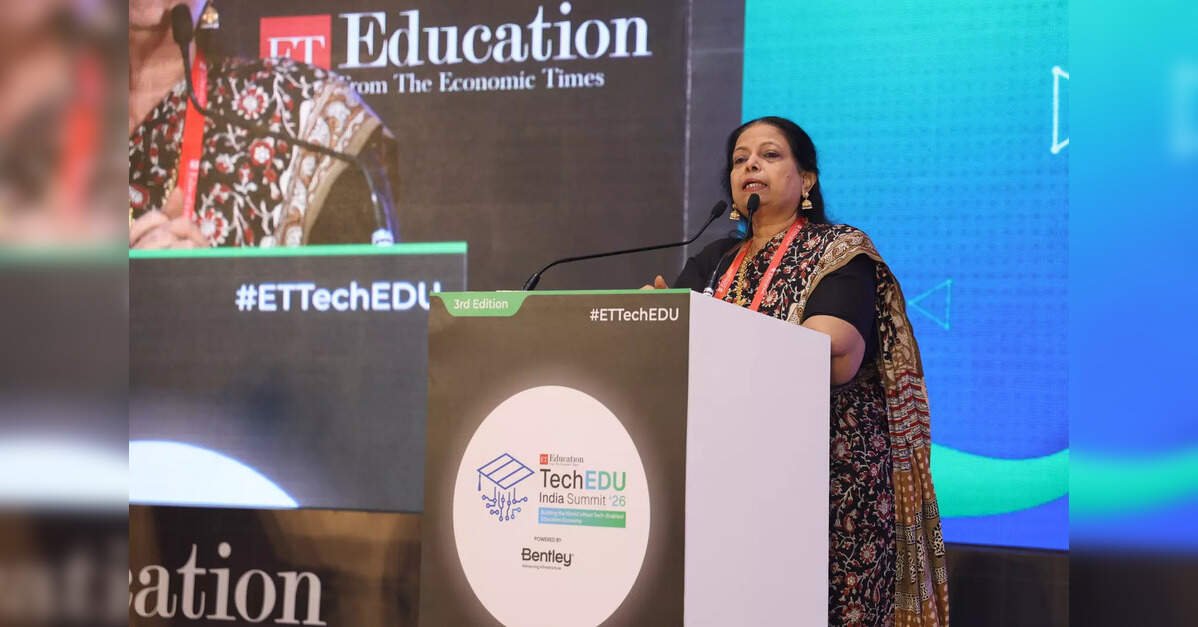
For Aruna Prem Bhalla, education has never been merely a profession—it has been a lifelong journey shaped by service, community and institutional transformation. Having spent over three decades within the ecosystem of Kendriya Vidyalaya Sangathan (KVS)—as a student, teacher, Assistant Commissioner and later Deputy Commissioner—Bhalla’s career reflects the evolution of India’s school education landscape.
Speaking at the TechEdu India Summit 2026, she shared insights from her extensive experience in the central school system while reflecting on how technology is gradually reshaping learning across the country.
“Kendriya Vidyalaya has always been like a family to me,” she remarked, recalling how the institution brings together students and teachers from diverse linguistic and cultural backgrounds across India.
Operating under the Ministry of Education, Kendriya Vidyalayas have expanded into one of the country’s most extensive public school networks. Today, the system serves over 1.3 million students across more than a thousand schools in India and abroad, including campuses in cities such as Kathmandu, Moscow and Tehran.
Early experiments with technology in classrooms
Bhalla highlighted that long before digital learning became mainstream during the COVID-19 pandemic, the KVS network had already begun experimenting with technology-driven solutions to address practical challenges.While leading regional operations in Chandigarh, Gujarat and Mumbai, several initiatives were introduced to modernise administrative processes and expand learning access.
One of the earliest innovations was the introduction of online admission software for Class I admissions, developed in collaboration with Indian Institute of Technology Bombay. The system streamlined a process that had traditionally been manual and is now used across Kendriya Vidyalayas nationwide.
Similarly, video-conferencing-based lectures were introduced in remote schools, particularly in parts of Gujarat where teacher availability was limited. Through digital connectivity, subject experts could deliver lessons to multiple classrooms simultaneously.
Another initiative focused on inclusive education. In collaboration with the National Association for the Blind, computer literacy programmes were launched for visually challenged learners, demonstrating how technology could help bridge accessibility gaps.
Digital infrastructure and AI-driven learning
Over the years, the digital transformation of the KVS ecosystem has accelerated significantly.
Today, Bhalla noted, many Kendriya Vidyalayas function as fully equipped smart schools, with interactive boards, internet-enabled classrooms and digital tools embedded in everyday teaching practices.
Several initiatives have been introduced to equip students with future-ready skills:
- Artificial intelligence and robotics courses introduced from Class VI onwards
- AI as a compulsory subject in Classes IX and X, in line with guidelines from the Central Board of Secondary Education
- Atal Tinkering Labs to encourage innovation and experimentation
- Vocational and skill development laboratories across campuses
Administrative processes have also undergone significant digitisation. Pension disbursement now operates through e-pension portals, financial systems have migrated to cloud-based accounting platforms, and internal processes such as teacher transfers, classroom observations and performance appraisals are handled through online systems.
KVS has also partnered with Indian Institute of Technology Delhi to strengthen its initiatives in artificial intelligence and robotics education.
Shalu: India’s multilingual classroom robot
Among the many innovations within the KVS ecosystem, Bhalla highlighted a particularly remarkable development—Shalu, a humanoid robot designed by Dinesh Patel, a teacher at Kendriya Vidyalaya IIT Powai.
Capable of speaking 47 languages, Shalu supports classroom activities and helps address diverse learning needs. The robot has gained international attention for demonstrating how artificial intelligence can be applied creatively in education.
Shalu has represented India at several global forums, including the World Summit AI 2022 in Thailand and the Bharat Bodhan AI Summit held at Bharat Mandapam.
Technology as a catalyst for human capability
Reflecting on the broader role of technology in education, Bhalla emphasised that digital tools should not merely be used for information delivery.
“Education is not simply the transmission of information,” she said. “It is about transforming human capability.”
When implemented thoughtfully, ethically and inclusively, technology becomes a powerful enabler that strengthens teaching and learning.
In this context, the focus must shift toward building 21st-century skills—critical thinking, creativity, problem-solving ability and ethical decision-making.
“The question is no longer whether technology should be used,” Bhalla observed. “The real question is how intelligently, how inclusively and how innovatively we integrate it into our education systems.”
Expanding digital access across the education ecosystem
As India moves toward becoming a global tech-enabled education economy, Bhalla argued that digital access must be treated as a fundamental necessity rather than a privilege.
Achieving this vision requires several key enablers:
- High-speed internet connectivity in schools
- Smart classrooms and affordable digital devices
- Cloud-based learning platforms and learning management systems
- AI-powered educational tools that support personalised learning
At the same time, she cautioned that technological adoption must be accompanied by data privacy safeguards, responsible AI implementation and measures to prevent digital addiction among students.
Addressing gaps through partnerships and innovation
Despite rapid progress, Bhalla acknowledged that digital transformation remains uneven across India’s education landscape.
Many rural and government schools continue to face challenges such as limited infrastructure, funding constraints and inconsistent internet connectivity.
However, she believes these gaps can be addressed through collaborative approaches, including public–private partnerships, collaboration with NGOs and the use of low-cost digital solutions.
Crowdsourcing educational content, inviting volunteer technology partners and connecting students with industry mentors can also help expand learning opportunities.
A rapidly growing edtech ecosystem
India’s education technology sector is witnessing significant growth, driven by policy support and expanding digital infrastructure.
Initiatives such as National Education Policy 2020 and programmes like PM eVidya are accelerating the adoption of digital learning platforms across the country.
With increasing smartphone penetration and internet access, the Indian edtech market is projected to grow substantially in the coming decade, positioning the country as a global hub for technology-enabled education.
Teachers and technology: A partnership for the future
Bhalla concluded her address with a reflection on how her own perspective on technology has evolved over time.
Coming from a traditional educational background, she once believed that teachers alone were the cornerstone of learning and that technology could never replace human instruction.
While that belief remains partly true, her experience over the years has reshaped her outlook.
Today, she believes the most powerful learning environments emerge when teachers and technology work together.
“Technology cannot replace teachers,” she emphasised. “But when teachers and technology work hand in hand, they can build a generation that will lead India into a truly tech-enabled future.”
Her message resonated strongly with the educators gathered at the summit—a reminder that while digital tools may transform classrooms, the human element of teaching remains at the heart of meaningful education.
