


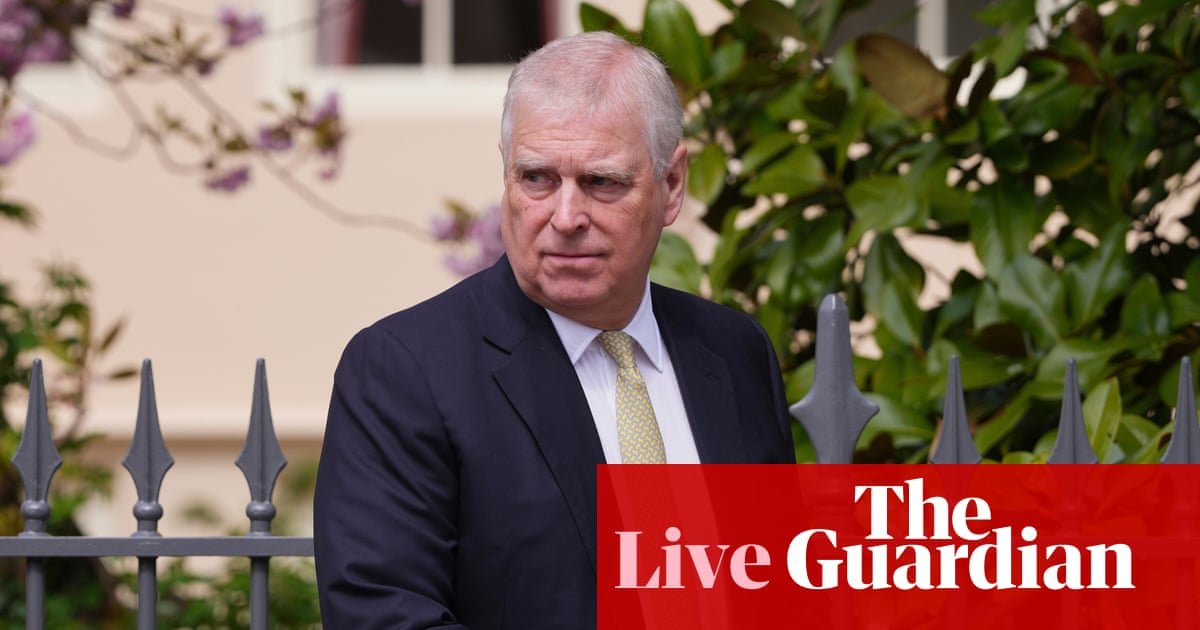
Andrew ‘rude, arrogant and entitled man’ who could not distinguish between public and personal interest, says Bryant
Bryant turned to Andrew Mountbatten-Windsor.
Colleagues and many civil servants have told me their own stories of their interactions with Mr. Mountbatten-Windsor, and they all betray the same pattern: a man on a constant self-aggrandising and self-enriching hustle, a rude, arrogant and entitled man who could not distinguish between the public interest which he said he served, and his own private interest.
He said he recalled Mountbatten-Windsor visiting Tonypandy to meet sea cadets.
They were absolutely delighted and excited to meet a member of the Royal family, but he insisted on coming by helicopter, unlike his mother, who came twice to the Rhondda and always came by car. He left early and he showed next to no interest in the young people.
Bryant said that was not a crime, “nor is arrogance – fortunately, I suppose”, he added, in a self-deprecating joke.
Key events
Bryant expresses doubts about Lib Dem call for two-part inquiry into Epstein’s links with UK
In the Commons Chris Bryant, the trade minister, is now winding up the humble address debate.
He thanks the Lib Dems for bringing the debate to the Commons.
He repeated the government’s intention to comply with the humble address motion “as soon as is practical within the law”.
But, in terms of delaying the release of information, he says the government would be guided by the advice of the prosecuting authorities.
Referring to the Lib Dem call for a public inquiry (see 3.13pm), he says that in 2011, as well as criticising Prince Andrew (see 1.49pm), he was also exposing phone hacking. That led to a public inquiry. It was meant to take part in two parts (as the Lib Dems propose this one could). But the police investigation went on for so long that part two never took place.
So he was “somewhat cautious” about calls for another two-part inquiry.
Lammy says courts will increase use of AI to ‘smash through delays’
The Ministry of Justice will ramp up use of artificial intelligence (AI) in courts to cut backlogs, David Lammy, the deputy PM and justice secretary has said. As the Press Association says, Lammy backed digital modernisation across the courts system, including using AI to keep notes and summarise judgments. PA says:
Lammy gave a speech at the Microsoft AI Tour in London where he said the Ministry of Justice (MoJ) is one of the fastest-growing users of Microsoft’s AI-powered assistant, Copilot.
He told the audience that new technology like AI will help the court system “smash through delays, cut complexity, and free up people to do what they do best”.
Lammy, a former barrister, said an AI tool had already been piloted in the probation service to record meetings between officers and offenders, removing the need for handwritten notes to be typed up.
The MoJ will also explore using AI to speed up case progression by transcribing material and summarising their judgments.
Pledging to increase spending on AI, Lammy said: “I want to see more AI initiatives like these. We’re going to invest more in our in-house, justice AI unit. A specialist team within my department, working with staff to tackle the challenges that they face.
“Over £12m in additional funding in the next financial year will expand our AI capabilities, putting this powerful tool finally in the hands of staff.”
Lammy said the MoJ’s relationship with Microsoft and others will represent an “unprecedented partnership between the public and private sectors”.
Technology will also be used to get defendants to court faster, Lammy said.
Prison transport vehicles will be able to use the same technology that switches traffic lights green as emergency vehicles approach in some areas, he said.
Lammy also said the cap on court sitting days will be lifted.
As Jessica Elgot reports, the Ministry of Justice has released figures suggesting that, even with all the measures being taken to speed up the criminal justice process, clearing the backlog in criminal courts will take a decade.
Rupert Lowe fails in effort to block investigation by MPs’ watchdog
A high court judge has dismissed an attempt by the independent MP Rupert Lowe to block a parliamentary watchdog from investigating a complaint against him, Kevin Rawlinson reports.
Lib Dems call for public inquiry into Epstein’s links with British establishment
In the Commons Daisy Cooper, the Lib Dem deputy leader, has just made an intervention to say that a public inquiry into Andrew Mountbatten-Windsor and other Jeffrey Epstein links with the UK could take place in two parts – with some parts delayed until after criminal proceedings, and some parts happening more quickly. She said there was precedent for inquiries being split into two parts.
Cooper intervened in a speech being given by her Lib Dem colleague Lisa Smart, who said the Lib Dems were “fizzing with ideas” about how systems could be improved in the light of this scandal. She said the inquiry should cover Epstein and his links with the British establishment.
Back in the Commons, the humble address debate is still going on, but it has now become a Lib Dem-only affair. We have only had speeches from two Labour MPs (the minister, Chris Byrant, and Rachael Maskell), one Conservative (the frontbencher Alex Burghart), one SNP MP (Brendan O’Hara) and one Green MP (Siân Berry). All the other speakers have been Lib Dems, and now the only MPs being called are Lib Dems. It is their motion after all.
Many of them are saying the release of the Andrew documents is not enough, and public inquiry is needed.
Liam Byrne confirms Commons business committee may launch Andrew inquiry after police probe over
Liam Byrne, the Labour chair of the Commons business committee, has said that his committee may launch an inquiry covering Andrew Mountbatten-Windsor’s work as a trade envoy when the police inquiry is over.
Speaking at the start of an unrelated committee hearing today, he said the committee would “begin gathering information immediately so that we might stand ready to launch an inquiry into the governance regime for trade envoys at the moment the police and criminal justice system action has concluded”.
The committee will write to ministers on the issue “and we will come back to the house with our opinion about whether an inquiry should be launched, depending on the information we receive”.
Keir Starmer participated online this morning in a coalition of the willing meeting about Ukraine. He was one the co-chairs, along with Emmanuel Macron of France and Friedrich Merz and afterwards, on behalf of the more than 30 leaders who took part, they issued a statement saying the leaders “offered their full and sustained support as Ukraine fights for its sovereignty and territorial integrity, and to defend Europe’s freedom”.
Jakub Krupa and Shaun Walker have more about the meeting on the Europe live blog. Shaun, the Guardian’s central and eastern Europe correspondent, is doing a Q&A with readers.
Lib Dems say humble address vote ‘important step in dismantling system that protected Andrew’
Ed Davey, the Lib Dem leader, has issued this statement following the confirmation from the government that it will support his Andrew Mountbatten-Windsor humble address motion (see 1.17pm and 1.56pm.)
Today is an important step in dismantling the system that protected Andrew Mountbatten-Windsor and Epstein’s other associates. The victims, survivors and their families have waited far too long for the truth to come out and justice to be done.
We need a complete change of culture to hold the powerful to account. That starts with full transparency so we can understand how and why Andrew was given the job of trade envoy in the first place.
Now that the government has agreed to publish these files, we will use every lever at our disposal – politically and legally – to prevent any needless delay in bringing out the truth.
Alex Burghart, the shadow Cabinet Office minister, followed Chris Bryant in the debate. He said that this was the second time recently the government was being forced to agree to the publication of internal papers because of a humble address motion tabled by an oppostion party, and he said the government was only doing the right thing because it was being “pushed every step of the way”.
Bryant said the work that Mountbatten-Windsor did as a trade envoy was quite different from the work being done by trade envoys now. He said they were all MPs or peers, and they were under the same obligations as ministers in their trade envoy duties.
He said he was “enormously grateful” to them for the work they did.
And he ended his speech saying:
One of the core principles of our constitutional system is the rule of law. That means that everyone is equal under the law and nobody is above the law.
I share the anger, the disgust, expressed by many at the alleged behaviour of Andrew Mountbatten-Windsor.
What we are seeing now is a full, fair and proper process by which this issue is investigated by the police and in that investigation they will, of course, have the government’s unwavering cooperation and support.
Towards the end of his speech Bryant returned to his point about the government backing the Lib Dem motion. But he said nothing should be published until the police investigation is over if it might prejudice the police investigation.
The government will, of course, comply with the terms of the humble address in full. As I say, we support the motion.
But as the House will know, there is a live police investigation into the former Duke of York after his arrest on suspicion of misconduct in public office …
As the police have rightly said, it is absolutely crucial that the integrity of their investigation is protected and, now these proceedings are under way, it would be wrong of me to say anything that might prejudice them, nor will the government be able to put into the public domain anything that is required by the police for them to conduct their inquiries unless and until the police are satisfied.
Ed Davey, the Lib Dem leader, intervened when Bryant was speaking to respond to his point about people defending Andrew in 2011. (See 1.49pm.) He said that he had apologised. And he said that other people in government at the time (Davey was a junior minister in the coalition then) might have known more than he did.
Bryant says Tory ministers and prominent journalists were defending Andrew in 2011 when warning signs already clear
In a reference to Ed Davey (see 9.06am), Bryant said that there were some people now saying, with reference to Mountbatten-Windsor, “if only we had known then what we know now”. He went on:
But I’m afraid that with me that doesn’t wash. We did actually have plenty of warning.
I called on the then prime minister, David Cameron, to dispense with the services of the then Duke of York in this chamber on 28 February 2011 because of his close friendship with Saif Gaddafi, as has just been referred to, and [a] convicted Libyan gun smuggler. I was rebuked by Speaker Bercow then for doing so because references to members of the royal family should be very rare, very sparing and very respectful.
(Bryant is right to say he was warning about Andrew 15 years ago. I covered this at the time on the live blog.)
Bryant said he repeatedly called for Andrew to lose his trade envoy job, over his relationship with Jeffrey Epstein and the mysteriously excessive payment he received for the sale of his home, among other reasons.
But he said David Cameron, the then PM, Theresa May, the then home secretary, and many others defended Andrew.
He said that John Humphrys, the broadcaster, told him on the Today programme at the time that Epstein “wasn’t quite a paedophile, drawing a distinction between sexual abuse of prepubescent and other children”. And he said that Dominic Lawson also defended Andrew in his Sunday Times column, making “the same distinction between Epstein’s involvement with teenage girls and paedophilia since, as he put it, none of the girls was prepubescent”. But Lawson “did at least admit that both were sordid and exploitative”, Bryant said.
Bryant said this was happening after the photograph of Andrew with his arm around Virginia Giuffre was published.
Andrew ‘rude, arrogant and entitled man’ who could not distinguish between public and personal interest, says Bryant
Bryant turned to Andrew Mountbatten-Windsor.
Colleagues and many civil servants have told me their own stories of their interactions with Mr. Mountbatten-Windsor, and they all betray the same pattern: a man on a constant self-aggrandising and self-enriching hustle, a rude, arrogant and entitled man who could not distinguish between the public interest which he said he served, and his own private interest.
He said he recalled Mountbatten-Windsor visiting Tonypandy to meet sea cadets.
They were absolutely delighted and excited to meet a member of the Royal family, but he insisted on coming by helicopter, unlike his mother, who came twice to the Rhondda and always came by car. He left early and he showed next to no interest in the young people.
Bryant said that was not a crime, “nor is arrogance – fortunately, I suppose”, he added, in a self-deprecating joke.
Bryant says those who turned blind eye to Epstein ‘out of greed, familiarity or deference’ were complict in his crimes
Bryant opened his speech by saying that abuse suffered by Epstein’s victims was horrific. He said:
The abuse that was enabled, aided and abetted by a very extensive group of arrogant, entitled, and often very wealthy individuals in this country and elsewhere.
It’s not just the people who participated in the abuse, it’s the many, many more who turned a blind eye out of greed, familiarity or deference. To my mind, they too were complicit. Just as complicit. And I welcome the reckoning that is coming to them now.
I doubt there is anyone in this House who is not shocked and appalled by the recent allegations.
Trade minister Chris Bryant tells MPs government will support Lib Dem motion for publication of Andrew trade envoy papers
Chris Bryant, the trade minister, is responding for the government.
He started by saying that the government will support the motion.
Later in his speech he said that was subject to the caveat that it would not publish anything that might prejudice the police inquiry until it was over.
Davey says Epstein tried to use Andrew’s trade envoy job ‘to enrich himself’
Davey gave an example of how Mountbatten-Windsor’s work as a trade envoy helped his friend, Jeffrey Epstein.
I would like to highlight one example of how Jeffrey Epstein sought to use Andrew’s role as trade envoy to enrich himself.
Channel 4 uncovered emails in the Epstein files in which Epstein was trying to meet the Libyan dictator Gaddafi in the dying months of the Gaddafi regime, to help him find somewhere to put his money.
In other words, Epstein looked at the deadly crisis in Libya and saw a chance to make some money. And he thought his friend Andrew could help.
And this is what it says in one of the emails: “I wondered if PA could make the intro.”
A few weeks later, Andrew wrote back: “Libya fixed.”
Though the Epstein Gaddafi meeting doesn’t appear to have happened, it does show clearly what these relationships were all about.
Davey said that the relationships that Andrew and Mandelson had with Epstein were “a stain” on the reputation of the country. “We must begin to clean away that stain with the disinfectant of transparency,” he said. He urged MPs to debate the motion.
