


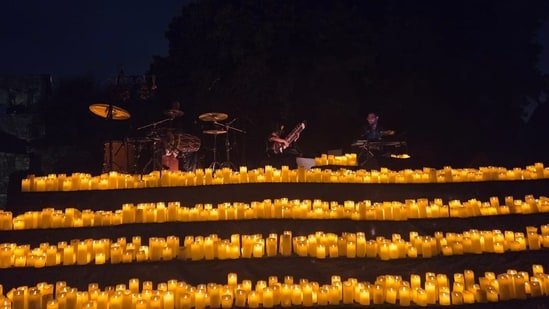
Purana Quila (Old Fort), the iconic fortress and a witness to centuries of conquests and change since the 1600s, stands as one of the oldest forts in Delhi. Imposing and formidable, its walls echo with great tales of conflicts, changes, and empires from a glorious past. Its staggering grandeur reflects its role as a fierce protector, standing tall through the eras.
On March 14th, however, the historic stronghold turned into a nurturer, embracing a softer, more intimate side, nestling a space for a unique musical experience, a format that is new to India.
Live Your City organised Candlelight Open Air: Mehfil-e-Sufi, featuring an Indian classical ensemble with Megha Rawoot at sitar, Makrand Sanon at percussion, and Ashwin Krishnan at keyboard. Let’s take a detailed look at this format and what it means for live musical shows for the Indian audience.
ALSO READ: Inside the Disney Adventure: A magical cruise of food, fantasy and unforgettable service
The trio performed instrumental renditions of classics such as Mast Kalandar, Yeh Jo Halka Halka Suroor Hai, Khwaja Mere Khwaja, Kun Faya Kun, and Chaap Tilak Sanson Ki Mala. The compositions included works by music stalwarts like AR Rahman and Nusrat Fateh Ali Khan, reinterpreted through sitar, percussion, and keyboard.
The atmosphere was breathtaking and goosebump-inducing. In the quiet darkness, with the silhouette of the fort in the background, flickering electric candles shaped the ambience, lined the grand entryway, stretched all the way to the lawns, and surrounded the stage and the musicians as they performed.
Unlike conventional concerts, whether modern or classical, which are usually dominated by brighter lighting in a more high-energy setting with floodlights, spotlights, and strobe effects, the warm lighting settings here felt softer and closer to the heart, where music became something larger than life against the backdrop of the historic monument.
Generally, live music shows are defined by scale and high-octane energy, but this format trades that scale for a novel sense of intimacy between the musicians and the audience, allowing a new kind of immersion to unfold.
This format of live musical show, called a candelight concert, has recently entered India. HT Lifestyle spoke to the organiser and the artists to better understand what this new experience is, the gap it fills in live music today, and how setting and sound shape this novel performance.
What is a candlelight concert, and how does it change live music experience?
Candelight concerts have existed globally for some time and have only recently entered India.
Pranjal Begwani, Candlelight Team Lead – India & Thailand (Fever), shared the trajectory of its growth and the need behind it, saying, “Candlelight entered India in June 2024. Candlelight emerged from the need to offer audiences a different way to experience live Classical music.”
There is a gap in how live music is experienced today, with a stronger focus on loud grandeur and spectacle. Candlelight concerts attempt to bridge this gap by creating a quieter and more personal atmosphere. This was evident during the Mehfil-e-Sufi performance, where the lead musician, Megha Rawoot and the ensemble blurred the boundary between the performers and audience. A proper conversation was held, thanks to the close-proximity seating, which led to the audience singing along, clapping and becoming a part of the sensory experience, surrounded by a sea of flickering candles and historic monuments.
Now, in a traditional concert or show, while the energy is undoubtedly electrifying and heart-pounding, several challenges and distractions come from the scale. From standing on tiptoe just to catch a glimpse of the artist to aggressively elbowing through the sweltering crowd for space, it can all feel a bit overwhelming. Add to this blaring sound systems, bright lights, and watching the performer from afar and only on a big screen, you simply listen to music, maybe zone out midway, instead of experiencing it.
Sharing some of the features of this format, and how it differs, Pranjal elaborated, “The format focuses on experience rather than scale, bringing live music into unique, historic and culturally significant venues and presenting it in a candlelit setting for smaller audiences.”
To add more points, this format also makes classical music more palatable for younger audiences because it provides a complete, sensory-new experience. Pranjal revealed just how much of the audience is younger: “Today, more than 70% of our audience is Gen Z and Millennials.”
Primarily in instrumental form, these shows reinterpret classical and contemporary music, and as Pranjal reiterated, they do so in a more ‘personal way’ while keeping the music larger than life; this time, the magnitude and spectacle are filled in by the quiet grandiose of history, present in the very walls of the monuments themselves.
The format also provides a platform for Indian artists and instrumentalists to showcase their craft to new audiences.
The process of bringing epic composition to life
The artists at the Candlelight Mehfil-E Sufi opened up about the nuances that went into bringing powerful compositions to life, through a unique interpretation on sitar, keyboard and percussion.
How does such a quiet setting influence the way artists present the music?
We asked Megha Rawoot, leading the ensemble at Sitar, how performing in such a tranquil, mesmerising atmosphere changes her musical presentation.
She acknowledged that the candelight setting at Purana Quila felt almost like ‘stepping into a different time.’ Highlighting why a candelight concert feels so personal, she added, “Without vocals, the music had to carry the entire emotional narrative, and on a Sufi night, it naturally became more immersive and meditative — almost like a conversation with the space itself.”
As previously mentioned about the blurred lines between performer and audience, Megha, too, observed that the experience felt as if the audience and performers were ‘breathing together.’ This way music is collectively felt, creating a bond in that moment.
How was the soundscape shaped in this format?
To Makrand Sanon, the percussionist navigating a wide array of drums, cymbals and hand percussion, we asked how he ensures that, despite the inherently loud and dynamic nature of his instruments, the soundscape remains aligned with the quiet, reflective atmosphere, avoiding any sense of dominance which may go against the nature of the intimate setting.
Sanon elaborated what goes into it, “It’s really about listening more than playing. In a candlelit, reflective setting, I naturally lean into a softer, more textured approach – letting the rhythms breathe rather than driving them forward too strongly.”
The approach to percussion in a candelight setting is not about rhythm or volume; it is about responding to the melody. The percussionist described his playing as ‘flowy,’ almost like it’s weaving around the melody instead of sitting on top of it, which creates this gentle, immersive pulse.
“Percussion doesn’t dominate but quietly deepens the mood, almost like an undercurrent you feel more than you hear,” Sanon explained, emphasising how percussion can help enhance the emotional depth of these quiet performances.
How were the originally vocal compositions turned instrumental?
Ashwin Krishnan, on keyboard, was asked about how the compositions are presented instrumentally while retaining their emotional depth and offering a fresh reimagination.
To this, he responded, “The idea is to treat the original composition as a starting point rather than something fixed.” This means the original songs are seen as a framework, and the musicians creatively explored how to add certain nuances to make a fresh rendition. When they are rendered instrumentally, subtle nuances are added.
Most importantly, without any lyrics to guide the narrative, Ashwin believed that harmony here acts as a different language, yet familiar and understandable all the same. “Since the lyrics aren’t there, you begin to reinterpret the emotional arc through harmony, voicing, and subtle variations – almost like telling the same story in a different language,” he noted.
Upcoming shows
Here are some of the upcoming shows you can head to:
March:
- Candlelight: Tribute to KK
Venue: Roseate House
Dates and Times: March 29 (Time- 16:30)
Duration: 60 minutes
Musicians: Pianist – Krishna
Value: 1 Ticket – from 1,499 onwards
- Candlelight: Tribute to A.R. Rahman
Venue: Roseate House
Dates and Times: March 29 (Time- 18:30, 20:30)
Duration: 60 minutes
Musicians: Pianist – Krishna
Value: 1 Ticket – from 1,499 onwards
April:
- Candlelight: Tribute to Arijit Singh
Venue: Le Méridien New Delhi
Dates and Times: April 11 (Time- 18:00)
Duration: 60 minutes
Musicians: Pianist – Krishna
Value: 1 Ticket – from 1,500 onwards
- Candlelight: A Night of Ghazals
Venue: Le Méridien New Delhi
Dates and Times: April 11 (Time- 20:30)
Duration: 60 minutes
Musicians: Piano, Tabla & Singer Trio – led by Pianist Krishna
Value: 1 Ticket – from 1,499 onwards
