


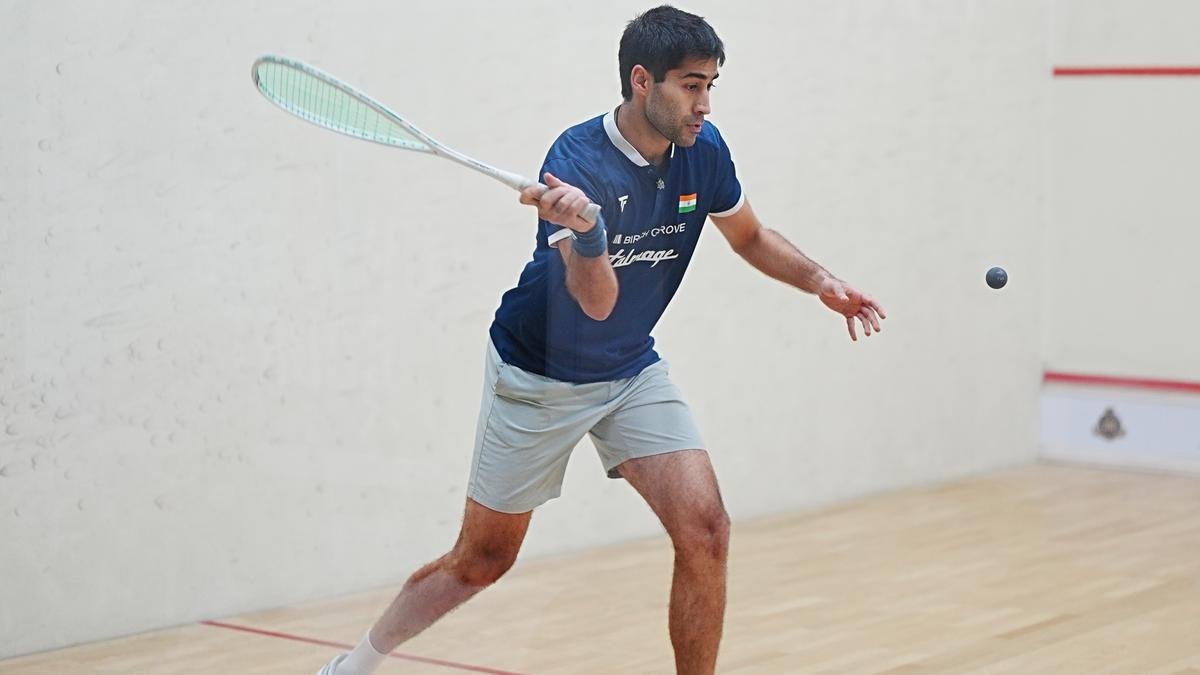
After a frustrating build-up to the 2022 Asian Games that ultimately cost him a place in the Indian team, Ramit Tandon has quietly rebuilt his rhythm and belief. Now ranked World No. 37 and coming off a strong start to the season, the 34-year-old is looking ahead with renewed clarity — targeting a return to the Asian Games stage and a deeper push on the PSA Tour.
On the eve of the JSW Indian Open in Mumbai, where he is seeded third, Tandon spoke to The Hindu about form, fitness, the evolving Indian squash landscape, and the road to a crucial year for the sport. Excerpts:
Your best result playing at home was reaching the semifinals at the CCI International, a PSA World Tour silver event, in 2019. Going into the the JSW Indian Open, how are you feeling?
It’s always wonderful playing at home. The issue is we don’t get to do it as frequently, but obviously with squash making it to the [2028 Los Angeles] Olympics, we are seeing a big boost. A couple of months ago, there was a massive event in Indore as well, at Daly College. Last year, the JSW Indian Open was the first glasscourt event after a gap of a few years. I think post COVID, Indore tournament was the first time they (organisers) hosted an event. And now it’s a yearly affair. It’s always a good feeling to play in front of people who have supported you through your career, those familiar faces and of course, the home support. It’s hard to beat that.
Ramit Tandon.
| Photo Credit:
Special Arrangement
At the Indian Open, you will be the third seed, behind Abhay Singh (second) and Egypt’s Yahya Elnawasany. What are your expectations?
Being the third seed, obviously, I would like to do well at the event. And I would love to hopefully go back home with the trophy. At the same time, you also have to take it one step at a time and be patient. It’s important not to get carried away with rankings. They are just a number. Anyone can beat anyone as there are a lot of upsets happening in the PSA Tour worldwide. My approach will be to enjoy my week in Mumbai and play my best squash.
You have spent much part of your time competing in USA training and sparring with top players…
I train with former World No. 1 David Palmer, who is now based in Utica in upstate New York. Then apart from that, when the season starts, there’s not much training that we can do as you don’t get much time since we are competing every other week. At that point in time, it just becomes a question of putting yourself in areas where there are enough players where you can continuously get sparring practice. So, a good chunk of my time has been in the USA. I am already in India (Kolkata now) getting used to the weather here, because it’s very different from the winters in America. I’m trying to get used to the climate here.
Tell us about the Indian squash landscape as far as the men are concerned?
I think Indian men’s squash is obviously at a very strong point. I can’t remember the last time we had four players ranked in the world’s top 50. We have been a dominant force. Back in the day, there was always Saurav Ghoshal, who was extremely good. He was in the top 10 (in 2019), but he didn’t have a backup. The other players back then were probably outside the 50s, 60s in the world. And the way squash is these days, it’s like there’s a difference in ranking, but there’s not much of a difference in level.
For example, when you’re saying someone is in the top 30, top 40, or top 50 in the world, it’s not surprising if you see them beat those in the top 20 or top 10. From a perspective of where we can go as a nation, I believe there is a lot of scope and potential for Indian squash on the men’s side in the way it has shown itself as a unit and as a team. Having said that, it’s also pressure to get it right. I feel like as a country, we need to take the right steps to make sure we groom the players in the right way so that they break into the world’s top 10 and come back with medals from the world championship and other big events.
Ramit Tandon.
| Photo Credit:
Special Arrangement
Do you think that is possible?
We are not in England, France, or Egypt where we have world champions in the past. No one has done it. It’s a bit of unknown territory for us. But with the support of corporates and with squash being added to TOPS scheme, I’m sure we can put together a plan that will see us maximise our potential.
With the Asian Games coming up this year, how keen are you to be part of the Indian men’s team?
Asian Games is the biggest event for us this year. India has always been a strong contender at the Asian Games. As the defending champion in men’s team, we would be keen to do well. All our scheduling is going to revolve around how to peak for the Asian Games. I am excited and looking forward to it. The last Asian Games in 2022 was a little tricky. I had a few injuries leading up to the Games and a few issues with rankings and selection policies and a bit of back injury that kind of ruled me out of the Games eventually. Of course, stakes are high because the Olympic qualification is on line the singles (men and women) winner will qualify for the 2028 Los Angeles Olympics.
At the moment, you are ranked 37 in the world. How difficult is it to maintain the ranking for you to be in the team at this stage for the Asian Games?
I don’t know what the selection format or the policies are for this year’s Asian Games. As of today, I would say the four boys in the world’s top 50 in the world should be the ones at the Asian Games.
Will there be a selection trials for the Asian Games?
We have received information on selection trials and training camp for the Indian team in Chennai in June. But there’s still no clarity on the exact process that will be followed.
Squash is making its debut at the 2028 Olympics. Who do you think will make the cut for it?
It’s the Olympics. It’s supposed to be difficult, right? There’s nothing easy when it comes to playing the Olympics. When you look at the world rankings changing every week, it gives every player a lot of opportunities to move up the rankings. Apart from that, there’s going to be the Asian qualification, which is the Asian Games. Then, there’s going to be an eventual world qualification, which would be after removing all the players who have qualified. As of now, anyone, for me, in the top 50 in the world stands a chance to make the cut for the Olympics.
Having said that, the nature of our sport with injuries and with how the game is structured, even the best player in the world today might lose his/her spot at the Olympics.
You did pretty well to reach the quarterfinals of the Motor City Open. How are you feeling heading into the Indian Open?
I’m happy with the level I’m playing. The Motor City Open was a good run for me. And I’m looking forward to this patch of events because I haven’t played this season. After Motor City, I was supposed to play in the Texas Open, but I fell sick and I haven’t competed in any event since. I’m looking forward to the Indian Open, following which that I have a packed calendar.
Do you think India should host more big events?
We are definitely seeing an increase in the number of PSA events in our country. I think we should consider hosting one or two major events every year. I do understand the requirement of smaller events as well because there are a lot of other players who are not in world’s top 50, who need that support to climb up in the rankings. Perhaps, a blend of maybe three events a year, a PSA Copper, Bronze, and above [Gold and Platinum] level will really benefit the higher ranked players. At least, India is bringing the world circuit and, the challenge for me and the other players in the country is to go deep in bigger tournaments.
Anahat Singh is the toast of nation as far as squash is concerned. How do you see the 17-year-old’s meteoric rise?
Anahat has been exceptional. I think what she’s achieved in general is exceptional for her age. If you look at Anahat’s ranking a year ago (WR 62) and you look at where she’s today (WR 20), it’s a massive, massive difference. If she just continues the way she’s doing, I hope she can break a lot more records.
