


Close your eyes and think of India. Do you see temples, Holi, cows and crows? Perhaps you’re imagining truck art, Bollywood posters and Mughal miniature paintings. The visuals aren’t wrong; they’re just dated. And that’s where the new maximalism comes in. Meet three artists who are determined to sketch new symbols of Indianness. There’s no elephant in the room.
Excess all areas
Srishti Guptaroy, 34, grew up in Kolkata, consuming American movies, music, and pop culture on TV. When she was 16, she noticed that Indian visual culture was levelling up too. Chumbak had eye-popping visuals of autorickshaws, the Taj Mahal, and slogans such as “Mad or what?” on their fridge magnets and mugs. Tantra T-shirts had jokes about Indian traffic and Hinglish puns. Manish Arora was designing outfits using neon pinks, fluorescent yellows and Hindu iconography. Roman letters had a shirorekha running through them to make it seem Indian.
“It was a new kind of Indian cool, and coincided with my formative design years,” recalls Guptaroy. “It’s why my art is so eye-catching and colourful.”
Guptaroy’s work, like herself, acknowledges that “some parts of you are sanskari and some parts of you are Western”. She illustrates women who pair T-shirts with bangles and jhumkas. The text includes terms such as Chillxiety (“being highly anxious but super chill about ongoing chaos”). She’s imagined a woman with the body of a horse, sprouting wings and a fishtail. It’s pop art mixed with traditional motifs and a “heavy dose of reinterpretation”.
An artist depicting India can’t escape the motifs. But a good one will nod to the past while riffing on it to, says Guptaroy. In 2024, she designed the digital invitations and advertising visuals for the opening of an Hermès store in Mumbai. No Gateway of India in sight. Instead, she drew the Bandra-Worli Sea Link, and little fish done in Gond-art style, but in non-traditional colours so it looked distinct from the OG version.
What a rush
In Bengaluru, Surabhi Banerjee thinks of her illustrations as a “living archive” of her time in Kolkata, Mumbai, and Chennai. “It’s not just the geometry of a façade, the compression of a narrow market lane, the canopy of trees in a park,” she says. “It’s also about how people lean against a wall, cluster in the shade, spill onto pavements, or carve out intimacy in a crowd.”
Her genius lies in depicting India’s constant hum of activity: People lounging in Cubbon Park, artisans making idols for Durga Puja, the crush of a Mumbai local. “I try to capture some sense of how I felt when I was in the thick of it.” Multiple things can be happening at the same time – in her Bombay Local print, a dabbawalla has stowed his lunch boxes under the seat, a woman is selling jewellery, and kids are running in the aisle, while others talk on their phone. The eye can’t decide what to focus on. “It’s less of an artistic style and more about how we just exist,” says Banerjee.
She also adds Easter eggs: A book she’s reading, names of friends and family members, cameos of her grandparents. “I want each piece to feel lived-in, like our homes and streets and city spaces do.” Viewers, she hopes, “feel recognition, as if they’ve seen this before”.
Without a bit of play, Indian motifs can easily look cliché, she says. But if you take a marigold out of a flower-seller’s basket and place it in a china vase, it’s no longer familiar but exotic. “Even a tiger or a temple arch can seem exciting, if they’re not treated as decoration.”
Southern comforts
Whether it’s portraits of daily-wage workers, or two friends helping each other dress up, or vacationers lounging on a beach, Muhammed Sajid’s art feels as if you’re part of a constantly unfolding scene. “When you leave your hometown, you suddenly notice how many small things you took for granted – your surroundings, the people, the everyday interactions,” says Sajid, 32, who grew up in Kozhikode, Kerala, and left ten years ago when he got a job in Bengaluru. “So, I started imagining what it would be like to paint those spaces and invite the viewer into them.”
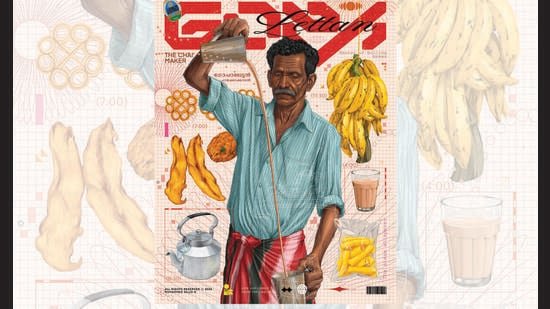
In 2018, Sajid started his Folks of Kerala series as a tribute to the people who were part of his world – neighbours putting clothes to dry, family members cooking. “Because it’s the people who give a place its atmosphere.” He started out with an illustration of his grandmother: “In many Muslim communities in Kerala, women wear multiple gold earrings stacked along the ear, and they often style their shawls or head coverings in very specific ways. I wanted to showcase this.” Later, he expanded the series to include everyday heroes: Postmen, fisherfolk, tea sellers. “These are the people we rely on, yet never notice.”
Sajid noticed that tea sellers in his hometown tended to have a bunch of bananas hanging from their cart, and snacks that accompany tea: Achappams (rose cookies), pazham pori (banana fritters), and dal vadas. Those little details helped him depict an India beyond the touristy symbolism. “Much of the art we see tends to focus on grand cultural symbols or festivals. While those are beautiful, I feel we don’t see enough of the quieter, more personal side of Indian life.”
The challenge while creating a portrait, he says, is avoiding over-romanticising a person’s background. “There will be some surrealism that creeps in – it’s why I chose to draw on a graph paper-like background, which gives it a picture-book feeling,” he explains. A good test is thinking what AI would do if it had to create the same imagery, and avoid that glossy, surface-level caricature. “That means you’ve got to go beyond bindis, elephants and lotuses.”
