


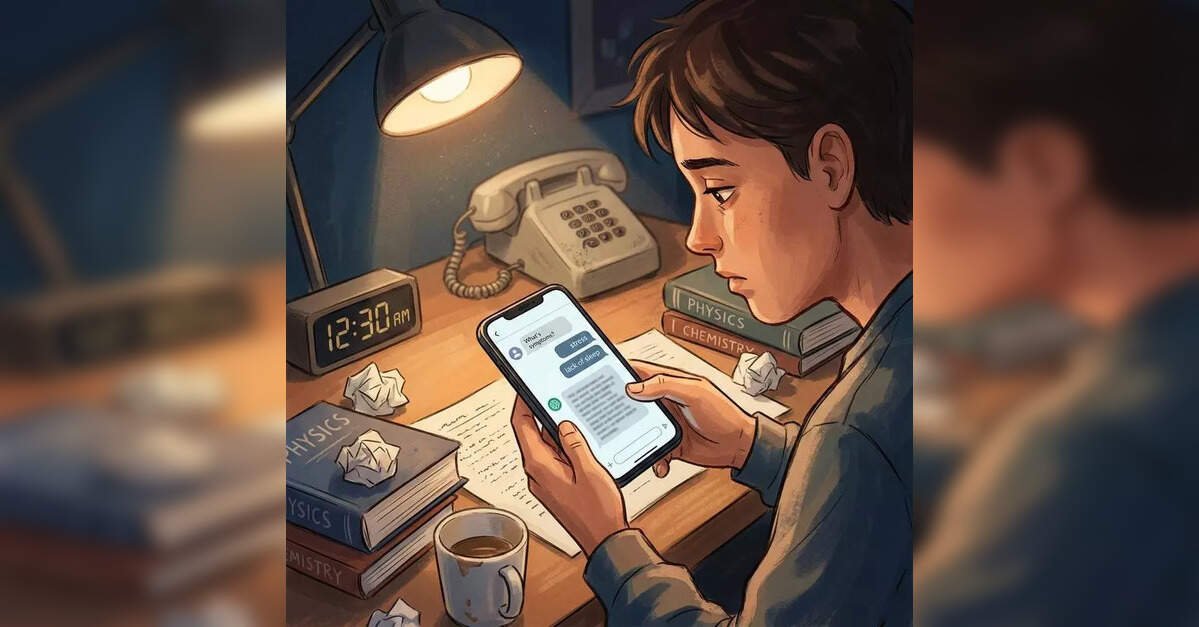
AHMEDABAD: When the parents of a 17-year-old Class 12 science stream student brought him to the counselling room of Dr Nehal Shah, a city-based psychiatrist, ahead of the board exams recently, he rattled off his symptoms, including lack of sleep, lack of appetite, and a feeling of overall disinterest, etc. “He told me that he has classical signs of exam-related anxiety as he is appearing for Class 12 exams. I asked him how he diagnosed his problem, and he confidently said he checked it already with a popular AI chatbot!” says Dr Shah.
It is not a one-off case for the counsellors, psychologists, and psychiatrists in the city. While the overall calls are recording a dip due to multiple reasons, the students appearing in Class 10 and 12 exams are also increasingly resorting to using the online AI platforms to find answers to their queries, say experts. Dr Shah underscored that AI cannot replace expert consultation, and students with exam-related issues should seek expert help over AI.
It is no surprise, then, that there is a sharp drop in distress calls made to helplines which come to life ahead of board exams to alleviate the anxiety of students. A senior official at GSHSEB told TOI that, compared to about 3,700 calls fielded by the Board helpline last year, the calls so far were about 70% less, at 1,000-odd calls, even as the exams are ongoing.
The helpline was launched on February 12.
Nirav Thakkar, principal of city-based AG High School and member of the core committee of the city-based helpline for Board exams, said that the city is divided into 10 clusters where a team helps students navigate common issues such as how to prepare, what to read, and how to address exam blues.
“Compared to the past couple of years, there is about an 80% drop in calls. Collectively, we fielded about 30-35 calls till Saturday. I believe that the major reduction in calls can be attributed to the fact that the papers are overall easy and there is less dependence on the marks scored in Class 12,” said Thakkar.
At Jeevan Aastha, the suicide prevention helpline, they are fielding about 80-100 calls daily since the start of February. Pravin Valera, mentor of the helpline, said that the calls are more than 30% less compared to the past couple of years. “The calls are primarily related to forgetting what they read, how to recollect what is read during exams, how to stay away from mobile phones, and what to expect if they score less compared to what their parents want them to score,” he said. “We ask them to believe in themselves and give their best shot. We also tell them that any exam is not the end of the world, and they always get another chance.”
Dr Deepti Bhatt, psychiatrist at the govt Hospital for Mental Health and coordinator for the TeleMANAS helpline, said that they answered about 30-40 calls related to Board exams. “The students often call about anxiety and performance pressure and seek help. Compared to last year, the call volume is less,” she said.
Dr Hansal Bhachech, a city-based psychiatrist, said that it is a given that the student who has reached a psychiatrist’s consultation went through other means and suggestions, be it teachers, parents, and peers, and now commonly AI.
“The students often have specific issues and come with self-diagnosis such as anxiety and depression thanks to AI. We tell them that they cannot believe medical diagnosis off the internet, and expert intervention is important. Apart from AI, I believe that abundant seats in even professional courses like medicine and engineering, and many other avenues for a good career, freed students from extreme stress over the outcome of board exams,” said Dr Bhachech, adding that he is also seeing fewer students who wish to opt for a drop from the exam.
Dr Nehal Shah added that earlier the students came with questions related to their own unease or preparations for exams.
“But now they are often very specific. We still see such patients, but the first question I ask now is what they searched about symptoms, and why it is not completely reliable. I tell them that AI is good for general awareness, but human intervention can understand underlying issues and various angles associated with the case. It is possible that the exams are just a trigger, and the patient may need to resolve deeper issues,” he said. “But in today’s age, we often require discreet and instant solutions, where AI comes in handy.”
