


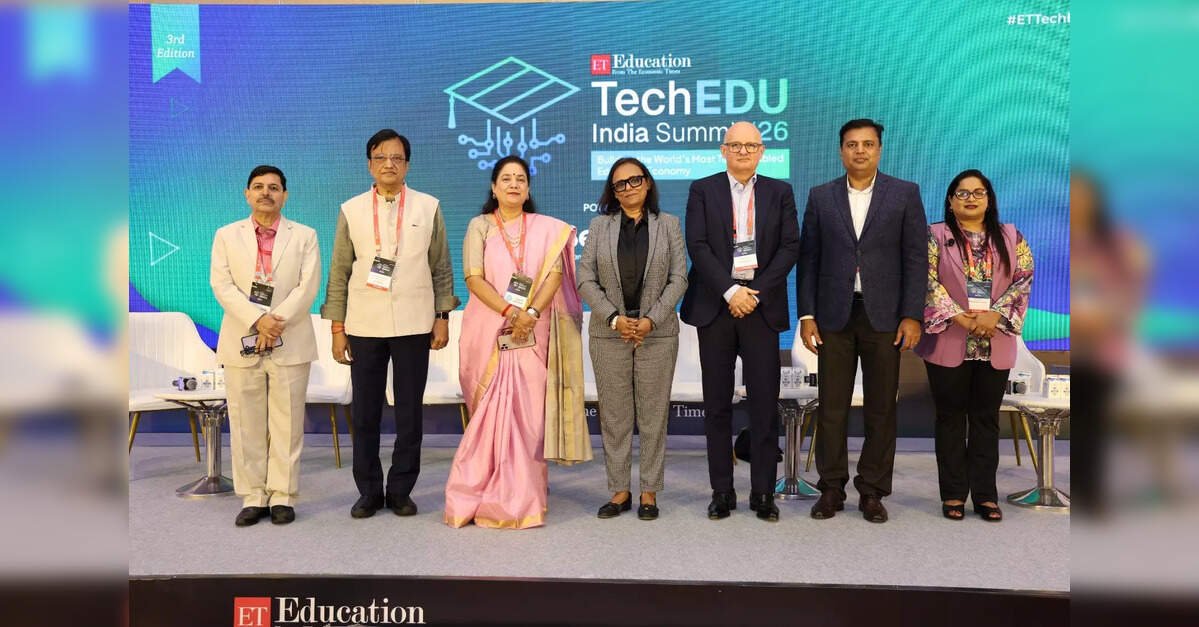
As India accelerates toward becoming a global knowledge economy, its higher education system stands at an inflection point. The 3rd edition of the ETEducation TechEDU India Summit convened policymakers, vice chancellors, edtech leaders, and industry stakeholders to deliberate on how India can strengthen academic integrity, integrate artificial intelligence responsibly, and build globally competitive institutions. Against the backdrop of demographic scale, digital transformation, and economic ambition, the conversations reflected a shared urgency: India’s higher education ecosystem must evolve from expansion to excellence. It was within this larger context that Mega Panel 1 examined a defining question — why are leading global universities increasingly investing in India’s higher education ecosystem? Moderated by Yasmin Taj, Editor, ETEducation & ETHRWorld, The Economic Times, the session brought together academic administrators and industry leaders to unpack the convergence of AI, academic integrity, digital infrastructure, and skills in shaping India’s global education standing.
Prof Ravindra Kulkarni, Vice Chancellor, University of Mumbai, argued that while India’s demographic dividend is compelling, it is far from the sole driver of global interest. He pointed to the country’s intellectual capital, governance stability, and regulatory transparency as equally significant factors. As India charts its ambition to become one of the world’s top three economies by 2047, he emphasised that higher education will be pivotal to enabling that transition. However, he cautioned against viewing India as a peripheral outpost. Instead, he called for fully established campuses anchored in research, innovation, and long-term institutional commitment — investments that strengthen, rather than merely extract from, the domestic ecosystem.
Dr Shankar S Mantha, Former Chairman, AICTE, and Chancellor, RB University, Nagpur, echoed the sentiment that India’s appeal extends beyond scale. He highlighted the nation’s expanding innovation ecosystem, entrepreneurial momentum, and regulatory continuity as powerful differentiators. While welcoming global participation, he underscored the importance of calibrated regulatory frameworks to safeguard quality, national priorities, and institutional security — ensuring that international entry enhances, rather than dilutes, India’s academic foundations.
Dr Vishwajeet Kadam, Secretary and Pro-Vice Chancellor, Bharati Vidyapeeth, Pune, shifted the lens toward partnership models rooted in reciprocity. India, he asserted, is not merely an investment destination but a mature academic ecosystem in its own right. Global collaborations, therefore, must be anchored in mutual value creation — through joint research, faculty exchange, student mobility, and shared innovation platforms — fostering integration rather than isolated academic enclaves.
A central thread running through the discussion was academic integrity in the age of AI. Chaitali Moitra, Senior Director, Turnitin India, stressed that institutions must rethink assessment frameworks to reflect authentic learning journeys rather than static outputs. “We are not saying don’t use AI. We are understanding how AI is being used… and enabling visibility into the thought process and writing journey,” she noted. In an era where AI tools are ubiquitous, she argued, transparency, iterative feedback, and deeper teacher-student engagement will be critical in preserving trust and academic credibility.
Adding a philosophical dimension, Prof Rajita Kulkarni, President, Sri Sri University, Odisha, emphasised that technological advancement must be guided by ethical consciousness. “Innovation without this awareness can get misdirected… spirituality and science is not contradictory, it is complementary,” she observed. In a rapidly evolving AI landscape, she advocated for resilience, mindfulness, and value-based education as essential anchors — equipping students to remain responsible innovators rather than reactive adopters.
From an industry vantage point, Zeljko Djuretic, Senior Director – Education, Bentley Systems, called for a shift from transactional engagement to genuine co-creation. “If you let technology companies lead, you’re going to end up with training programs. The perfect project is co-creation between academia and industry,” he said. He envisioned campuses as living laboratories, where digital twins and simulation technologies mirror real-world infrastructure challenges. Complementing this, Bhavesh Budhabhatti, Director, Enterprise Systems Development, ISDL, IBM India Pvt. Ltd., emphasised the importance of systems thinking and comfort with ambiguity in enterprise environments. “We would like certain foundation strength in system thinking… understanding interactions, trade-offs, compliance and boundary conditions,” he remarked, urging students to see AI not as a shortcut, but as a collaborative design partner.
The panel concluded with a shared recognition: India’s readiness is not defined solely by scale, but by its ability to embed integrity, digital capability, and industry relevance into its academic DNA. As global universities deepen their engagement, the larger opportunity lies in building world-class Indian institutions — institutions capable not only of collaborating globally, but of competing confidently on the world stage.
