


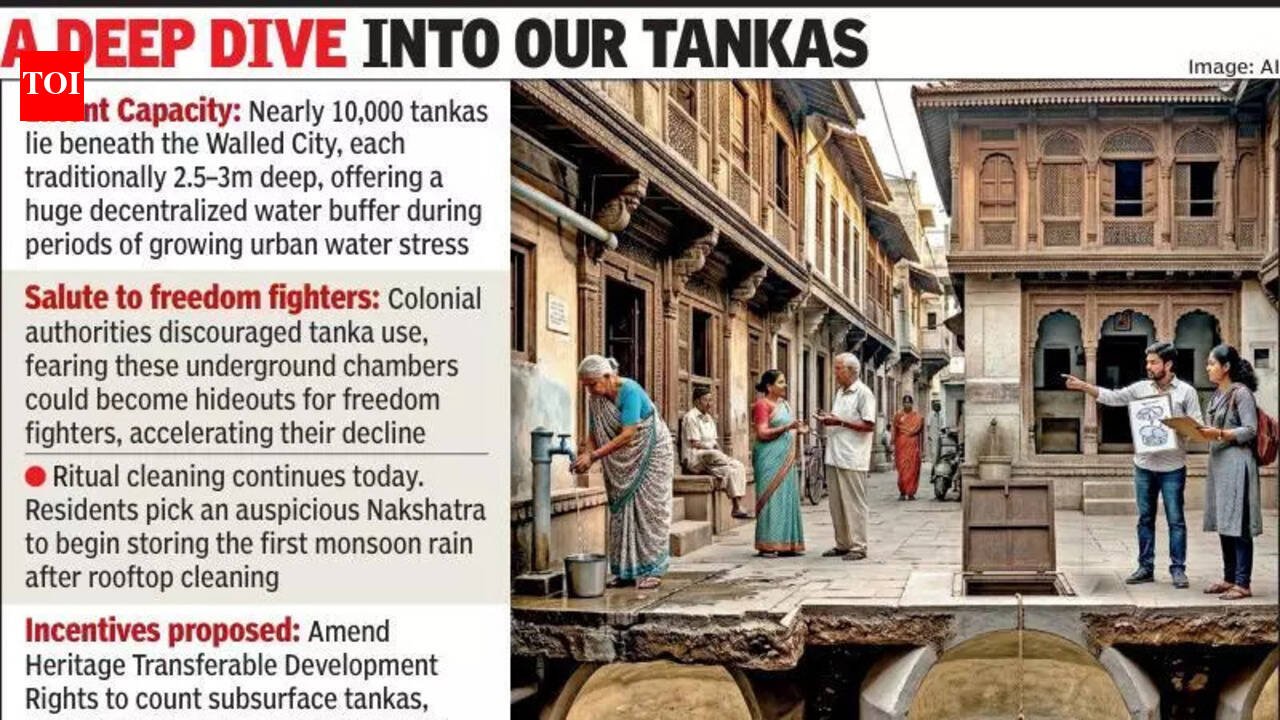
Ahmedabad: The Unesco-Icomos reactive monitoring team concluded its high-stakes audit of Ahmedabad’s Walled City on Sunday, leaving local authorities with a pointed inquiry into the preservation of the city’s living heritage.According to civic sources, during their final rounds, the Unesco-Icomos experts also sought details from the AMC on the current status of the historical underground water tankas — centuries-old infrastructure buried beneath the city’s dense Pol neighborhoods.“The inspectors looked for signs of active conservation,” said a senior AMC official. A seminal research paper published in Springer’s ‘Built Heritage’ journal in March 2026 titled “Tapping into tradition: a multi-method approach for reviving Tankas for climate-resilient water management in Ahmedabad” argues that these structures are essential tools for survival.Authored by Piyush Pandya and Debalina Ghosh of Woxsen University, with heritage professional Maniti Desai, the study identifies a “structural mismatch” between modern governance and the Walled City’s organic fabric.The researchers reveal that the 535.7-hectare area relies on intermittent piped water — often available for only two hours a day. But the city, according to the study, sits atop nearly 10,000 tankas, each with an average capacity of 25,000 litres.This latent infrastructure remains marginalized by a “techno-bureaucratic” model that favours external river sourcing, according to experts.The research highlights a solution: groundwater tables have plummeted below 40 metres, yet the tankas remain viable because they harvest surface rainwater.These lime-lined chambers, typically 18-25 feet deep, offer “passive purification” by increasing water pH and reducing microbial activity. Pandya and his colleagues argue that “reviving such vernacular systems offers a low-carbon, culturally embedded solution for managing urban resilience”. The researchers have advocated for a tripartite approach that combines the resources of the state with the active participation of residents. However, the study cites significant “institutional inertia”, noting that current Heritage Transferable Development Rights (HTDR) only factor in above-ground features, ignoring these vital subsurface assets. The researchers propose a “co-governance model” where the state incentivizes the 90% of residents who expressed a willingness to reintegrate tanka water into the urban system.
