


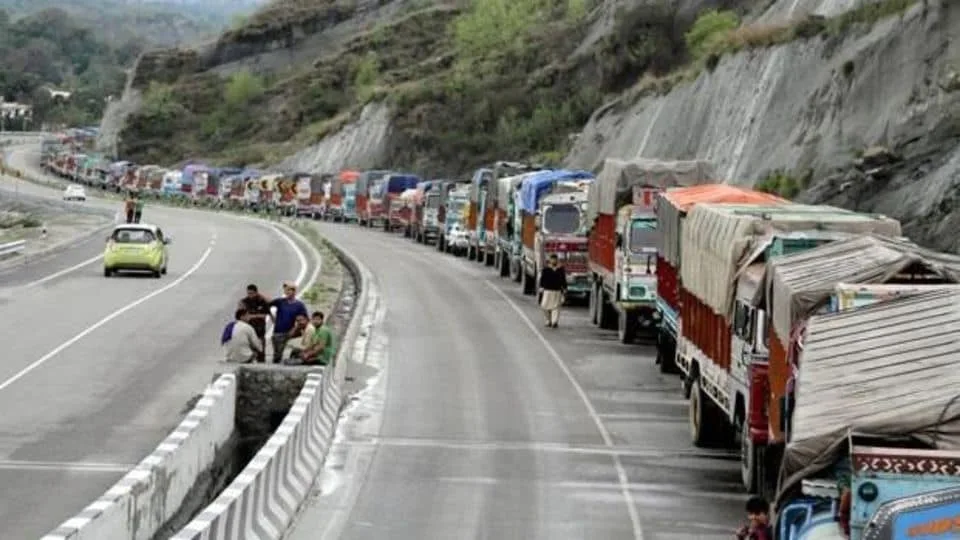
Srinagar, Mar 02: For decades, the 270-km Srinagar–Jammu National Highway (NH-44) was less a corridor than a gamble. Heavy snowfall, landslides and flash floods regularly immobilised the only all-weather surface link between the Kashmir Valley and the rest of India, sometimes shutting traffic for days on end.
In peak years, closures stretched into the teens and even multiple weeks, most recently in 2025 when the highway remained shut for up to 20 days continuously due to rain-induced landslides and washouts before reopening for alternating traffic lanes.
This winter, officials say, the landscape has changed partly. With key stretches of the upgraded alignment operational, including long tunnels that bypass some of the most vulnerable stretches, the frequency and duration of full-day closures have fallen significantly compared to earlier years.
Traffic authorities point to fewer total closure days and quicker restoration after events like snowfall, suggesting an incremental payoff from years of investment.
Traffic police in the Jammu division estimate that average travel time between Srinagar and Jammu on uncongested days has shrunk by three to four hours, thanks largely to bypasses and tunnels such as the completed Dr Syama Prasad Mookerjee (Chenani–Nashri) Tunnel, India’s longest highway tunnel at more than 9 km, which cuts distance and snow-prone exposure near Patnitop and Kud.
“The difference now is predictability,” said Shahid Bashir, who ferries passengers frequently between the Valley and Jammu. “Before, we factored in uncertainty, 12 to 16 hours, sometimes two days. Now, we plan schedules better.”
The Banihal–Qazigund Road Tunnel, an 8.45-km twin-tube stretch at a lower elevation than the older Jawahar tunnel, has further reduced vulnerability to snowfall and eased travel through the Pir Panjal range.
With these engineering interventions, landslide-related shutdowns appear shorter and less frequent. Traffic authorities report that the most recent disruptions have lasted hours rather than days, and restoration efforts, including debris clearance by BRO and NHAI personnel, have been more rapid.
But the relief is incomplete. Heavy traffic congestion still plagues merging points where new alignments meet older carriageways, particularly near Nashri and Ramban towns.
Kashmir Based Transport union President told Rising Kashmir that incident response, such as managing breakdowns in narrow stretches, remains slow, often leading to multi-kilometre backlogs.
There are also new safety risks. Police data indicate that while closures from natural hazards have reduced, accident rates along certain upgraded stretches have not declined proportionately, attributed largely to overspeeding on straighter roads and mixed traffic flows.
In 2025, about 1,056 road accidents were reported on the Srinagar–Jammu National Highway, resulting in 170 fatalities, according to traffic police statistics shared by officials overseeing the route’s enforcement and safety measures.
In 2024, around 1,300 accidents were recorded on the same highway, with 173 deaths. The data indicates a moderation in accident numbers in 2025, even as accidents continue to be a serious safety concern on the NH-44 corridor.
Despite upgraded alignments, the highway’s route through the geologically fragile Pir Panchal Himalayas, marked by weak shale, slate and fault lines, ensures that threats from heavy rain and snow persist. Minor landslides continued during rainfall spells this winter, though officials said that rapid response teams are now strategically positioned to contain disruptions faster than in previous years.
The economic consequences of disruption are profound. The highway ferries virtually all surface freight to the Valley, including fuel, LPG, food grains, construction material and Kashmir’s signature horticulture produce.
Extended blockades in past monsoon and pre-monsoon seasons have forced rerouting via less efficient alternatives like the Mughal Road and have inflicted heavy costs on apple growers and transporters, who reported losses running into hundreds of crores during prolonged closures in 2025 alone from produce spoilage and logistic gridlocks.
Small businesses and eateries along the corridor suffer too; many were forced to suspend operations during months-long disruptions, while pilgrims to destinations such as Vaishno Devi faced cancellations as related routes remained blocked for up to two weeks in 2025.
The transformation of NH-44 has come at a significant expense. While detailed consolidated cost data for the entire four-lane realignment is not always readily available in the public domain, individual projects such as the Chenani–Nashri Tunnel alone cost over ₹3,700 crore to construct, and the state is expected to receive further highway investments running into thousands of crores in the next two years under broader national highway development plans.
Yet much work remains incomplete. On the Ramban–Banihal stretch, the most problematic zone historically, several tunnel packages and viaducts are still under construction, with completion timelines now extending to 2027 and beyond as engineering challenges mount.
