


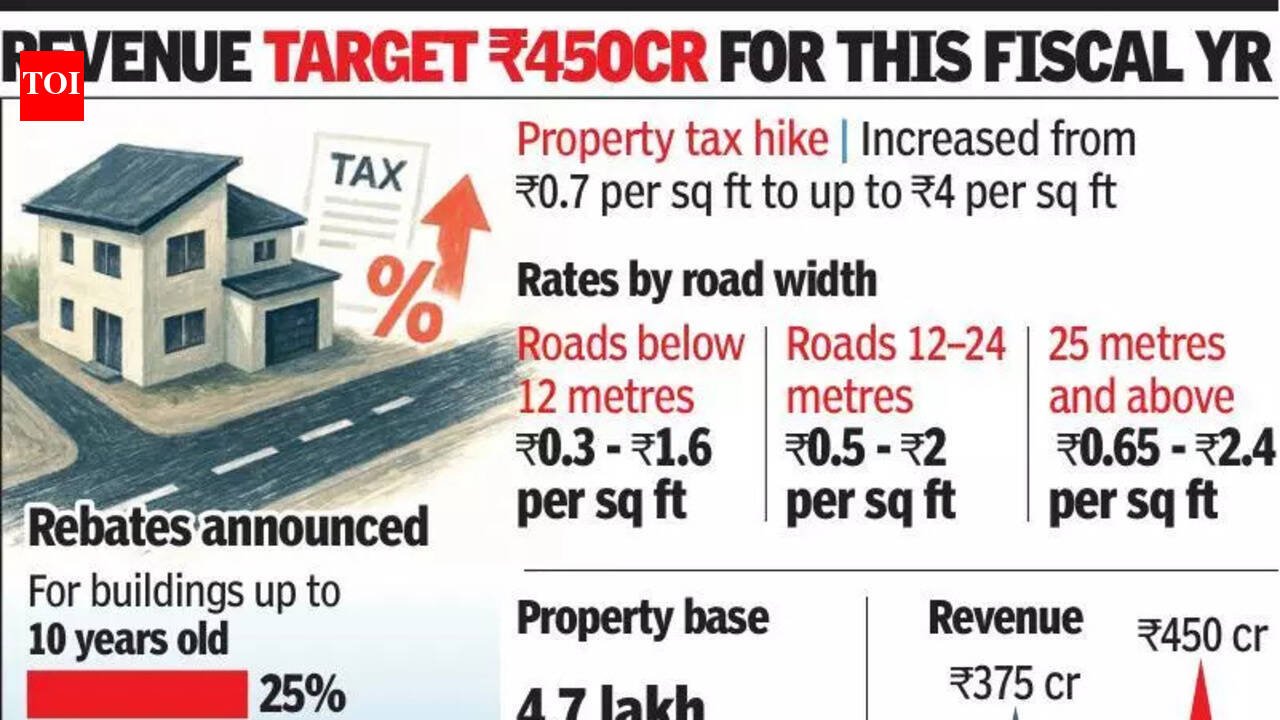
Ghaziabad: After the Allahabad High Court earlier this week upheld the Ghaziabad Municipal Corporation’s (GMC) decision to increase property tax, former councillors said they were now exploring political options to reverse the move, even as the possibility of a further legal challenge remains open.A co-petitioner and former GMC councillor, Rajendra Tyagi, said they would approach the Supreme Court within the stipulated 90-day window to challenge the Feb 25 ruling, but added that a political resolution would be preferable. “Going to the Supreme Court would be a long-drawn-out process. We are in favour of finding a political solution in the larger interest of the people,” Tyagi said.The controversy centres on a new property tax regime introduced by the GMC from April 1 last year, under which tax slabs were aligned with district magistrate (DM) circle rates. The revision resulted in a three- to four-fold increase in property tax for many households. Rates rose from about Rs 0.7 per sq ft to as high as Rs 4 per sq ft, pushing up annual tax bills by roughly Rs 5,000 for a large section of residents.Under the revised structure, tax rates vary according to road width. Properties on roads narrower than 12 metres are charged between Rs 0.3 and Rs 1.6 per sq ft, those on 12–24 metre-wide roads between Rs 0.5 and Rs 2 per sq ft, and properties along wider roads between Rs 0.65 and Rs 2.4 per sq ft. Property tax is calculated on the basis of annual rental value (ARV), and six lakh properties are currently registered under GMC.Officials said the revision will substantially bolster civic finances and essential to fund infrastructure and development projects across the city. The corporation expects additional annual revenue of over Rs 120 crore. In financial year (FY) 2025-26, the GMC collected Rs 375 crore from property tax. The hike, however, triggered sustained protests from resident welfare associations (RWAs), apartment owners and traders’ bodies. Amid mounting pressure, the GMC Board had earlier indicated it would repeal the hike, but the corporation continued issuing tax notices under the revised slabs, keeping the dispute alive and prompting legal action.On Feb 25, a two-judge bench of the Allahabad high court dismissed a petition filed by former councillors, ruling that the corporation’s method of fixing minimum monthly rent rates (MMRR) and revising property tax accordingly was legally sound.Following the verdict, mayor Sunita Dayal said the ruling significantly narrowed the scope for reversal of the revised tax. Dayal pointed out that she had earlier opposed linking property tax to DM circle rates and had even succeeded in getting the move repealed by the GMC Board in the past. “I had openly asked residents not to pay the hiked tax when the matter was before the court. Now that the order has come, we have to abide by it, even as our legal team examines its finer details,” she said.Residents said the ruling has come as a blow. Ashisk Kumar, an office bearer of Supertech Apartment RWA, said the hike was unprecedented. “We opposed it from day one. Many of us held back payments hoping the court would rule in our favour, but that has not happened,” he said.Political opposition has also sharpened. All India Congress Committee spokesperson Dolly Sharma accused the BJP-led govt of unfairly targeting Ghaziabad. “Is Ghaziabad being treated like an ATM for the govt?” she asked. Claiming that Ghaziabad now has the highest property tax among the state’s 17 municipal corporations, Sharma warned of citywide protests if the hike was not rolled back. “The GMC Board has enough legislative power to restore taxes to pre-April 2025 levels,” she said.GMC officials, however, defended the decision, insisting that higher revenues are necessary for the city’s growth. “The money collected from property tax will be used for Ghaziabad’s development,” an official said.
