


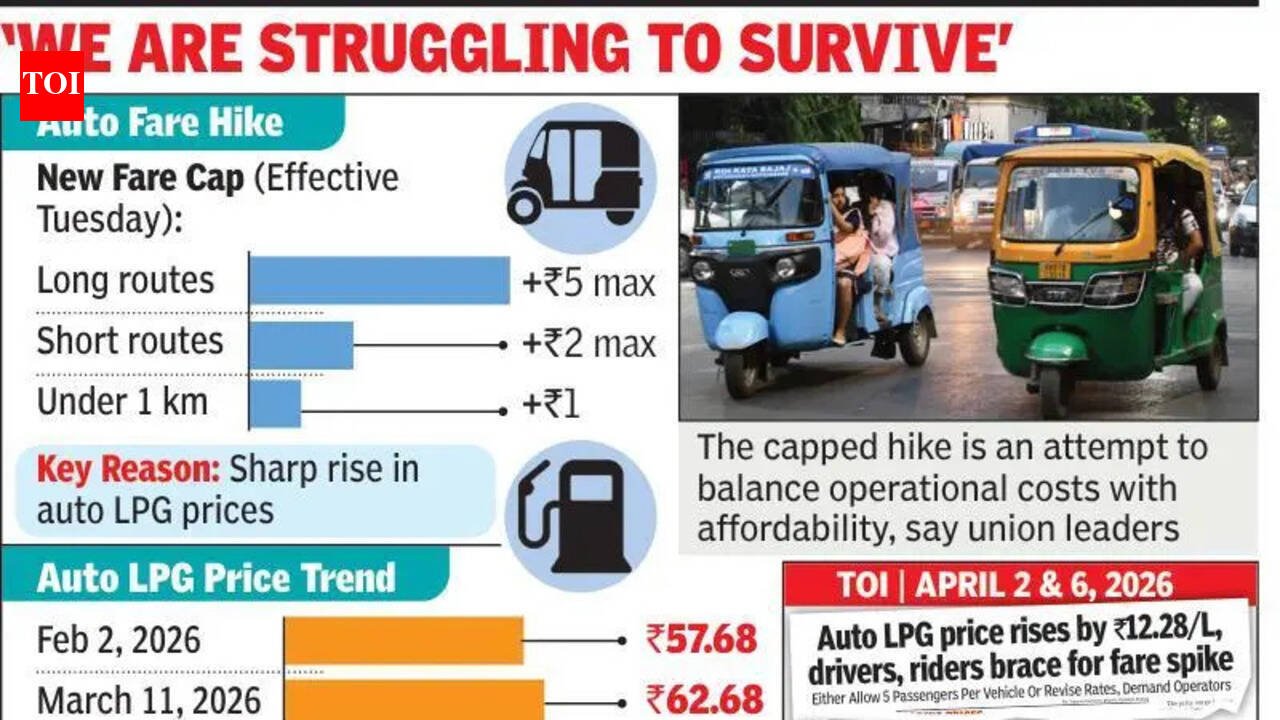
Kolkata: After weeks of fare disputes, commuter complaints and internal disagreements, auto-rickshaw unions in Kolkata have finally agreed to implement a uniform fare hike across routes, bringing temporary relief from the chaos that gripped the city’s last-mile connectivity.The revised fares, approved by the ATTUC-affiliated Auto Operators Welfare Association, will come into effect from Tuesday. Under the new structure, fares on long routes will see a maximum increase of Rs 5, while shorter routes will be capped at Rs 2, and trips under one kilometre will rise by Re 1.The decision follows sustained pressure from auto operators after three successive hikes in auto LPG prices, which surged to Rs 82.96 per litre in less than 30 days in March and April. Operators had been demanding either a fare revision or permission to carry five passengers per trip — something authorities were reluctant to allow due to safety concerns.For many drivers, the fare hike comes as a necessary correction rather than a gain. “Fuel prices have gone up so sharply in just a month. Earlier we managed somehow, but now it’s impossible,” said Abdul Rahman, an auto driver operating on the Tollygunge-Behala route. “We were struggling to survive. This hike is small, but at least it acknowledges our situation.”Auto LPG prices have risen steeply since Feb— jumping from Rs 57.68 on Feb 2 to Rs 82.96 by April 1 — placing significant financial strain on operators. Union representatives said that the delay in implementing a uniform revision was due to internal disagreements and concerns over public backlash run up to the poll.“We did not want arbitrary fare hikes. Some routes increased fares on their own, which created confusion,” said a representative of the Auto Operators Welfare Association. “After discussions, we have ensured a uniform and regulated structure across the city,” he added.In the absence of a coordinated decision, several routes briefly raised fares independently, triggering protests from commuters and intervention from unions. Many of these hikes were later rolled back. For daily passengers, the past few weeks have been marked by uncertainty.“Every day the fare was different. Sometimes Rs 5 more, sometimes back to normal. We didn’t know what to expect,” said Priyanka Das, a student, who commutes between Gariahat and Behala. “At least now there is clarity, even if we have to pay more,” she added. Office-goers, too, expressed mixed reactions. “I understand drivers are facing issues, but for us also expenses are rising. Transport is a daily necessity and small increases add up over time,” said IT employee Souvik Chatterjee, who travels from Ultadanga to Sector V. Union leaders say the capped increase is an attempt to balance rising operational costs with commuter affordability. “There was pressure from drivers, some even threatening to leave unions. At the same time, we had to consider public sentiment,” said another union member. However, concerns remain over enforcement and future revisions if fuel prices continue to rise. For now, both commuters and operators appear willing to accept the compromise, hoping it brings stability after weeks of disruption. “Will the fare be rolled back once the fuel price goes down?” asked Sourav De, a filmmaker.
