


There is nothing worse than struggling in the middle of the night with being too cold one minute and uncomfortably warm the next. Most of us have lived with that Goldilocks-like problem. You wake up shivering, pull the comforter up, then wake again feeling stuffy.
Here is what you need to understand. One fabric and type never works for bedding. Especially not in Indian homes where AC bedrooms are now common. Sleep quality is directly linked to thermoregulation, which is simply your body’s ability to maintain a stable internal temperature. When your bedding does not support your comfort, your sleep suffers.
As someone who feels very cold in winter and suffocated in summer, I learnt this the hard way.
What is GSM, and why is this important?
GSM stands for grams per square metre. It measures the weight and density of fabric or filling inside a comforter. A higher GSM usually means more warmth and insulation, while a lower GSM feels lighter and more breathable. Understanding GSM helps you choose bedding suited to your room temperature and sleep style.
Understanding the AC Comforter
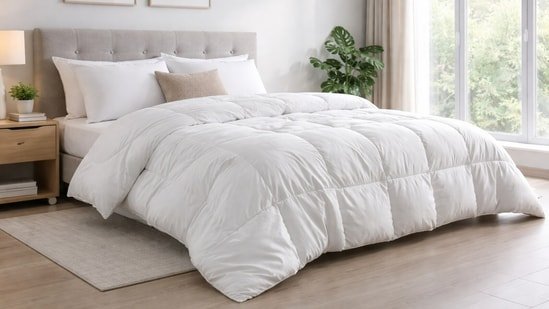
An AC comforter is a lightweight, breathable blanket made for air-conditioned rooms. It is designed to feel cosy without trapping heat. You get the comfort of a blanket without feeling stuffy.
I prefer cotton with a microfibre fill because cotton allows airflow, and the lighter filling keeps the comforter soft but not bulky. Fabrics like bamboo and Tencel also work well for this reason.
Most AC comforters fall between 150 and 250 GSM. That lower GSM means less insulation. In a bedroom set between 22°C and 25°C, this is exactly what keeps you comfortable through the night.
What makes winter comforters inappropriate for summer weather?
Winter comforters are made to retain heat. They are thicker, heavier, and built to keep warmth close to your body during colder months. These comforters create air pockets that hold warmth in place.
You will usually see GSM starting at 400 and going higher. The higher the GSM, the more insulation you get. These comforters create air pockets that hold warmth in place.
In an AC bedroom during summer, this much insulation feels stuffy and makes you warmer than you want to be. You lower the temperature to cope with the discomfort and eventually burn more electricity. It is far better to switch to the right layer and keep the AC at a pleasant temperature.
Comparison breakdown: GSM, fill, and fabric weave
My experience over time with both types of comforters
When I compared both at home, the difference was immediate. The winter comforter kept getting kicked off during summer nights. The AC comforter stayed in place, and I finally slept through without adjusting it constantly.
If your AC bedroom stays between 18°C and 22°C, a light AC comforter works beautifully. If you prefer 22°C to 25°C as I do, it is almost essential. If your room drops below 18°C during peak winter, then bring out the winter comforter. It is as simple as understanding your room temperature before you make the right choice.
There is also the hot sleeper exception. Some people generate more body heat naturally. They may need an AC comforter even in December.
The author of this article holds a Master’s Degree in Interior Design and has spent over a decade in research, teaching, and designing homes from scratch.
Disclaimer: At Hindustan Times, we help you stay up-to-date with the latest trends and products. Hindustan Times has an affiliate partnership, so we may get a part of the revenue when you make a purchase. We shall not be liable for any claim under applicable laws, including but not limited to the Consumer Protection Act, 2019, concerning the products. The products listed in this article are in no particular order of priority.
