


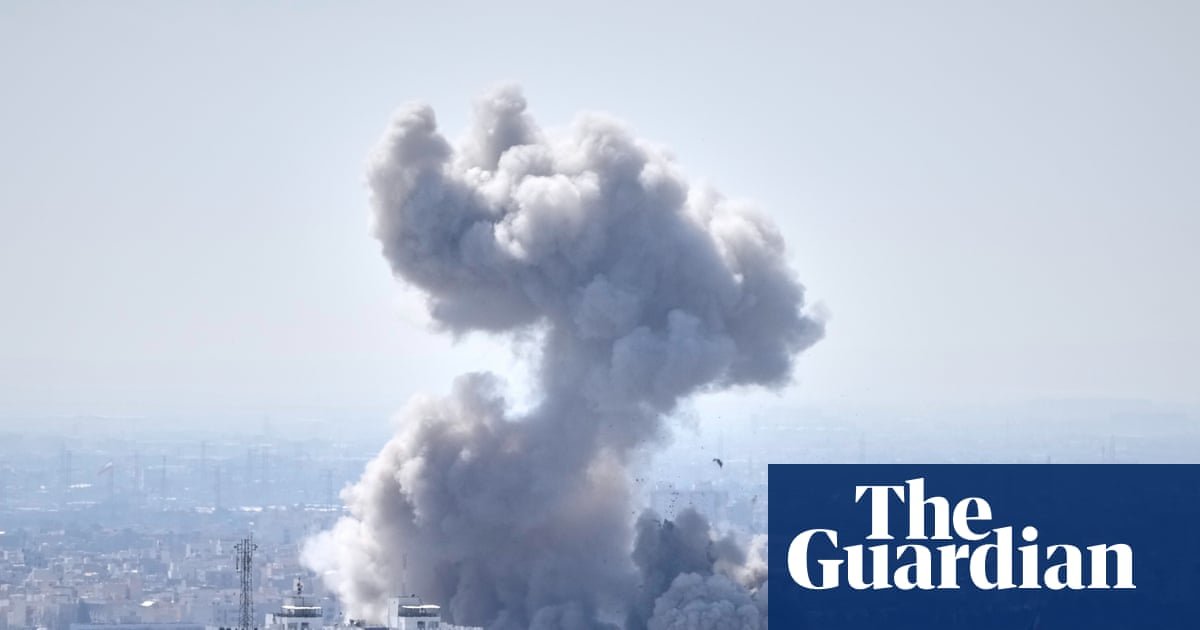
The US-Israeli war against Iran entered its second day on Sunday, as news of the assassination of the country’s supreme leader, Ali Khamenei, shook the Islamic Republic and the wider region.
Donald Trump announced Khamenei’s death while Israel claimed to have killed at least 40 senior Iranian commanders in the first day of attacks. Both countries continued to pound Iran, conducting hundreds of airstrikes across the country overnight and on Sunday.
Despite the apparent loss of a significant portion of its senior military and political leadership, Iran did not slow its retaliation on Sunday, bombing targets in the Gulf and unleashing waves of ballistic missiles towards Israel.
On Saturday, Israel announced the beginning of what it called Operation Lion’s Roar in tandem with Trump, which an Israeli military official said was intended to “degrade the regime’s capabilities”. They said operations would continue for “as long as necessary”. Trump went further, saying in a video posted on his Truth Social platform as the assault began that the aim was regime change.
Strikes hit across the country on Saturday, and were followed up on Sunday with further rounds, including in central Tehran.
The strikes hit key security and political targets in Tehran, including Khamenei’s residence, and ballistic missile caches elsewhere in the country. Satellite footage showed black smoke coming from the supreme leader’s badly damaged compound, and Iranian state media later confirmed he had been killed.
Hundreds of strikes hit at least 14 cities across Iran in what an Israeli military official said was a much more wide-ranging campaign than the previous US-Israeli attack on Iran in the 12-day war last summer. Strikes were aimed at intelligence and security headquarters, homes of Iranian officials, as well as ballistic missile launchers and caches – a tactic intended to limit Iran’s ability to respond to the US and Israeli attacks. Israel also said it had targeted Iran’s air defence systems in the west of the country to help establish air supremacy.
Almost 150 people were killed and at least 95 wounded in a strike on a girls’ school in Minab in the southern Hormozgan province, according to state media. The attack was verified by Reuters. There is an Islamic Revolutionary Guard Corps base in the same city.
Reuters said it had also verified the footage as being from the school.
Iran’s retaliation pushed past previous red lines that had excluded the Gulf from conflict. Much of the Middle East had be affected by Sunday.
Iran struck targetsincluding luxury hotels in Dubai and Bahrain, and airports in Dubai, Kuwait and Bahrain.
It also struck a port facility in Oman and ship north-west of Muscat as the Iranian military broadcast radio warnings to ships intending to cross the Strait of Hormuz.
People in Damascus, south Lebanon and Amman were shaken by explosions as Israel intercepted incoming Iranian missiles in the sky.
Strikes on Gulf countries and the wider region left travellers stranded as major hubs in Dubai and Qatar were closed. Flights around and through the region were cancelled or delayed, and it was unclear when the airspace above Gulf countries would reopen.
The speed at which the conflict turned regional was dizzying. The geographical scope of the conflict exceeded that of the 12-day war within just a few hours.
Satellite imagery from Vantor showed Iranian vessels burning at the Konarak naval base on Saturday.
Thousands of people gathered in Tehran’s Enghalab Square to mourn the supreme leader, waving flags and chanting slogans. Women wailed and beat their chests in grief and men holding images of Khamenei aloft called for retaliation against the US and Israel for the assassination.
Protests broke out across the Middle East and the wider region as Shia Muslims gathered to express their shock and anger over Khamenei’s killing. As an ayatollah, he was a major religious figure for members of the Shia faith.
In Pakistan, hundreds of pro-Iran protesters attempted to storm the US consulate in Karachi, prompting security forces to disperse the crowd. At least nine people were killed and several others injured.
Protests also broke out in Baghdad’s green zone, as the Iraqi Shia leaders Ali Sistani and Moqtada al-Sadr expressed their condolences for Khamenei’s death. Hezbollah also called for a rally in Beirut on Sunday afternoon.
Panic consumed the streets of Tehran as explosions rocked the densely populated city. Israeli military spokespeople told Iranians to distance themselves from military and industrial facilities. Iranian authorities instructed citizens to flee big cities for safety in scenes reminiscent of the mass exodus from Tehran this summer when Israel last attacked the city.
Many security institutions and officials are located in residential areas, making civilian casualties likely.
Israelis spent much of Sunday in air-raid shelters as sirens sounded almost constantly. One person was killed and dozens more injured when an Iranian missile hit Tel Aviv on Saturday night. Another eight people were killed and 20 injured when a missile hit the town of Bet Shemesh on Sunday afternoon.
Israel’s home command instructed its citizens to take shelter as Iran launched wave after wave of ballistic missiles at the country. Most of them were intercepted by Israel’s Iron Dome missile defence system, which hits projectiles heading towards populated areas in mid-air.
