


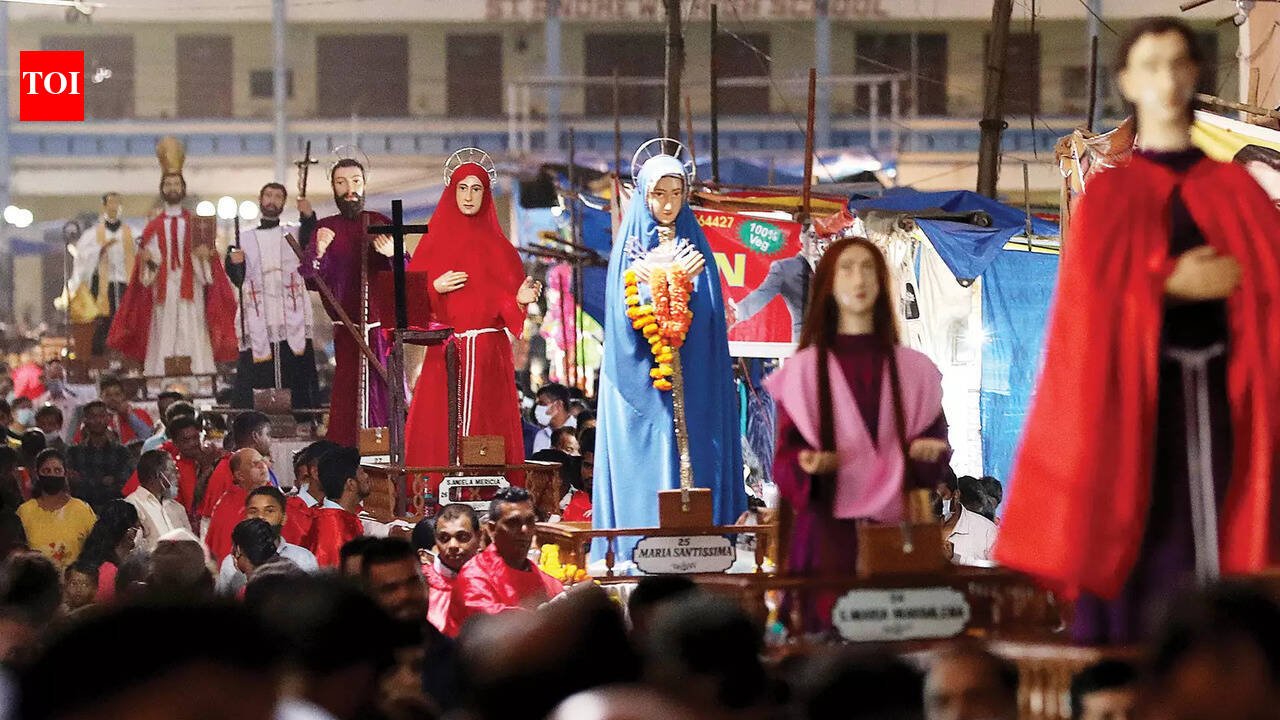
At the peak of the procession of saints, which began over 400 years ago, there were 65 statues. As time went by and decay set in, the number reduced to 25 by the time it moved from Pilar to Goa Velha in 1868. Since then, six more life-size statues have been added, and now, there’s a growing demand to add more
Around the world, Christians observe Lent, a 40-day penitential period of prayer, fasting, and reflection, leading up to Easter, the most important celebration in the Christian calendar. However, on the fifth Monday of Lent, Goa Velha, a small village around 12km from Panaji, comes alive.The village, which has a significant number of emigrants in Europe and West Asia, sees many of its sons and daughters coincide their visits home with this procession, locally called ‘Santachem Pursanv’.Nowhere else in the world—with the possible exception of Rome, though on a smaller scale—do devotees walk alongside so many saints, popes, martyrs, kings, queens and cardinals.
“I’ve been trying to tell the people that this is not a feast, so there cannot be a celebration,” said parish priest of St Andrew’s church, Fr Antonio Albuquerque. “I’ve asked people not to wish each other ‘happy feast’, because it’s not a feast. It’s a misnomer. All these years, the penitential character of the procession seems to be lost somewhere.”The procession, a Lenten penitential practice, started between 1614 and 1617 from Pilar, where the Franciscan Capuchins—the first order to reach Goa in 1517 after the Portuguese conquest of Goa—had their monastery.Interestingly, the procession did not have any saint at the start. “At first, the procession was only of the Veil of Veronica. It is believed that the Franciscan priests brought the veil from Rome along with them. By the end of the 17th century, a lot of saints were added, 65 to be exact. The focus is on Jesus and his cross. This was a way of telling people how the saints lived their lives,” said Albuquerque.
The Veil of Veronica is believed to be the divine imprint of Jesus’s face onto the veil of a woman named Veronica, who is said to have used it to wipe Christ’s face as he was carrying the cross on his way to his crucifixion.In 1835, when Queen Maria II of Portugal issued a decree ordering the expulsion of all religious orders, including the Franciscans, in Portugal and other colonies, the Pilar hill was abandoned. The monastery was closed, and the procession stopped.“During this period, many images and vestments were uncared for, vandalised, and destroyed,” writes Rosario Rodrigues in ‘World’s Grand Procession of Saints in India: A Study on the Procession of Saints at Goa-Velha Village in Goa’.It was not until 1868 that the procession restarted, this time from its current location, St Andrew’s Church, Goa Velha, as all belongings from the Pilar monastery were shifted to the new church under the guidance of Fr Cyrilo de Anunciacao. “When it restarted, the penitential procession of saints had residuals of 25 tableaux,” said Rodrigues.The researcher notes that the procession is an “exclusively unique event in the world”, an outstanding and specific celebration for the lenten season. “The object of the procession is a penitential practice and presentation of the history and life of saints as models before people.”Contrary to popular belief, not all saints included in the almost 2km-long procession are popular ones. There are little-known saints like Paschal Baylon, a Franciscan lay brother, Philip of Jesus, the martyr of Nagasaki, Agnes of Assisi, and others. There were additions in 1889 and 1895, while recent ones include St Andrew (1981), the patron saint of the village, ‘Goencho Saib’ St Francis Xavier (1984), St Peter (1985), the first Pope, and St Joseph Vaz, Goa’s only saint, the last to be added to the list in 2009.“There is a huge demand to add more saints, but we cannot accommodate any more since the church gets filled up (with saints). People want a statue of St. (Mother) Teresa to be installed. There’s also a demand for St Carlo Acutis (the youngest and most recent saint) and St. Jude (one of Jesus’ 12 apostles),” said Albuquerque.The procession starts with the Tau and the Crossed Arms, the Franciscan symbol, while St Francis of Assisi, the founder of the Franciscans, is the first saint to emerge, shown receiving the approval for his order from Pope Innocent III.All life-size statues of saints, some weighing up to 200kg, are numbered and name-plated. They are shouldered by devotees, and others walk alongside, many even walking under the tableaux, believing they will be blessed. The Veil of Veronica is the last in the procession, with devotees falling over each other to somehow touch it.“It’s an ancient artefact and people down the ages have realised that it’s a sacred relic. But we cannot allow the veil to be damaged,” said Albuquerque. I’ve even tried to discourage people ducking (under the statues), only to be told by old-timers that it’s a tradition that cannot be disturbed. People have strong faith.”
