


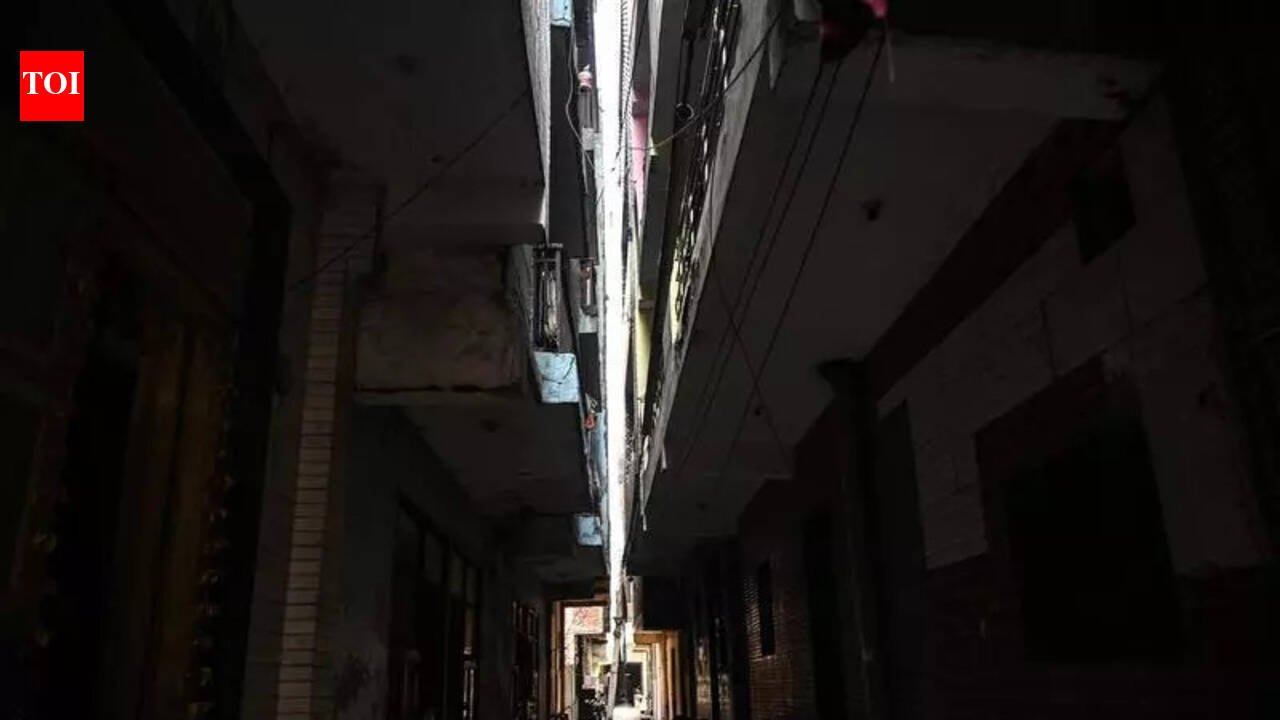
Ghaziabad: A deadly blaze that tore through a five-storey building in Khoda Colony earlier this week, killing three people, has put the spotlight on one of the India’s most densely packed residential areas.Wedged between Sector 62 Noida and Delhi-Meerut Expressway, Khoda, spread across 10 square kilometres, has undergone a dramatic transformation over the past two decades, especially after the Covid pandemic. What was once a peri-urban settlement has grown vertically and rapidly, mostly outside the bounds of planning regulations.Buildings routinely rise beyond permitted heights —sometimes six storeys high—packed tightly along lanes so narrow that fire engines struggle to enter. The structures stand wall-to-wall, their balconies nearly touching. In several stretches, residents on opposite balconies can converse without raising their voices, or even stretch out for a quick handshake. The lanes below feel like trenches where sunlight rarely reaches the ground. Above, a web of power cables hangs loose between buildings, criss-crossing the sky in tangled clusters.Cheap rents fueling vertical growthFor thousands of workers scattered across Noida, Delhi and Ghaziabad — delivery riders, cab drivers, factory hands and construction labourers — Khoda has become one of the region’s most accessible places to live. Cheap rents draw them in. For local landowners, those same rents have turned small plots into steady sources of income.A room here can cost as little as Rs 3,000 a month. Most are little more than compact spaces with a cooking corner and a wash basin; tenants on each floor share a common toilet. Deepak Sharma, who has lived in the colony since the 1980s, owns a five-storey building on a 60-square-yard plot in Azad Vihar. Each floor holds four small rooms that rent for about Rs 3,500 a month. The tenants come and go with the rhythms of work. “Sometimes they stay for a few months and return to their villages if work stops,” Sharma said. “But the demand is so high that rooms never remain empty.” The building earns him nearly Rs 60,000 in rent every month.He traces the surge in demand to the rapid development across the road in Sector 62, where an IT park and data centre brought thousands of workers to the area about a decade ago. Many ended up renting rooms in Khoda, accelerating the colony’s upward expansion.Not all residents are gig workers. Some are lower-income salaried workers priced out of Noida’s planned sectors. Dinesh Singh, a clerk at a school in Sector 62, moved here four years ago with his wife and two children after failing to find a one-bedroom flat he could afford in Noida. He eventually rented a modest unit in Khoda for Rs 10,000 a month.”My school is only two kilometres away, so I cycle,” Singh said. “It helps me save on travel and manage my children’s school fees.“Alongside small landlords are larger buildings that function almost like informal hostels. Residents told TOI the building where the recent fire broke out was one such structure. Built on plots of around 200 to 250 square yards, these blocks often contain dozens of rooms spread across multiple floors, sometimes housing more than 150 people.“These buildings are owned by builders with more money and influence,” said a resident living near the site of the fire. “They pack in more than 30 rooms, so when something like a fire happens, evacuating everyone becomes extremely difficult.”Officials from the fire department said most such buildings operate without mandatory safety approvals. Chief fire officer Rahul Pal estimates that nearly 90% of structures in the colony lack fire safety clearance. Many are built without approved maps from the Khoda Makanpur Nagar Palika Parishad, making them ineligible for a fire NOC in the first place.“Khoda is among the city’s most fire-prone areas, reporting around 25-30 fire incidents every year, but fire engines can barely enter most of the inner lanes of the colony. Firefighters have to manually lay water pipelines stretching two to three kilometres to reach the spot,” Pal said.Zoning rules lax, builders cash in The transformation of Khoda Colony is not confined to cramped apartment blocks. Along the roads facing Sector 62 Noida and DME, a commercial strip has emerged, where retail outlets, garment stores, sweet shops, dhabas and electronics showrooms crowd the roadside.In most buildings, shops occupy the ground floor while rental rooms stack up above. With zoning rules existing largely on paper, businesses of every kind sit side by side: a biryani outlet beside a mechanic’s workshop, a bridal wear store next to a grocery shop.Local property dealers said a three-storey commercial building along the main roads could command rents of Rs 2 lakh to Rs 3 lakh a month. Gyms are among the biggest tenants, often taking one or two floors and paying Rs 55,000 to Rs 60,000 monthly.Property values have climbed sharply as well. A five-storey building on a 60-square-yard plot recently sold for about Rs 1.2 crore, a dealer said.The promise of such returns has set off a relentless building race. In many lanes, construction debris piles up as owners add extra floors to ageing structures. Residents said that in almost every third or fourth building, columns are being raised for yet another level.Deepak Joshi, president of the local residents’ welfare association, argues that weak civic infrastructure is quietly reshaping ownership patterns in the colony. With groundwater levels plunging to nearly 350 feet and no reliable piped supply, some long-time residents have begun selling their plots to builders.“Many people fear that once water runs out completely, no one will buy property here,” Joshi said. Builders purchase the land cheaply, he added, and replace modest homes with five-, six- or even seven-storey buildings — often with little attention to safety.For older residents, the vertical expansion has changed everyday life in subtler ways, too. Avtar Singh, who lives in the Adarsh Nagar area, said a six-storey structure rising beside his house has begun blocking sunlight from his rooftop. “My neighbour already built five floors and is now raising columns for a sixth floor nearly 70 feet high, along with a large advertising hoarding,” he said.All this growth has unfolded alongside a sharp rise in population. According to Census 2011 data, Khoda had just under two lakh residents. Local officials estimate the population at nearly seven lakh, while some residents believe it may have reached close to 10 lakh. Even local authorities acknowledge that enforcement has struggled to keep pace. Mohini Sharma, chairperson of the Khoda-Makanpur Nagar Palika Parishad, said many illegal structures are built by developers with political backing. “By law, construction is allowed only up to ground plus four floors,” she said. “But in many places, buildings have extended to six floors or more. When we try to stop such work, we are accused of harassment or extortion.”In the aftermath of the recent fire, the residents’ association submitted a memorandum to SDM Arun Dixit seeking action against illegal buildings. RWA members said the tragedy had raised questions about how structures housing hundreds of people could be built without approvals or fire safety clearances. Yet among some long-time residents, the sense of risk remains muted.Deepak Sharma, a landlord who has lived here for three decades, said people have grown used to the colony’s precarious order. “We have lived like this for years,” he said. “Most people here don’t see it as a major danger.”
