
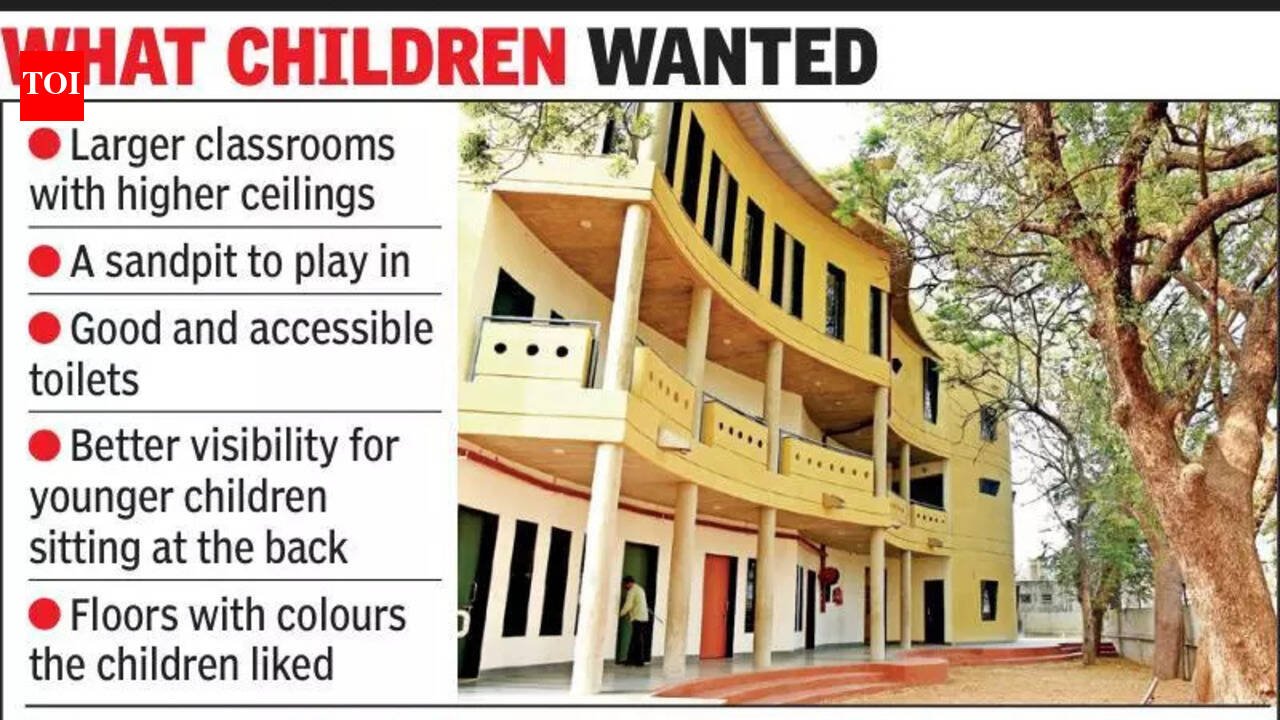
Vadodara: This municipal school building in Vadodara is no less than many private schools. It stands out, and students and teachers here take pride in the fact that their recommendations were woven into the new structure.Shyama Prasad Mukherjee Primary and Secondary School in Atladara stands tall amid thick green cover, as if the trees — some nearly a century old — had grown around the building over time. In truth, the new building replaced the old one without disturbing the trees that give the campus its calm and charm. Before designing the school—which was built and handed over to the municipal school board by Round Table India (RTI)—the designers listened to the voices of those who use it every day. “A workshop was held before designing the school, where students and teachers participated. They gave their opinions on what the school should include,” said the school’s principal, Gaurangi Upadhyay. The workshop was split into three groups of students and filled with hands-on tasks. Students shared their ideas through drawings and paintings, essays and speeches. Site plans were laid out, and children placed markers and materials on them to show how they pictured their ideal school. Project architect Bhavik Thakkar said the effort followed a participatory design process. “We incorporated several aspects from the suggestions received at the workshop. These included higher ceilings, larger classrooms, good toilets, a sandpit and others,” said Thakkar. He added that the children felt uneasy in low-ceilinged, cramped classrooms. The new building fixes that with ceiling heights of 15 to 18 feet and classrooms spread across 550 to 650 square feet. Even specific concerns were addressed. Students of Classes 3 and 4 said they struggled to see the teacher from their desks. Their feedback led to the creation of an amphitheatre-style classroom with stepped seating. The floors across classrooms use natural stone in colours chosen based on the students’ inputs. Thakkar added that the design brings in as much sun and fresh air as possible. The central atrium has vents that let hot air escape, and the flow of fresh air into the building stays free and steady. The Baroda Young Turks Round Table 201 oversaw the project. Upadhyay said the campus had about 100 trees, and all but two were left untouched. “Two trees were transplanted to different locations only because it emerged that their roots were in the way of the foundation,” she said. The school now has seven classrooms, an activity room, a science lab, a library and an amphitheatre. Fifty paintings created by children during the workshop brighten its walls. The new building has been named New Horizon. VMC primary education committee administrator Vipul Bhartiya said eight new school buildings were opened in the recent past. “More schools which are equipped with the latest technology are planned with various NGOs,” he said.
